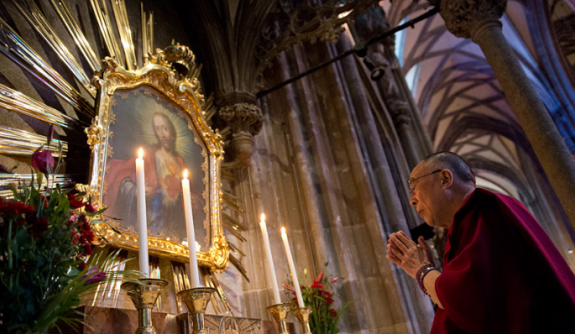
The Dalai Lama attended Mass on Pentecost
Now I just have to wonder if there will be radical traditionalist Tibetan Buddhists who will be complaining about this for years to come?
The Dalai Lama attended Mass on Pentecost
Now I just have to wonder if there will be radical traditionalist Tibetan Buddhists who will be complaining about this for years to come?
Check out this worthy project to send 2,000 CDs to all the seminarians in Cameroon, each loaded with Catholic eBooks such as:
TJ Burdick is putting together an ebook and asks me the question “In your opinion, what are the ‘ten commandments’ that Catholic bloggers should keep in mind while pressing on in their digital mission?”
Well considering the name of my site a more humorous replay comes to me at first. In fact this is from a post written almost ten years ago on the blogging Ten Commandments.
Really though the ten commandments Catholic bloggers must keep in mind are of course the original ones and they also collapse into the same Catholic both/and of loving God and neighbor.
The different forms of media including new media all have their inherit temptations and difficulties when it comes to preaching and commenting on the faith. Specifically I will speak to though temptations of pundit bloggers such as myself.
For one is is quite easy to conflate a person with what they say and write and then end up attacking the person more than responding to what they say. I try to take up the example of G.K. Chesterton who could publicly take on the ideas of people who were his friends while remaining friends with them. He never compromised his opinion of their ideas, but his writing also never devolved into personal attacks. I am certain I have failed in this regard, but this is the example I try to adhere to.
The use of parody and sarcasm is also an area fraught with difficulties to keep from descending into callousness and mean-spiritness. You really have to evaluate what your trying to say and while doing parody. Parody can validly have an edge to, but that does not mean you have carte blanche permission to be uncharitable. Even being generally aware of this you can still fall into the problem by admiring what you see as the wit behind it and not its effects. If others take you to task for the way you have said something you really must give it some serious weight in evaluating if your really have transgressed. While I have not had to pull many posts over the last decade, I have pulled some upon reevaluating them. Pride can easily be a barrier in this regard as I well know.
Another inherit danger is our own bias in taking sides. Often we are only able to see the details of a story via the lens of a story from the media. Yet rarely knowing the people involved we jump to conclusions that may or may not be attached to the truth. Lots of Catholic red meat stories are not always as straight-forward as they appear. So a certain healthy skepticism needs to be developed in the way you respond to a story. This needs to ben taken in account since often there is a low certitude level involved. When a story does take such a turn you also need to post about it, especially when it goes against your initial diagnosis and the way you wanted a story to fit.
Blogging can be quite a humbling experience or just another way to feed your ego. Their are plenty of opportunities for that humbling experience if we are open to them as avenues of grace. To say the least bloggers are generally quite opinionated and not afraid to let loose those opinions on the internet public. We will concede that the Pope is only infallible within a narrow scope with specific conditions, but less willing to reduce the scope of our own infallibility when opining.
Like most things there is a spiritual battle involved and your really need to constantly verify your motives. For Catholic bloggers are we really motivated to spread the Good News and to help spread the faith along with giving encouragement to other Catholics? Or is it just an ego trip where you constantly check your site statistics to see if somebody is linking to you or approving of what your wrote. It is also easy to almost think the Catholic blogosphere exists to link to your own posts. To be annoyed when another blogger posts on a subject and gets linked to even though your own analysis was posted first. I know from experience how petty I can be and what imagined slights I can make in regards to whether a post gets linked to or not. It’s very funny to reflect on, but not so funny to look more closely at.
In other words blogging is prone to same problems of the spiritual life and require the same remedies. Prayer, fasting, examination of conscience, the sacramental life, spiritual reading and so forth. If prayer isn’t a serious part of your life than why are you involved in the Catholic blogosphere. This is a question I have certainly put to myself during these years as my prayer life has waxed and waned based on moods and the desire to rely on spiritual feelings instead of steadfastness in prayer despite not feeling spiritual “goodies.”
So do onto other bloggers as you would want them to do on to you. If you want to be linked by others, than be generous in linking to others and to give proper attributions to where you first noticed a story. If you want others not to jump to conclusions about what you write, make sure you are not doing the same.
Now hardly any of us have to be concerned that after we die a group is going to be looking over our blog posts in an investigation into our sanctity. Heroic punditry is currently not a category they look at. Though really if we worry that the first think Jesus says to us after we die is “..about your blog” or you ponder the years in purgatory based on blog entries – you just might need to reevaluate things. While we really don’t need to worry about that future investigation of our blog posts, really there are people investigating them right now and if some level of sanctity is not coming through – something is seriously wrong. This does not mean that a blog just say pious things and quote scripture and the Fathers of the Church, but it does mean that what is said is said with charity when a post takes a more serious turn. We know that they are Christians by their blogging – won’t be a slogan anytime soon, but it at least should be a possibility of one.
Here is a rather interesting story on a couple of levels.
A Umatilla teenager said she was forced to choose between her Catholic faith and serving as a delegate to Florida Girls State, a government-in-action leadership program for teen girls.
“I was shocked. This is basically discrimination,” said Margeaux (Mar-go) Graham, 16, a junior at Umatilla High School, who was told that she would not be allowed to attend Sunday Mass while Girls State is hosted June 15-23 at Florida State University in Tallahassee, even though a Catholic cathedral is across the street from FSU.
Graham’s mother, Mary, offered to make the trip to escort her daughter to church.“The girls are not allowed to leave our program for any reason,” said Robin Briere, department secretary-treasurer of the American Legion Auxiliary, who noted it would be an insurance liability to allow any of the 300 delegates to leave the premises.
Briere said a non-denominational Sunday service is provided for the delegates.
As a faithful Catholic, Graham said it would be a mortal sin for her not to attend Mass, as it’s her religious and moral obligation to attend Mass every single Sunday.“Missing Mass is not an option,” added Jackie Smart, director of religious education at St. Mary of the Lakes Catholic Church in Eustis, where Graham is a parishioner.
“If you’re Catholic, you’re obliged to gather with your fellow Catholics on Sundays to celebrate Mass and it’s not something that we can choose not to participate in, if you’re an active Catholic,” Smart said. “If you really believe what our faith teaches, there would be no way to keep you from Mass and that’s the way Margeaux feels…
“Good for Margeaux for not being afraid to stand up for her faith. There is so much pressure on these young men and women nowadays that it’s not cool to embrace your faith, and I think that it’s really great that Margeaux is willing to stand up for that. …She is just a very determined young lady. She has a very strong grasps of her faith and what it means to be a Catholic.”
A friend of the Graham family, Carl Ludecke, commander of American Legion Post 21 in Umatilla, called Robin Briere at the state American Legion Auxiliary and proposed the idea of allowing a priest or university chaplain to come to Girls State to celebrate Mass for the Catholic delegates.
“I thought, why not bring in somebody in at the same time as they were doing a service in another room?, Ludecke said, recalling the idea was immediately rejected.
“I was absolutely flabbergasted. I was just trying to get this resolved so everybody could be happy,” he said. “We had a screaming match on the telephone and I didn’t get anywhere, because I really don’t have any jurisdiction to do it.”
Briere said this is the first time in her 19 years on staff with Girls State, a privately-funded program, that religion has become an issue.
“We are a non-denominational program and intentionally keep religion out of our program out of respect for the 300 girls that come from many different faiths,” she said. “We set aside time on Sunday morning, from our very busy schedule, to allow each girl to honor her faith silently and the girls collectively put a program together to honor all faiths.”
The Sunday service is written and executed by the delegates, she said, adding it’s something that they enjoy doing.
What I find interesting is that this had never been seen as a problem before and surely a percentage of Catholics had participated in this program during all these years. Offering only a ecumenical Sunday service is certainly of the Protestant mindset where they think there is not any actual obligation in the first place. A non-sacramental mindset that reduces worship to a sermon that could just as well be heard on TV or the internet.
The keystone of the article is the subject of missing Mass on Sunday.
Canon 1247
On Sundays and other holy days of obligation the faithful are bound to participate in the Mass; they are also to abstain from those labors and business concerns which impede the worship to be rendered to God, the joy which is proper to the Lord’s Day, or the proper relaxation of mind and body.
Canon 1248
The precept of participating in the Mass is satisfied by assistance at a Mass which is celebrated anywhere in a Catholic rite either on the holy day or on the evening of the preceding day.
If because of lack of a sacred minister or for other grave cause participation in the celebration of the Eucharist is impossible, it is specially recommended that the faithful take part in the liturgy of the word if it is celebrated in the parish church or in another sacred place according to the prescriptions of the diocesan bishop, or engage in prayer for an appropriate amount of time personally or in a family or, as occasion offers, in groups of families.
With missing Mass requiring a “grave cause”. Of course illness or having to take care of a family member are often given as examples that meet this criteria. Being on vacation in an area with no convenient access to Mass is another example and there is no requirement to drive a long distance in these circumstances. Now whether attending a leadership conference and not being allowed permission to go to Mass is a sufficient “grave cause”, I certainly could not be definitive on. This would be an area that would be best discussed with their parish priest. Though I also think while possible this could fall into that category, it is more meritorious in taking this requirement obligation seriously.
It is also very nice to see a director of religious education at her home parish (Jackie Smart) say something like “Missing Mass is not an option” since the serious obligation to attend Mass is something that many serious Catholics seem to think has been done away with since Vatican II. I like Jackie Smart’s comment “If you really believe what our faith teaches, there would be no way to keep you from Mass and that’s the way Margeaux feels..” So often you hear Mass proposes as an imposition, something to get out of the way. That actually being told to go to Mass is rather mean or troublesome – a view I think bishops unintentionally reinforce when they do things like move the Ascension to Sunday.
The other interesting thing about the story is how the staff of Girls State will not make the simplest compromise on the subject. They wouldn’t even allow the mother to come in an take her to Mass across the street. If this is the type of leadership this organization is demonstrating then it is a good thing this young women is missing out on it. Why is this rule so unbreakable and no compromise possible. The staff of Girls State might have a promising career working for President Obama’s HHS.
“I’m just amazed at the uproar over this,” added Briere, who also is Catholic by faith. “It’s not like she’s forced to go to this program and we’re denying her religious rights. … What has surprised me the most, through all of this, was having the Umatilla American Legion commander call and demand that we had to do it.”
Briere said she does not feel less of a Catholic when she misses Mass while being involved in leading Girls State.
Because the objective state of something is based on what you feel. I don’t feel this is a sin, so thus it isn’t. The cry of “Officer I didn’t feel this was a crime” would be laughed at, unfortunately similar protestations are taken seriously. Besides is it really the case that Briere is not allowed to attend Mass when these conferences happen?
She goes on to say:
“I respect her religious beliefs, and certainly I share them as we’re the same faith,” Briere said. “The Catholic religion that I know is not that narrow thinking, but I do respect how she feels. I’m not disrespecting her in any way. I just feel bad that she is being put in the position to choose between the two. Unfortunately, because of this, she has lost her opportunity to go to Girl State and that cannot be changed now. She’s out of the program, and it was her choice.”
She is being put into that position simply because they refuse to make any compromise. Funny how so many will deride you for not making a compromise when they would not offer a compromise themselves.
Father Z does an excellent parody, and I measure this by the “hmm, is this parody or not” test.
NCFishwrap EXCLUSIVE
ROME – Joining forces with the Women’s Ordination Conference, the Leadership Conference of Women Religious has enlisted the services of Fr. Ray Bourgeois, MM, in an effort to secure the release of the Pope’s Butler from a Vatican jail cell where he awaits trial for stealing and disclosing classified papal and Holy See documents to the press.
Likening the Pope’s Butler to Daniel Ellsberg of Pentagon Papers fame, Sr. R.U. Kidding, a Daughter of Charity and co-mentor of the LCWR, said that the Pope’s Butler was a “political prisoner” and that the Vatican was “torturing” him and should release him as the hero he is.
“Yes, the Vatican is just as mediveal as we have always said it was. This just proves it.”, reiterated Sr Randi McNulty, a Sister of Mercy and another LCWR co-mentor.
When questioned about the possibility that crimes were committed, Bourgeois shot back, “Some needs outweigh outdated male-made rules. We call on the Vatican gendarmes to free that butler and free him now. Free The Vatican 1!”
Bourgeois, co-spokesperson and famed rights champion said, “The butler is in solitary confinement in a Vatican jail for trying to bring transparency to the highest levels of Vatican intrigue. We stand in solidarity with all those oppressed by male-hierarchical power.”
A clearly angry Sr. Kidding said, “He struck a blow for equality and they’re making him a scapegoat.”
Visibly moved, Bourgeois added, “This guy’s… a hero.”
There have been unconfirmed reports of nuns in pants suits with scaling ladders at the Vatican walls.
For more information visit the organization’s website: FreeTheVatican1.org.
I certainly won’t be surprised if life imitates parody once again.
The Environment
In an age where discussion of the environment has been so politicized it is quite refreshing to see discussions on the subject that starts from the perspective of the Earth as an act of creation and our responsibilities regarding stewardship of this gift.
It is also quite interesting just how many times the Pope has incorporated this subject in what he says. Now as a collection of his thoughts on the environment I really appreciate how OSV put this together. Instead of just pulling these references to the environment, this book takes the effort to print the full context of what was said. So what the book contains is full speeches or sections of larger document that aren’t just reflecting specifically on the environment, but how the subject is integral to his larger discussion.
The encyclical letter Caritas in Veritate” gives a solid glimpse into how the Pope and really the Catholic Church sees both our rights and responsibilities in regard to creation and specifically the environment.
48. Today the subject of development is also closely related to the duties arising from our relationship to the natural environment. The environment is God’s gift to everyone, and in our use of it we have a responsibility towards the poor, towards future generations and towards humanity as a whole. When nature, including the human being, is viewed as the result of mere chance or evolutionary determinism, our sense of responsibility wanes. In nature, the believer recognizes the wonderful result of God’s creative activity, which we may use responsibly to satisfy our legitimate needs, material or otherwise, while respecting the intrinsic balance of creation. If this vision is lost, we end up either considering nature an untouchable taboo or, on the contrary, abusing it. Neither attitude is consonant with the Christian vision of nature as the fruit of God’s creation.
Nature expresses a design of love and truth. It is prior to us, and it has been given to us by God as the setting for our life. Nature speaks to us of the Creator (cf. Rom 1:20) and his love for humanity. It is destined to be “recapitulated” in Christ at the end of time (cf. Eph 1:9-10; Col 1:19-20). Thus it too is a “vocation”[115]. Nature is at our disposal not as “a heap of scattered refuse”[116], but as a gift of the Creator who has given it an inbuilt order, enabling man to draw from it the principles needed in order “to till it and keep it” (Gen 2:15). But it should also be stressed that it is contrary to authentic development to view nature as something more important than the human person. This position leads to attitudes of neo-paganism or a new pantheism — human salvation cannot come from nature alone, understood in a purely naturalistic sense. This having been said, it is also necessary to reject the opposite position, which aims at total technical dominion over nature, because the natural environment is more than raw material to be manipulated at our pleasure; it is a wondrous work of the Creator containing a “grammar” which sets forth ends and criteria for its wise use, not its reckless exploitation. Today much harm is done to development precisely as a result of these distorted notions. Reducing nature merely to a collection of contingent data ends up doing violence to the environment and even encouraging activity that fails to respect human nature itself. Our nature, constituted not only by matter but also by spirit, and as such, endowed with transcendent meaning and aspirations, is also normative for culture. Human beings interpret and shape the natural environment through culture, which in turn is given direction by the responsible use of freedom, in accordance with the dictates of the moral law. Consequently, projects for integral human development cannot ignore coming generations, but need to be marked by solidarity and inter-generational justice, while taking into account a variety of contexts: ecological, juridical, economic, political and cultural[117].
This both/and approach is what is missing from both the (1) radical environmentalists such as the deep ecology movement that see humanity as almost a virus harming the planet or (2) the individualist view to use the environment with no considerations for others and future generations. What the Pope has to say on the subject is so much deeper than the political arguments we so often hear regarding whatever doomsday environmental catastrophe is currently in vogue.
I found this book to be quite helpful for myself in more fully understanding the subject. I was once part of the radical environmentalist camp myself buying into a Malthesian view of population and the dire predictions of the seventies. The environmental doomsday prophets have done us no favors by both their false prophecies and the fact that people can then turn a deaf-ear to actual environmental problems because of too many false alarms for the “cry of wolf.” The politically conservative side thus mostly spends its time rightly decrying these false prophets and unfortunately much less time our actual duties in regard to stewardship. This book helped me with gaining a more balanced view of the subject.
This subject does remind me of one episode when the media called Pope Benedict XVI “The Green Pope” because they thought his wearing green on Earthday was symbolic and not the fact that it was a Mass during Ordinary Time.

This is the 19th volume of The Weekly Benedict ebook which is a compilation of the Holy Father’s writings, speeches, etc which I pull from Jimmy Akin’s The Weekly Benedict. This volume covers material released during the last week for 9 May – 21 May, 2012.
The ebook contains a table of contents and the material is arranged in sections such as Angelus, Speeches, etc in date order. The full index is listed on Jimmy’s site.
The Weekly Benedict – Volume 19 – ePub (supports most readers)
The Weekly Benedict – Volume 19 – Kindle
There is an archive for all of The Weekly Benedict eBook volumes. This page is available via the header of this blog or from [here][weeklybenedict].
Those who have been around the Catholic blogosphere during it’s early part a decade a go will remember (and fondly remember) Fr. Bryce Sibley.
He has an article in Crisis Magazine which voices my opinion on Christian films like Courageous quite well. He is able to put succinctly what I try to grasp to understand in why I think these movies don’t ultimately succeed. His comparison of these movies to the Christian fiction so often produced is a nice parallel in that as he says they both fail to have a “sacramental imagination”.
I also fully agree when he writes:
While films like Courageous have their place, Christian filmmakers should take up the challenge to not only convey the truths of the Christian faith, but that also convey a sense of beauty and mystery in their films. These are the type films that will have the power to truly change minds and touch hearts for generations to come.
Courageous certainly shows the filmmaker has grown, but compare it to a movie like “Of Gods and Men” and then you can rightly see it more as a good Christian Bookstore Movie than what it should be, a work of art.
I encourage you to read his thoughtful article.

Rorate Caeli has a story of Hans Küng declaring Benedict XVI schismatic over the issue of the possible SSPX unification.
Now while Hans Küng is somewhat of an expert on disobedience, heresy, and schism somehow I think he got this one wrong. Yeah what a surprise. He pins all this on the extremely debatable point that the Bishops and Priests of the SSPX were “definitely invalidly ordained.” Well not really debatable just plain Bravo Sierra. So I guess according to Mr. Küng attempts at ordaining women by a range of suspects are all valid, but the Bishops and Priest of the SSPX weren’t.
This is a kind of a “I’m rubber you’re glue, if I’m a schismatic than so are you.”
MIAMI, FLORIDA, May 17, 2012, (LifeSiteNews.com) – Republican presidential candidate Mitt Romney scheduled a $50,000-a-plate fundraiser at the home of Phil Frost, the executive of the company that makes the Morning After Pill, on Wednesday night. Plan B One-Step is produced by Teva Pharmaceuticals, Frost’s company.
The pharmaceutical executive’s residence was one of several stops scheduled to increase Romney’s war chest during a two-day swing through Florida.
“It’s a huge disappointment,” Brian Camenker, director of the Massachusetts-based pro-family organization MassResistance told LifeSiteNews.com. “You wouldn’t see someone who was really pro-life doing a fundraiser with somebody who helped the abortion industry.”
Brian Burch, president of CatholicVote.org, didn’t seem troubled by the fundraiser saying, “What matters is whether a President Romney will end all taxpayer support for abortion-inducing drugs, repeal unconstitutional mandates that force private institutions to cover such drugs, and whether he will make progress in building a culture of life.” Lifesite News
Brian Burch illustrates why we get such crappy candidates. While the possibility of one candidate contributing more to the common good than the other certainly has moral weight – it does not mean putting blinders on when something seriously problematic happens. You can’t hold a candidate’s feet to the fire if you don’t even light the match. The “What matters is …” can be and has been used to justify just about anything. The Democratic Party did not start as the Party of Death and while many Democrats might have been reticent about the parties increasing pro-abortion fever, no doubt many explained it away with a “What matters is {insert favorite cause}.”
The idea that since Romney will probably do the right thing so we should ignore when he does the totally wrong thing is a really bad idea. Mitt “Believe me I am pro-life now” Romney does not exactly build credibility by having a fundraiser with Phil Frost. The ends justify the gaffe. Though this is more than just a gaffe. Giving him a free pass on this just means you better keep a pocketful of passes since you are going to need them later.