Barbara Kralis goes deeper into the story of Cardinal Mahony and the Gay and Lesbian Rainbow Fish used in his diocese.

Today being the feast of the Epiphany here is a little known episode of what happened after the three wise men left.
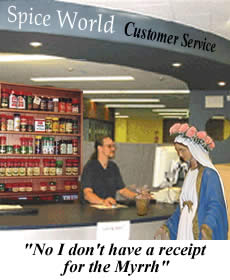
Here is also a rerun of a post five years ago.
A Church of England bishop has attacked “sentimental” Christmas card portrayals of the Nativity, saying that Jesus’s family were asylum seekers and the three Wise Men were part of an assassination plot.
The Bishop of Lichfield, the Rt Rev Keith Sutton, said the shepherds were not the lovable characters depicted in Nativity plays but were on “the fringes of society” and that, for most people, Christmas was a chore.
[Full Delusion]
Did Herod the Great contract out a hit to three foreigners for plausible deniability? How did this assassination go awry? Did King Herod say “Go and murder him” and they thought he said “Gold and myrrh to him?", frankly that makes sense.
BEND — More than a year ago, Pope Benedict XVI issued his first encyclical, Deus Caritas Est or God Is Love. That letter, issued on Christmas Day 2005, is not necessarily an easy read, and yet I believe it is a document that bears reading. I choose to spend a little time with this document today because I do believe it has something significant to offer to our modern society and to us.
The Holy Father, early in the encyclical, identifies a major problem with love. He writes: “Today the term ‘love’ has become one of the most frequently used and misused of words, a word to which we attach quite different meanings.” He then goes on to discuss two specific forms or types to which this single word “love” might refer. The terms he chooses, or rather draws from Greek and Christian cultures, are eros and agape.
He identifies “eros as a term to indicate ‘worldly’ love, and agape, referring to love grounded in and shaped by faith. The two notions are often contrasted as ‘ascending’ love and ‘descending’ love.” In other words, one is a love that seeks to receive and the other a love that is intent on giving.
In a very surprising way, the Holy Father then points out the essential connection between these two forms of love. In our society the differences between the two are readily obvious. They are as distinct as the eros of simply living together and the agape of a faith-filled committed marriage.
The difference is even seen in approach to liturgy or Mass attendance. On the one hand the love of eros inclines one to attend Mass because of what one receives, how it makes one “feel,” while the love of agape inclines one to attend Mass out of a self-giving desire to love and serve the Lord.
Eros inclines us to seek our own good, whereas agape inclines us to seek the good of another. Many people respond to the “eros love” of Christmas and Easter but a much smaller number respond to the challenge of the “agape love” required for weekly or even more frequent Mass attendance. Many married couples seek the “eros love” of the marital embrace, but far too many reject the “agape love” of genuine openness to children.
This is from the beginning of a column by Bishop Robert Vasa who is always a joy to read. He goes on to give other examples and further looks into what the Pope is saying. [Via Domincan Idaho]
You can subscribe to Bishop Vasa’s columns here.
(Washington D.C.) Roto Reuters – Speaker of the House Nancy Pelosi has suffered a concussion as a result of her crashing through the marble ceiling yesterday. She still shows signs of confusion in that she thinks she can be both Catholic and pro-abortion, though this is probably a pre-existing condition.

When I first read that the U.S. Bishops conference was going to produce an Adult Catechism my first thoughts were rather skeptical of how this document would turn out. To be truthful my second, third, and so on thoughts ran down the same line. I did not think that it would be as bad as the infamous Dutch Catechism that got even worse on the second printing after the Vatican had demanded changes to the first one. I thought though that it would be watered down or at least weak.
It is always nice to find yourself totally wrong in your skepticism. I picked up the United States Catholic Catechism for Adults
I pretty much totally agree with Rich Leonardi’s review of this Catechism. Like the Catechism of the Catholic (CCC) Church the Adult Catechism is divided into four parts as is traditional. The format is that each chapter starts for the most part with an introduction to a saint or somebody else whose story was applicable to the topic of that chapter. They mainly stuck with using Americans as examples which is of course fitting for a local Catechism. Some cases they did use examples of other saints when there was really no applicable American counterpart. I found most of the stories to be used quite fitting and I learned a lot about some American Catholics who I either never heard of or knew little about. A couple of the people used were a little problematic, but I will discuss that later in my review.
The Catechism then delves into the topic at hand with very readable and quite orthodox explanations of the faith.
At no time is the faith watered down, in fact areas of common disagreement among so-called progressive Catholics are presented with a more forthright explanation with trouble taken to address these areas. For example the issue of women’s ordination is brought up and then several paragraphs follow to explain the Church’s teaching. This example was one of the better explanations on the subject that I have read. Common issues of social justice involving topics from abortion to the preferential love for the poor were also well addressed and there is no moral relativism involved in discussing these topics or putting all moral issues on the same plain.
The chapters include frequent references to the CCC and the paragraph they are referencing along with each Chapter containing a section of explicit CCC text for the current topic. There are also of course plenty of references to the Bible and other Church documents. Each Chapter also contains at the end of it Questions for discussion, a list of doctrinal statements, a final meditations on the topic, followed by a prayer. I pretty much liked the format since the CCC section emphasizes what was written and the doctrinal statements reiterate them once again so you have a good tool for remembering the key points.
Once questions though is how the Adult Catechism really fits in and how it will be used. The Adult Catechism extends to close to 700 pages so it is not like it is much smaller than the CCC itself. And as Rich mentions there is also the Compendium of the Catechism of the Catholic Church which the Bishop’s conference wants to target for only younger readers. For my part I think there is a place for all three and really that all three should be read. They all have a different format. The Compendium is great for easily finding and understanding Church teaching. The Adult Catechism has a highly readable format that really anchors itself in the context of our highly materialistic American lifestyle and addresses specific concerns in that climate. The CCC itself is really a masterpiece in the explanation of the faith and one that cemented for me the truth of the Church.
Will the Adult Catechism make a major inroad in catechesis in the United States is a question though. The CCC was often disparaged and time and time again many catechists tried to limit who it should be read by. The Adult Catechism is just as Orthodox as the CCC so it is hard for me to imagine that the same groups of people who disliked the CCC are going to embrace it.
Now for the parts of the Adult Catechism I had more problems with. This though is a surprisingly small list. Some of the introductary examples of Americans used are what Rich Leornardi calls polarizing figures. The two and only real examples of this were Cardinal Joseph Bernardin and labor leader Cesar Chavez. The introductions themselves were fine and not really problematic, but surely the Adult Catechism could have found others with less baggage since not every American Saint, Blessed,, or Venerable were used for examples.
The funniest part of the Cesar Chavez introduction was the use of the words Mexican-American Immigrants and Mexican Immigrants. I have never seen this particular politically correct way of referring to legal and illegal Mexican immigrants before. I also found it highly ironic since Cesar Chavez was not in favor of illegal immigration himself.
Another funny part of the Adult Catechism is what must have been a mistaken word that made it in.
As we have mentioned, in New Testament times, the Apostles encountered moral challenges every bit as awesome as ours.
Moral challenges as awesome? Obviously not what the writer meant, but I had a good laugh when I came to it.
The head of the team who wrote the Adult Catechism was Archbishop Wuerl, now Archbishop of Washington D.C. I had read that he is a master catechist and this catechism truly proves it. Despite my very minor criticism I can easily recommend this Adult Catechism very highly and hope that it will be fully used. It’s format might lead to distortion by some catechist, but they also distort the CCC also.
PORTLAND, Ore. (CNS) — Cells taken from embryos hold therapeutic promise, but it is simply wrong to destroy human life in its early stages.
That’s the opinion of the chief stem-cell researcher at a medical school hospital in what some would say is one of the nation’s most liberal cities.
Dr. Markus Grompe, director of Oregon Health & Science University’s Stem Cell Center since 2004, is a devout Catholic and a member of St. John Fisher Parish in Portland.
"I support the church’s view on protection of embryonic life," Grompe told the Catholic Sentinel, Portland archdiocesan newspaper, in an interview in his office at the hospital. "That has sometimes put me in a difficult situation."
Grompe is looking forward to the day when a method is discovered to provide embryonic stem cells — or their equal — without destroying embryos. But for now, his lab works with cells taken from adults, and he is keen on those advances.
Grompe and his team are devising a way to repair diseased livers by injecting adult stem cells into the organs. The work has a special focus on children with genetic liver disorders. The method, which would nix the need for liver transplants, has worked in lab animals.
"There is a lot in favor of embryonic stem cells," said Grompe, a German citizen who studied at the University of Ulm in southern Germany. "But we need to make a choice based on ethics." He said the colleagues who disagree with him are not evil, but want to advance medicine.
The German-born Grompe has been active on the international level in the stem-cell debate. In April 2006, he went to the Vatican and addressed the Pontifical Academy for Life.
Grompe allows that the question of the therapeutic use of embryonic stem cells is still open. But he insists that embryonic cells are likely to lead to a therapy that adult cells cannot reach.
"What makes embryonic stem cells so different is that they can be grown to unlimited quantities," he said. "You can make a lot of what you need to make and you can do it again and again. Adult stem cells don’t do that."
That potential makes the Catholic stand all the more difficult yet necessary, he said. "As Catholics, we need to stick to the facts and the truth. The reason we object to embryonic stem-cell research is not because the cells are not good or the adult cells are better. The real reason is that we have moral and ethical objections. We have to stick to our guns. Just because a medical procedure is immoral doesn’t mean it will not work."

This is an important point to make. Right now there is a lot of effort in the pro-life movement used in debunking ESCR because of the lack so far of actual cures. The main point should be that it is simply wrong to use a human person in experiments. Though you can easily understand by the ineffectiveness of ESCR so far has been much touted since it is an easy point to make. Much harder in the current culture to speak of the personhood of the human embryo. It is quite unlikely that in a sound bite society that arguments made by Peter Kreeft in his excellent article Human Personhood Begins at Conception are likely to be heard.
The January issue had a real good view of the science of ESCR and the fact that the morality of it goes beyond killing embryos for research and that it involved serious health risks to women who donate eggs for this research.
One of my readers suggests that Mary’s car would be a hybrid and not a Fiat as I have suggested.
Today being the Memorial for The Holy Name of Jesus I was thinking about my many years as an atheist how my favorite curse words were all religious in nature. As an atheist to be consistent when blaspheming I should have used words and phrases that were sacred to me. A hammered finger should have received an exclaim of "Charles Darwin", getting cut off on the freeway should have elicited "Primordial Soup!", other incidents perhaps "millions and millions of years" in my best Carl Sagan accent. G.K. Chesterton already wrote on this phenomenon in Heretics.
Blasphemy is an artistic effect, because blasphemy depends upon a philosophic conviction. Blasphemy depends upon belief and is fading with it. If any one doubts this, let him sit down seriously and try to think blasphemous thoughts about Thor. I think his family will find him at the end of the day in a state of some exhaustion.
Wikipedia says this about the memorial.
The veneration of the Holy Name was encouraged by the example of St. Bernard of Clairvaux, who apostrophized it in many sermons. But the greatest promoters of this devotion were St. Bernardino of Siena and his follower St. John Capistrano. "They carried with them on their missions in the turbulent cities of Italy a copy of the monogram of the Holy Name, surrounded by rays, painted on a wooden tablet, wherewith they blessed the sick and wrought great miracles. At the close of their sermons they exhibited this emblem to the faithful and asked them to prostrate themselves, to adore the Redeemer of mankind." (Catholic Encyclopedia) The practice of showing the monogram of Jesus over gates and above doors largely begins with their exhortations, which had an unorthodox air that brought Bernardino before the tribunal of Pope Martin V. But St. John Capistrano defended his master so successfully that the pope not only permitted the veneration of the Holy Name, but also assisted at a procession in which the holy monogram was carried. The tablet used by St. Bernardino is venerated at the basilica of Santa Maria in Aracoeli at Rome.
And of course there is this passage in Philippians 2:9.
Therefore God has highly exalted him and bestowed on him the name which is above every name, that at the name of Jesus every knee should bow, in heaven and on earth and under the earth.
Unless of course if you live in the Diocese of Orange.
Diogenes has more on the history of the Archdiocese of L.A. Ministry with Lesbian and Gay Catholics,
You’ll remember the Archdiocese’s original animator of gay ministry was a Carmelite named Peter Liuzzi, who dismayed orthodox Angelenos with his counter-Catholic advocacy and who was constantly protected by Mahony’s inner circle. That Liuzzi’s abstract advocacy fronted for a personal lifestyle issue became obvious when fellow Carmelite Dominic Savino was found to have molested high school boys, and Mahony’s right-hand man Msgr. Richard Loomis, in a hacked e-mail, urged his fellow apparatchiks to play down the Savino-Liuzzi connection (3/19/2002):
A complicating fact: I believe that Father Peter Liuzzi is being assigned to Crespi Carmelite HS as a faculty member. A representative of the "Lay Catholic Mission" has approached a Carmelite priest who occasionally helps here at Saint Charles to question "the wisdom of assigning Father Liuzzi to an all-boy school." On top of that, Father Liuzzi and Father Savino have lived in the same community house for as long as I have worked at the ACC — not quite seven years. They are close friends. I am not sure how many people know these facts and I would not want to tip my hand. Everything in this "complicating fact" paragraph would be tracked right back to me. I would not want it made public if it can be avoided. But my thought is that one issue might ignite the other in the press, both secular and retro-Catholic.
Here’s how the daisies were chained: Liuzzi was the Archdiocese’s gay ministry guru. He left the job, and was teaching part time at a Carmelite high school, while sharing a bungalow with his boyfriend Savino, who’d molested boys at the same school. Loomis, the director of the Cardinal’s secretariat for administrative services, ran interference for Liuzzi when the Savino story broke. But it doesn’t end there. Loomis himself later left ministry after being accused of molesting two boys. ("Loomis. That case proves that our procedures are working," said Cardinal Mahony, when taxed by Jason Berry in 2005 with his adjutant’s perfidy in the matter.)
The conflict of interest here speaks for itself. Yet the Archbishop, and the Archdiocese’s Ministry with Lesbians and Gays, are still under full sail — which indicates that the forces that share their sympathies have more clout than those that don’t. Those of us Loomis calls retro-Catholics might object to the Gay Rainbow Jesus, but it’s clear that most senior churchmen in the Archdiocese would be bewildered at the suggestion that there’s anything objectionable about it. In heraldic terms, it’s an eloquent emblem of Cardinal Mahony’s tenure as bishop and, indeed, of what they understand as religion full stop.
Cardinal Mahony himself ordained an openly homosexual deacon and activist last year so you know the Archdiocese ministry is really just a subversion of the Church’s teaching under the wraps of tolerance. They talk about being "consonant with Church teaching", but somehow never get around to what those teachings actually are as evidenced by their web page. No references to the Catechism or any authoritative Church documents on their ministry site. Now how could that happen? I guess it is just a coincidence that Deacon Eric Stoltz the openly homosexual activist who designed the ministries website and in fact the archdiocese website is involved.
This has to be one of the worst hymns ever conceived by man:
Any hymn with the words "economies" and "sewage" in it has to be awful.
[Via Fr. Robb]