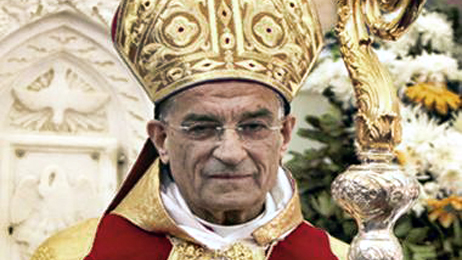
Beirut Arab news agency al Nashra reported on Saturday November 22, that [White House Muslim envoy] Dalia Mogahed has succeeded in canceling a meeting between the Maronite Patriarch of Lebanon and President Barack Obama. Writing in al Nashra, the reporter said “an unnamed US source told the news agency, that those who sought canceling a visit of (the spiritual head of the Maronite Church) Patriarch Beshara Rahi to the White House are Dalia Mujahid (Mogahed), the highest adviser on Arab and Islamic Affairs in the State Department, who is from Egyptian origins. And that,” according to al Nashra, “heeding a request by the higher leadership of the Muslim Brotherhood in Egypt, who consider that US Administration must support the Islamist Sunni current facing the Iranian current in the region.”
The al Nashra report, circulating now widely in the Middle East, but also in the United States and across the Lebanese Christian Diaspora confirms what was already known about the impact the so-called “advisors on Arab and Islamic Affairs” in the White House on Middle East issues in general and on US policies regarding the Christians in the Middle East.
Jeffrey Miller
I had seen this in regards to the recent Ad Limina visits for the Australian Bishops, but didn’t realize this is now the norm.
VATICAN CITY (CNS) — In a quiet modification of a traditional format, the Vatican has dropped most of the individual private meetings between Pope Benedict XVI and bishops making their “ad limina” visits to Rome.
The unannounced change was instituted earlier this year, apparently in an effort to reduce the scheduling burden on the 84-year-old pope and to help cut through the backlog of “ad limina” visits, which are supposed to be made every five years by heads of dioceses.
In place of one-on-one meetings, the pope now usually holds more freewheeling sessions with groups of 7-10 bishops at a time, lasting about an hour. That is expected to be the format for U.S. bishops when they begin their “ad limina” visits in early November.
Several bishops who have recently come through Rome on “ad limina” visits had good things to say about the new practice.
“The Holy Father welcomed us, he sat down and made us comfortable, at home and he chatted with us. He said, ‘Now tell me,’ and he listened very attentively and made a comment here or there. At the end, he summed up beautifully what was said,” said Archbishop Felix Machado of Vasai, India, who met the pope with a group of eight others in early September.
“It was very spontaneous, a heart-to-heart talk. And that’s what it should be. It was a real sharing between him and us,” the archbishop said.
Bishop William Morris doubles down in refusing to resign from the Diocese of Toowoomba. He responds to charges that he supports women’s ordination and recognizing some Protestant priestly orders as valid.
How it can be said that my Pastoral Letter teaches these things is beyond me when it purely refers to the fact that these are among many questions being discussed internationally, nationally and locally. To me this shows a total misreading and misinterpretation of what my Pastoral Letter is saying. Pope Benedict further states that my leadership of the priests and faithful of the diocese raises serious questions and that the diocesan bishop must above all be an authentic teacher of the faith, which is the foundation of all pastoral ministry. This is said without any foundation or proof. I have also been told that it is the bishops role to support the Pope in whatever he says without question, to teach from the Catechism and the documents of the Church and not to ask questions about topics that have been declared definitive or closed. I ask you, where is the Spirit in this? I was also told by Pope Benedict that I am too practical and it is the will of God that I resign.
Where is the Spirit in this? Considering the teaching or male-only ordination is part of the ordinary magisterium I should certainly say the Holy Spirit is involved in that. The problem is not with asking questions about these subjects, but with rejecting the answers. When the Pope writes “I declare that the Church has no authority whatsoever to confer priestly ordination on women and that this judgment is to be definitively held by all the Church’s faithful.” it does not mean that you get to keep questioning and doubting. Even though Ordinatio Sacerdotalis was not a solemn definition itself, it is an infallible teaching of the ordinary magisterium. But even if it had only been taught as part of the Papal Magisterium:
LG 25: “Religious submission of mind and of will must be shown in a special way to the authentic Magisterium of the Roman Pontiff even when he is not defining, in such a way, namely, that the judgments made by him are sincerely adhered to according to his manifested mind and will, which is clear either from the nature of the documents, or from the repeated presentation of the same doctrine, or from the manner of speaking.”
I’m not seeing much religious submission on the part of Bishop Morris, or much submission at all for that matter.
He is also being a bit disingenuous on his pastoral letter – a letter he later scrubbed from his site. In it he wrote:
As has been discussed internationally, nationally and locally the ideas of:
• ordaining women, married or single;
• recognising Anglican, Lutheran and Uniting Church Orders.
He mixed these in with valid approaches for the vocation crisis in his diocese. Just presenting them as “ideas” in a pastoral document is rather weaselly since bringing it up implies some level of support for the idea. Certainly all the women ordination advocates totally believe that he supports them.
If indeed he supports the Church’s teaching than why not make a positive statement in this regard as Australia Incognita suggests? If he is really just misunderstood it would have been simple for him to affirm the Church’s teaching.
The whole process has relied on the presumption that I would be compliant and resign. However, I cannot do so in conscience because my resignation would be based on my acceptance of a lie. My resignation would mean that I accept the assessment of my being unfaithful to the Magisterium and breaking communio. I absolutely refute and reject this assessment. I do not accept that there is any grave reason for me to resign and the conditions of Canon 401 §§ 1,2 not being met, it would be dishonest of me to suggest that they had.
Funny thing that when the Pope asks you to resign their usually is a presumption that you will be compliant and resign. You know that whole Holy Obedience thing? What if St. Padre Pio refused to stop offering Mass publicly with the excuse that doing so would give in to the false accusations against him? Bearing accusations even if false is a path of humility and holiness and I detect only the path of pride here. There seems to be absolutely no concern for the effects on his diocese and the Australian Bishops Conference by his intransigence.
He even has the audacity to compare himself to St. Thomas More towards the end of his letter. So a bishop refusing to be obedient to the Pope is the same as a man who lost his head for defending the authority of the Pope?
St. Thomas More Ora pro nobis.
I’ve already admitted to being a Jimmy Akin fanboy, but his new podcasts is just so full of awesome sauce.
Over the years I have done a fair amount of coverage on the women’s ordination movement and one question I had was did support of women’s ordination technically constitute heresy. From the little research I did I could not definitively say yeah or nay, but leaned towards nay.
Jimmy goes through the technical issues which are many. The following are his show notes for the documents he referenced. This is a very good look at the subject of what heresy is and what would formally constitute heresy.
Canons relating to the Church’s Magisterium, including the definition of heresy:http://www.vatican.va/archive/ENG1104/__P2H.HTM
Who must make the profession of faith: http://www.vatican.va/archive/ENG1104/__P2R.HTM
Text of the profession of faith: http://www.ewtn.com/library/curia/cdfoath.htm
Doctrinal commentary on the profession of faith: http://www.ewtn.com/library/curia/cdfadtu.htm
Jimmy Akin’s page where you can listen to this episode or subscribe to this podcast.
Being that I am somewhat immobilized with a muscle tear it at least has given me a chance for even more reading. So I started reading the letters of St. John of Avila. Due to the recent announcement that he will be made a Doctor of the Church I figured it would be a good idea to acquaint myself with a saint who preached to saints and whose preaching led to conversions of saints.
So far his letters have been just what I needed to read as they are so punctuated with the Gospel and his solid spiritual advice. It is hard to whine about my relatively minor pains reading his advice on suffering to those really suffering. There is just so much good stuff in his letters and yes I use stuff in the theologically technical sense. When his contemporary St. Teresa of Avila was being questioned about her teaching she was told to write it down and submit it to John of Avila and that they would go by what he had to say. In response St. John of Avila writes a great letter thanking her for what she has to say on prayer for his own soul while also making some suggestions for improving the clarity of her book to avoid confusion.
His letters are quite warm while showing great concern for a persons spiritual life and the dangers contained. One passage left me laughing in an example he gave.
While pondering over this truth, a holy hermit saw a woman of the world pass by, magnificently dressed and bejewelled. He burst into tears, exclaiming: “I beseech Thee to pardon me, O Lord, for this woman in one day takes more trouble to please men, than I have done in many years to please Thee!”
Now that is some holy humor! A footnote on this passage revealed.
The monk was St. Nonnus, Bishop of Heliopolis, and the woman St. Pelagia, an actress at Antioch, of bad repute, who had formerly been a catechumen. A few days after the incident recorded, she heard St. Nonnus preach a sermon on the Last Judgment, which so touched her heart, that she went to him and with many tears, begged him to baptise her. He did so, and, giving all her riches to the poor, she went to the Holy Land, where, under the name of Pelagius, she spent many years in penance, shut up in a narrow cell with only a small aperture for a window. She acquired the reputation of a Saint, and at her death, the people were surprised to discover that she was not a man: the virgins of the neighbourhood bore her body to their church as a rich treasure.
In another letter written to a Jesuit near death he playfully congratulates him on his upcoming promotion.
However, I am sending you my congratulations on your promotion to be prebendary 1 in the heavenly Jerusalem, where God is praised to all eternity and seen face to face.
Another footnote explains that a prebendary is he:
who resides within the precincts of a Cathedral and constantly attends its services, to that of the Saints who “stand before the throne” of God and “rest not day nor night, saying ‘Holy, Holy, Holy, Lord God Almighty,” and whose company the dying Jesuit hoped soon to join.
I just absolutely love this idea of death as a promotion for the faithful. Though prudentially I doubt if Hallmark will come up with “Congratulations on your upcoming promotion” cards for those who are dying. I do hope to be promoted one day and to avoid demotion.
You can get the letters in various ebook formats here. The formatting is not the best and there are obvious OCR translation errors. Though they are minor enough.
Creative Minority Reports covers an article in the Miami New Times that must be seen to be believed. If the article and accompanying picture was in The Onion it would be hilarious. It has all the markings of a parody except in fact being one.
By the way the picture was taken by a photographer whose biography screams “ax to grind”
Tabatha Mudra was born on the side of the road in south eastern Iowa in the early 1980’s and later adopted into a family of pious Estonian Vagabonds. Unscathed by the confines of Estonian dogma as a child,
Oh those mean dogmatic Christians who actually went and adopted a child and tried to teach her truth.
The erudite Fr. George Rutler writes a column on the “Shorter Form” of the modern Roman lectionary. The “Shorter Form” are edits of the Sunday Gospel readings supposedly allowed because of time considerations. Though as Fr. Rutler points out some of these edits reduce the Gospel by only 30 seconds.
Regardless this column is well worth reading and too good to just excerpt.
I find the whole concept of the “Shorter Form” Gospel readings to be a real bad idea driven really by removing hard sayings and not time reduction. This fact is obvious considering the readings that are shortened. If parishes have enough time for the “Liturgy of the Bulletin” where they read all the announcements, they have time for the Gospel.
St. Paul did not say.
“For I am not ashamed of the Gospel, unless of course it is a hard saying and might make somebody in the pew uncomfortable.”
Though of course it must be remembered that the”Shorter Form” is optional and we really should encourage our pastors to preach the full Gospel.
If someone were the prominent wife of a former head of state who has publicly supported abortion and contraception and even held a fundraiser for International Planned Parenthood would you label them a devout Catholic. What if she and her husband had called out the Pope on condoms and homosexuality ascribing Church doctrine to “fear” and as a “generational” issue. Now the “devout” label would certainly be used by the New York Times.
Today I saw a tweet via the same Twitter account the Pope used to send his first tweet. The tweet referenced this Vatican News Story.
Most people know her as the wife of the former British Prime Minister, Tony Blair – but Cherie Blair is every bit as professionally qualified as her famous husband. An attorney or “Queens Council” as they’re known in the United Kingdom, Cherie Blair is a judge, mediator and an active campaigner on equality and human rights issues. She’s also a devout Catholic and mother of four.
During her days at 10 Downing Street, where she met weekly with charitable institutions in support of their work, she was greatly impressed by the imbalances of world poverty and literacy: far more women than men are poor or illiterate, and the resources of women remain largely untapped in many parts of the world’s economies. So, with a mind to do her part to empower women to help themselves, she set up the Cherie Blair Foundation for Women in 2008.With financial support and through its business mentoring program, the Foundation helps women in Africa, South Asia and the Middle East to play an increasingly important role in their local economies and societies. With the Foundation’s assistance, often with internet and mobile communications technology, women can generate their own income and develop projects which encourage them to become successful and self sustaining entrepreneurs.
Tracey McClure met Cherie Blair after she spoke to participants at a recent conference in Rome organized by the Women’s Studies Institute at the Pontifical Atheneum Regina Apostolorum. Mrs. Blair said she was surprised and pleased to learn that such an institute exists and urged the Church to do more to acknowledge and support the role and contributions of women to the life of the Church.
Her own Catholic faith, she explains, played an important part in the way she views social and human rights issues and led to her involvement in works of charity from her Liverpool school days when she was an active member of the Young Christian Students movement.
Exactly why is someone in the Vatican so friendly to the Blair’s despite them being very public dissenters? A couple of years back she gave a lecture at the Pontifical University of St. Thomas Aquinas (the Angelicum). This is really unacceptable for Vatican Radio to be pushing her as a “devout” Catholic. How can someone repent if they are confirmed in their evil.
I have not written anything since the initial news concerning Bp. Zurek and Fr. Pavone. From my sofa-eyed view of the situation there seemed to be much fault on both sides and I was not exactly thrilled with the actions of either.
The latest news that Fr. Pavone had not attended a private meeting with his bishop due to his canon lawyer’s advice added a new wrinkle to this conflict. Fr. Pavone is adept at using media to get information out so I really wonder why he did not announce that he was not going to attend this meeting ahead of time? I also wonder why exactly he feels he needs a mediator when talking with his bishop. This action is more like somebody who is lawyering-up before meeting a district attorney. This makes the bishop-priest relationship an adversarial one and that he feels he must be protected from his bishop. That it seems his greatest fear is that he will be given a parish. With first Fr. Corapi and now Fr. Pavone is canon-lawyering-up to be the latest phrase.
Now I have long admired Fr. Pavone’s pro-life work and the good he has done, but doing pro-life work does not excuse you from Holy Obedience. Even if your bishop throws around words like “suspended” when they are canonically incorrect. Even if your bishop might not be making the most prudential choice in this matter. Would having Fr. Pavone step down from his leadership roles in the pro-life movement to be a parish priest be the most prudential use of his talents? Maybe not, but a parish priest is simply not a low-rung on the ladder as many great saints and St. John Vianney in particular have shown.
I was hoping that Canonist Ed Peters would post more on the subject of mediation. I certainly wanted to understand the subject of mediation in the view of Canon Law since I know nothing on the subject.
His post is informative and answers my questions and confirms some initial thoughts on the subject.