Funny piece by Carl Olson on an imagined conversation with The Washington Post that puts the idiocy of the WP’s recent take on fidelity oaths.

Fr. Philip Neri Powell, OP with some excellent liturgical analysis.
By placing relevance and novelty above organic development and continuity, liturgical Poundians ignore the historical and ecclesial nature of the liturgy and privilege their subjective cultural assessments above the real spiritual needs of their charges. The widespread phenomenon of liturgical abuse is an insidious form of clericalism that encourages those with clerical power to use that power to inflict their private preferences, political agendas, and ideological quirks on congregations powerless to stop them. Though Catholics have seen a dramatic decline in liturgical abuse in the last twenty-years, abuses still occur, and in some places, abuses are the norm.
Liturgical abuse as clericalism is exactly right.
Like they say “Read the whole thing“
The Arlington Diocese, which includes nearly a half-million Catholics across northern and eastern Virginia, is one of a small but growing number that are starting to demand fidelity oaths. The oaths reflect a churchwide push in recent years to revive orthodoxy that has sharply divided Catholics.
Such oaths are not new for priests or nuns but extend now in some places to people like volunteer Sunday school teachers as well as workers at Catholic hospitals and parish offices.
…
The Arlington “profession of faith” asks teachers to commit to “believe everything” the bishops characterize as divinely revealed, and Arlington’s top doctrine official said it would include things like the bishops’ recent campaign against a White House mandate that most employers offer contraception coverage. Critics consider the mandate a violation of religious freedom.
Articles like this almost make me wish I was a journalist. Instead of actual research and getting quotes I could just write “critics say” followed by anything I wanted to make a point with – that done I could go home after a days work. Yes religious freedom now means you have the right to be a catechist even if you won’t swear to teach what the Church teaches.
So far, out of the diocese’s 5,000 Sunday and parochial school teachers, four are objecting to it and will not take the oath.
So what exactly is objectionable to them? The Profession of Faith simply starts with the Creed and then says:
With firm faith, I also believe everything contained in the Word of God, whether written or handed down in tradition, which the Church, either by solemn judgment or by the ordinary and universal Magisterium, sets forth to be believed as divinely inspired.
I also accept and hold each and everything definitively proposed by the Church regarding teaching on faith and morals.
Moreover, I adhere with religious submission of will and intellect to the teachings with either the Roman Pontiff or the College of Bishops enunciate whey the exercise their authentic Magisterium, even if they do not intend to proclaim theses teachings by a definitive act.
This section is pretty much a restatement of the levels of Church teaching from the Vatican II document Lumen Gentium section 25. Though an actual document from Vatican II doesn’t count since as much as ye ole spirit of Vatican II.
Now as far as these four women saying they can’t take the oath. Well if their conscience seriously objects to it, than that is what they should do. This is much better than those who would swear the oath and not fully mean it. Oath-taking has fallen on hard times across the spectrum from marriages to politicians swearing to defend the Constitution.
One of the women submitted a letter explaining why she won’t take the oath and I don’t think she really explained why she won’t. One of the reasons is that she says it is not even possible to “specify ALL the teachings proposed definitively.” I find this rather lame as if you can know most of them yet the one you might not knows directly is the one you would object to. As if the Church has hidden the definitive teachings making it impossible to know them all without looking at lots of fine print. She says it is “impossible to know” what she is assenting to. Yeah that shows a lot of faith and trust in the Church. Another reason has even less substance in that the “expression of teachings have not reached their fullest expression in the present.” Well if the Magisterium’s deepening understanding in the area of faith and morals makes it so that you can no longer accept the faith at that point, well then resign at that point.
She even goes on to write that “only a person who is willing to abandon her own reason and judgment, or who is wiling to go against the dictates of her own conscience, can agree to sign such a document.” Wow so of the 5,000 catechetical teachers who will sign this document they are all willing to abandon reason and their conscience. Talk about abandoning reason and pure vanity. Being guided by the Magisterium is not abandoning reason since we must fully engage our reason to come to a fuller understanding of Church teaching.
She also says that forcing this issue she will be depriving students of teachers. Well 4 out of 5,000 is not much depriving. Though the 5,000 figure seems awfully high to me. One thing for sure this policy is already working if it keeps teachers like her from poisoning others with such a skeptical view of the Magisterium and the ability to know what she teaches. She treats this oath like a contract with the Devil where you must make sure there are no loopholes that will back-stab you later.
Via Rorate Caeli
MANILA, Philippines – Catholic bishops are sending their prayers for the eternal repose of Dolphy, with one bishop calling on God to appoint the Philippines’ comedy king as a court jester in heaven.
“We pray for the repose of his soul. His death reminds us that there is an end to our life. It is important that we discover and develop the talents the Lord had given us for the service of others and thank Him,” said Cubao Bishop Honesto Ongtioco in a report from CBCP News.
Archbishop Angel Lagdameo, former president of the Catholic Bishops’ Conference of the Philippines, said Dolphy was an inspiration to Filipinos.
“We thank God for the gift of Dolphy who served the country with his more than 2009 films, making all kinds of viewers cry and laugh through their shared experiences in life. He was a classic entertainer. May he rest in peace,” he said.
Sorsogon Bishop Arturo Bastes said: “I and many of my clergy are saddened by the death of the comedy king. We pray that the Lord will bring him soon to His kingdom and appoint Dolphy as His court jester to make heaven a merrier state.” [Source]
Boy do I want that job as Heaven’s Court Jester. After all my plans have been cracking up God for years.
Msgr. Charles Pope points out some interesting data from CARA.
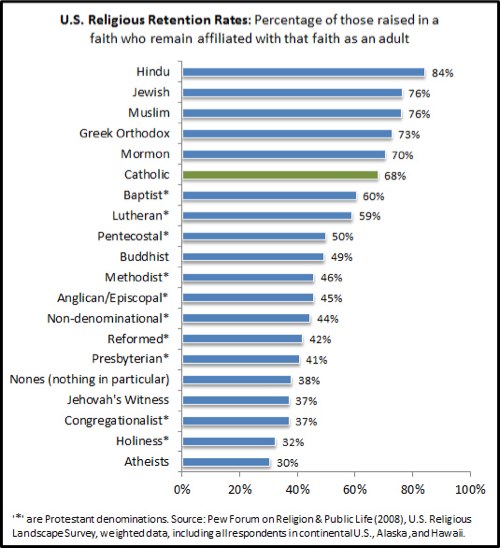
You often hear that ex-Catholics would make up one of the largest denominations. Apparently the category of ex-atheist’s make up a larger percentage. This data relates to people raised in an atheist household, not the retention rate of atheists not raised in such households.
But take a special look at that number at the bottom of the pile, yes the very bottom. Atheists “retain” only thirty percent of their “flock.” To quote the CARA blog: And if you think it is challenging to be a Catholic parent, try being an Atheist parent! Some 70% of Americans raised to believe God does not exist end up being a member of a religion as an adult (about one in five former Atheists drift off to become an open-minded agnostic or None).
N.B this number reflects only those raised as Atheists. A large number of Atheists in this Country are “made” in the sense that they were raised to believe but now are Atheists. It remains to study how many of them remain atheists and for how long.
The Monsignor goes on to write why he thinks this is so and of course the comment section is full of outraged atheists. I must applaud Msgr. Pope for the amount of engagement and his many responses to atheists who mainly assert that the study must be flawed (which of course is always possible).
So what we can take from this study and act on is to obviously raise our kids as atheists so that they will later have some form of belief! Hey it worked in my case raised in an atheist household. Well probably not the best approach, but you do have to wonder if atheist parents will complain about the state of atheist catechesis and the problem of backsliding atheists straying into faith.
Converts and Kingdoms: How the Church Converted the Pagan West and How We Can Do It Again
This book illustrates some of the major movements of conversion throughout history. Starting with the time just before Constantine and dealing with the growth of Christianity prominently in Europe and later the New World. I was somewhat familiar with some of this history from the books of the late Warren H. Carroll and others, but I really liked the focus of this book and all the details amplifying the growth of Christendom and just how unlikely it all seems.
The relating of this history did bring to me often in mind the writing style of Warren H. Carroll and I say that as the highest compliment. Clearly shown just what is history and avoiding hagiography (in the negative sense of the word) while not being dismissive of miracles. I also enjoyed some of the comments by the author peppered throughout that added some humor and here own clarification of what she thought of some streams of historical thought. This is certainly not dry history and I found myself reading large sections of it at a time finding that I enjoyed it so much. I found it an informative read.
The only complaint I had with the book is that it did not really live up to the subtitle. Specifically the “How we can do it again” part. While I am sure there are lessons learned from these segments of history, the author really didn’t point them out as to their applicability today. I expected that there would be a final chapter making these arguments. Considering that many of these major conversion points in Christendom involved conversions of emperors, kings, and chieftains that aspect is much less important today. Even in our celebrity-soaked culture, celebrity religious conversions don’t hold much sway” The same goes for nationality in relation to state religions. We just don’t have the huge shortcut available today where the religion of the king becomes the religion of the people. Though I can’t say I am very fond of that method in the first place.
What we can emulate is of course the same method always available of personal holiness and evangelical zeal. While the conversions of leaders played a great part, these conversion came as a result of contact with saints. The thing about conversion is that it is not a static thing and constantly requires reconversion. Complacency is the enemy of holiness and we see so much complacency and luke-warmness today. Though as this book demonstrates this is nothing new and a constant struggle. Overall I greatly enjoyed this book and the unsanitized history it presented. Her other books now go on my must-read wish list.
A district judge in Cologne, Germany, recently ruled that ritual circumcision is a crime, violating “the fundamental right of the child to bodily integrity,” which outweighs other parental and religious rights. “This change runs counter to the interests of the child,” the court concluded, “who can decide his religious affiliation himself later in life.” (source)
Now of course if the mother had chosen to have an abortion and chopping up the child – bodily integrity not so big a deal. So maybe in utero circumcision?

This is the 25th volume of The Weekly Benedict ebook which is a compilation of the Holy Father’s writings, speeches, etc which I pull from Jimmy Akin’s The Weekly Benedict. This volume covers material released during the last week for 26 June – 1 July , 2012.
The ebook contains a table of contents and the material is arranged in sections such as Angelus, Speeches, etc in date order. The full index is listed on Jimmy’s site.
The Weekly Benedict – Volume 25 – ePub (supports most readers)
The Weekly Benedict – Volume 25 – Kindle
There is an archive for all of The Weekly Benedict eBook volumes. This page is available via the header of this blog or from here.
History was made in the Catholic Diocese of St. Augustine when Nick Marziani became the first married man to be ordained as a Catholic priest under authority of the Personal Ordinariate of the Chair of St. Peter, set up by the Pope to provide pastoral care to former Episcopalians and Anglicans. Marziani was ordained June 17 by the Most Rev. Felipe J. Estevez, Bishop of the Diocese of St. Augustine.
Marziani, 61, is a former engineer, teacher and Episcopal priest and holds the doctor of ministry from Trinity Episcopal School of Ministry in Ambridge, Pa. He and his wife of 40 years, Joanne, are residents of St. Augustine Beach. The couple has three adult children and four grandchildren.
According to Father Mike Morgan, chancellor for the diocese, “Father Marziani was not ordained for service to the Diocese of St. Augustine, so he will not be receiving an assignment from Bishop Estevez. His ministry and assignments will be under the authority of the Ordinariate of the Chair of Peter, set up by the Pope to provide pastoral care to former Episcopalians and Anglicans, and headquartered in Houston, Texas.
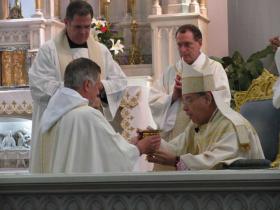
The story is not quite accurate, last week 6 former Episcopal clergy were ordained in Fort Worth, Tx and five of them were married and two of them were in fact father and son. This though is my diocese and the ordination was held in my parish Immaculate Conception in downtown Jacksonville, Fl.
Interesting though in that the majority of the stories that cover these clergy conversions put much more stress on that fact that they were married than that there were converts from Episcopalianism. Really the historic part is the number of converts from Anglican and Episcopal churches. The other really historic part is the length that Pope Benedict XVI has gone to to welcome these converts by setting up the Ordinariate.
[Source]
We do have a rich treasury of hymn-poems to read, to sing, and to keep close to the heart. Some of them are almost as old as Christianity itself. They come from Latin and Greek, from our own English, from French and German and all the languages of Europe. Some were written by saintly divines with a fine ear for poetry: John Henry Newman (“Praise to the Holiest in the Height”), Charles Wesley (“Love Divine, All Loves Excelling”). Many were written by the great Dr. Isaac Watts, who set the psalms to English meter and rhyme. Some rose up from an anonymous lyricist among the folk: “What Wondrous Love Is This.” Some entered our language by the skill of great translators, like John Mason Neale and Catherine Winkworth. Some were the work of pious laymen who meditated upon Scripture all their lives: so the blind Fanny Crosby gives us “Jesus, Keep Me Near the Cross.” Just as many of our most beautiful melodies were written by the finest composers who ever lived—Bach, Handel, Haydn—so too many of our hymn lyrics were written by poets of some renown: George Herbert, Robert Bridges, Gerard Manley Hopkins, John Milton.
So why, then, why do we have verse-by-numbers lyrics posing as real poems in our hymnals? Why, when we have such a trove of the great, the profound, the beautiful, the memorable, the poignant, the splendid, do we have to endure what is banal, clunky, clumsy, dull, vague, and silly?
A piece from an excellent article from Antony Esolen
Often it is like living in a warehouse full of fine china plates and when we eat we break out paper plates. We do the same with our hymns – our heritage is a treasury of beautiful hymns and we dine on banal ones.
The headline at the top is from Fr. Dwight Longenecker who has his own thoughts on the article.