An interesting article by Catholic World Report on Guidelines for nonprofits are often misunderstood. And they are sometimes misrepresented by those seeking to quiet churches.

 I’ve posted before about the petition on the White House site to Officially recognize the Roman Catholic Church as a hate group. While sad it isn’t really something to pay attention to since anybody can start one of these petitions and even after publicity both pro and con it still only has a little over 3,000 signatures.
I bring this up today because there was this story.
The White House has removed a petition from its We the People Web site calling for singer Beyonce to be disinvited from performing the national anthem at President Obama’s inauguration.
The star and longtime Obama supporter has a $50 million sponsorship contract with PepsiCo. Public health advocates urged her to reconsider the deal last month, citing health issues linked to soft drinks.
So now we know what is beyond the pale for White House petitions. Catholics as a hate group, fine. Criticism of Beyonce, that can’t stand.
The irony is also very rich considering Michelle Obama’s food nanny state proclivities and her association with “public health advocates.”
A White House spokesperson told the Obama Foodarama blog that Beyonce’s performance at the inaugural is “not something the White House actually has jurisdiction over.”
Selecting performers is a function of the Presidential Inaugural Committee, not the White House. We the People’s terms of participation state that users cannot post “petitions that do not address the current or potential actions or policies of the federal government.”
For the Obama Administration, Catholics as a hate group did not meet the last criteria mentioned.
In other recent petition news the White House responded to a petition to make a Death Star to spur job creation. There was a rather humorous response in rejecting the idea. Although the real reason they declined is that they felt Planned Parenthood was doing a good enough job and a Death Star would be overkill.
From a Zenit article about the Congregation for Divine Worship and the Sacraments is preparing a booklet to help priests celebrate the Mass properly and the faithful to participate better.
The prefect of the Congregation for Divine Worship and the Sacraments criticized existing abuses such as showmanship, and praised moments of silence “that are action,” which enable the priest and the faithful to talk with Jesus Christ and which exclude the predominance of words that often becomes showmanship on the part of the priest. The correct attitude is the one “indicated by Saint John the Baptist, when he says he must decrease and the Messiah must increase.”
The cardinal criticized the effort to make the Mass “entertaining” with certain songs – instead of focusing on the mystery – in an attempt to overcome “boredom” by transforming the Mass into a show.
Wow silence, what a concept. I would love to have more prayerful silence during the Mass. Often it seems we go overboard with trying to create a soundtrack for the Mass where every moment has to be filled with sound. I am probably more guilty than the majority in filling my day with sound from music, podcasts, audiobooks, and other media. Yet I can still feel that the Mass becomes cluttered with sound in that there is no room to just breath and pray. While actual sacred music can be a great help in prayer, the same is true regarding silence. We don’t have to have a hymn at every point of the Mass or transitional music to fill in all gaps. There is certainly a both/and for music and silence.
From the Pope’s 7 March 2012 General Audience which has a lot to say about silence.
In the preceding series of Catecheses I have spoken of Jesus’ prayer and I would not like to conclude this reflection without briefly considering the topic of Jesus’ silence, so important in his relationship with God.
In the Post-Synodal Apostolic Exhortation Verbum Domini, I spoke of the role that silence plays in Jesus’ life, especially on Golgotha: “here we find ourselves before ‘the word of the cross’ (cf. 1 Cor 1:18). The word is muted; it becomes mortal silence, for it has ‘spoken’ exhaustively, holding back nothing of what it had to tell us” (n. 12). Before this silence of the Cross, St Maximus the Confessor puts this phrase on the lips of the Mother of God: “Wordless is the Word of the Father, who made every creature which speaks, lifeless are the eyes of the one at whose word and whose nod all living things move!” (Life of Mary, n. 89: Testi mariani del primo millennio, 2, Rome, 1989, p. 253).
The Cross of Christ does not only demonstrate Jesus’ silence as his last word to the Father but reveals that God also speaks through silence: “the silence of God, the experience of the distance of the almighty Father, is a decisive stage in the earthly journey of the Son of God, the Incarnate Word. Hanging from the wood of the cross, he lamented the suffering caused by that silence: ‘My God, my God, why have you forsaken me?’ (Mk 15:34; Mt 27:46). Advancing in obedience to his very last breath, in the obscurity of death, Jesus called upon the Father. He commended himself to him at the moment of passage, through death, to eternal life: ‘Father, into your hands I commend my spirit’ (Lk 23:46)” (Post-Synodal Apostolic Exhortation Verbum Domini, n. 21).
Jesus’ experience on the cross profoundly reveals the situation of the person praying and the culmination of his prayer: having heard and recognized the word of God, we must also come to terms with the silence of God, an important expression of the same divine Word.
The dynamic of words and silence which marks Jesus’ prayer throughout his earthly existence, especially on the cross, also touches our own prayer life in two directions.
The first is the one that concerns the acceptance of the word of God. Inward and outward silence are necessary if we are to be able to hear this word. And in our time this point is particularly difficult for us. In fact, ours is an era that does not encourage recollection; indeed, one sometimes gets the impression that people are frightened of being cut off, even for an instant, from the torrent of words and images that mark and fill the day.
It was for this reason that in the above mentioned Exhortation Verbum Domini I recalled our need to learn the value of silence: “Rediscovering the centrality of God’s word in the life of the Church also means rediscovering a sense of recollection and inner repose. The great patristic tradition teaches us that the mysteries of Christ all involve silence. Only in silence can the word of God find a home in us, as it did in Mary, woman of the word and, inseparably, woman of silence” (n. 66). This principle — that without silence one does not hear, does not listen, does not receive a word — applies especially to personal prayer as well as to our liturgies: to facilitate authentic listening, they must also be rich in moments of silence and of non-verbal reception.
St Augustine’s observation is still valid: Verbo crescente, verba deficiunt “when the word of God increases, the words of men fail” (cf. Sermo 288, 5: pl 38, 1307;Sermo 120, 2: pl 38, 677). The Gospels often present Jesus, especially at times of crucial decisions, withdrawing to lonely places, away from the crowds and even from the disciples in order to pray in silence and to live his filial relationship with God. Silence can carve out an inner space in our very depths to enable God to dwell there, so that his word will remain within us and love for him take root in our minds and hearts and inspire our life. Hence the first direction: relearning silence, openness to listening, which opens us to the other, to the word of God.
However, there is also a second important connection between silence and prayer. Indeed it is not only our silence that disposes us to listen to the word of God; in our prayers we often find we are confronted by God’s silence, we feel, as it were, let down, it seems to us that God neither listens nor responds. Yet God’s silence, as happened to Jesus, does not indicate his absence. Christians know well that the Lord is present and listens, even in the darkness of pain, rejection and loneliness.
Jesus reassures his disciples and each one of us that God is well acquainted with our needs at every moment of our life. He teaches the disciples: “In praying do not heap up empty phrases as the Gentiles do; for they think that they will be heard for their many words. Do not be like them, for your Father knows what you need before you ask him” (Mt 6:7-8): an attentive, silent and open heart is more important than many words. God knows us in our inmost depths, better than we ourselves, and loves us; and knowing this must suffice.
In the Bible Job’s experience is particularly significant in this regard. In a short time this man lost everything: relatives, possessions, friends and health. It truly seems that God’s attitude to him was one of abandonment, of total silence. Yet in his relationship with God, Job speaks to God, cries out to God; in his prayers, in spite of all, he keeps his faith intact, and in the end, discovers the value of his experience and of God’s silence. And thus he can finally conclude, addressing the Creator: “I had heard of you by the hearing of the ear, but now my eye sees you” (Job 42:5): almost all of us know God only through hearsay and the more open we are to his silence and to our own silence, the more we truly begin to know him.
This total trust that opens us to the profound encounter with God developed in silence. St Francis Xavier prayed to the Lord saying: I do not love you because you can give me paradise or condemn me to hell, but because you are my God. I love you because You are You.
As we reach the end of the reflections on Jesus’ prayer, certain teachings of the Catechism of the Catholic Church spring to mind: “The drama of prayer is fully revealed to us in the Word who became flesh and dwells among us. To seek to understand his prayer through what his witnesses proclaim to us in the Gospel is to approach the holy Lord Jesus as Moses approached the burning bush: first to contemplate him in prayer, then to hear how he teaches us to pray, in order to know how he hears our prayer” (n. 2598).
…
A Connecticut priest was part of a cross-country drug ring that smuggled crystal meth from California into the well-heeled hamlets of Fairfield County, federal prosecutors said.
Monsignor Kevin Wallin, a former pastor of St. Augustine Parish in Bridgeport, sold meth to undercover narcs six times since September 2012, the U.S. Attorney’s Office said Wednesday.
The 61-year-old former church leader and four others were indicted by a grand jury on six counts of possession with intent to distribute. (Via The Deacon’s Bench)
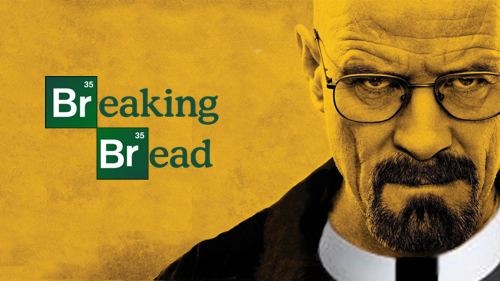
Not the direction I envisioned things in my Breaking Bad parody.
Many have noted the President’s heavily ironic proclaiming of January 16, 2013 as Religious Freedom Day. I have stated before that many liberals are irony deficient and the President suffers from the same deficiency.
Whenever a quote is used which contains multiple ellipses it is usually interesting what was taken out. In this case the quote from Thomas Jefferson also included.
All attempts to influence it by temporal punishments or burthens are a departure from the plan of the holy author of our religion No man shall be compelled to frequent or support any religious worship or ministry or shall otherwise suffer on account of his religious opinions or belief, but all men shall be free to profess and by argument to maintain, their opinions in matters of religion.
Right now if you are a religious believer and refuse to support an insurance plan because of its support of intrinsic evils you are indeed punished and burdened. If $100 dollars per day is not a punishment and burden I am not sure what is. Although for a President who goes through trillions as if it was tissue paper it might not seem like much in perspective. Well maybe not since this was intended as a fine so large as to be an encouragement to just buckle under to the oppression.
This is social engineering akin to Mafia fire insurance. “You don’t want something to happen to your fine business”? Pay up or you will be put out of business via fines.
So you might ask how the President can be so paradoxical between what he says and what he does? I mean other than the fact that this is typical politician behavior. Is he just totally being a hypocrite here? I would say probably not. A thrust of the Obama administration has been the emphasis of “worship” over “religion.” Where religious freedom comes to mean being able to belong to a church and to attend worship services. You are even allowed to practice your faith in everyday life just as long as it does not intersect with some government/culture created right.
This is the Chinese government model where they have Patriotic churches created by the government. A Catholic would be allowed by the government to belong to a Patriotic Catholic Church, but would not be allowed to rebel against intrinsic evils such as abortion or contraception. Citing conscience against the one child policy will get you nowhere except possibly prison. We have not gone that far down this road, but there are many similarities. Somebody who totally accepts the culture of death will not be having their conscience violated by Obamacare. This is why most so-called progressive Catholics have no problem with the HHS mandate. They might talk about this being the result of living in a pluralistic society, but really it is because they have no problem with abortion, sterilization, and contraception in the first place. An article in Commonweal today illustrates this.
As bad as the current situation is, no doubt it will only get worse as more phony rights are created and weighed against actual rights. When God-given rights are balanced against created rights the current administration has their thumb on the scales.
BY THE PRESIDENT OF THE UNITED STATES OF AMERICA
A PROCLAMATIONForemost among the rights Americans hold sacred is the freedom to worship as we choose. Today, we celebrate one of our Nation’s first laws to protect that right — the Virginia Statute for Religious Freedom. Written by Thomas Jefferson and guided through the Virginia legislature by James Madison, the Statute affirmed that “Almighty God hath created the mind free” and “all men shall be free to profess … their opinions in matters of religion.” Years later, our Founders looked to the Statute as a model when they enshrined the principle of religious liberty in the Bill of Rights.
Because of the protections guaranteed by our Constitution, each of us has the right to practice our faith openly and as we choose. As a free country, our story has been shaped by every language and enriched by every culture. We are a nation of Christians and Muslims, Jews and Hindus, Sikhs and non-believers. Our patchwork heritage is a strength we owe to our religious freedom.
Americans of every faith have molded the character of our Nation. They were pilgrims who sought refuge from persecution; pioneers who pursued brighter horizons; protesters who fought for abolition, women’s suffrage, and civil rights. Each generation has seen people of different faiths join together to advance peace, justice, and dignity for all.
Today, we also remember that religious liberty is not just an American right; it is a universal human right to be protected here at home and across the globe. This freedom is an essential part of human dignity, and without it our world cannot know lasting peace.
As we observe Religious Freedom Day, let us remember the legacy of faith and independence we have inherited, and let us honor it by forever upholding our right to exercise our beliefs free from prejudice or persecution.
NOW, THEREFORE, I, BARACK OBAMA, President of the United States of America, by virtue of the authority vested in me by the Constitution and the laws of the United States, do hereby proclaim January 16, 2013, as Religious Freedom Day. I call on all Americans to commemorate this day with events and activities that teach us about this critical foundation of our Nation’s liberty, and show us how we can protect it for future generations at home and around the world.
IN WITNESS WHEREOF, I have hereunto set my hand this sixteenth day of January, in the year of our Lord two thousand thirteen, and of the Independence of the United States of America the two hundred and thirty-seventh.
Irony Alert! Today is Religious Freedom Day – Frank Weathers
Who Knew Our President Was Such a Great Comedian? – Tom McDonald
Media boosterism of women priests is nothing new. PBS totally one-sided coverage on this issue is just the latest broadside.
This bit is also pretty muddle headed.
REV. THOMAS RAUSCH (Professor of Catholic Theology, Loyola Marymount University): The Catholic Church is not ready for the ordination of women right now.
… As far as the church is concerned, these are not valid ordinations. Ordination is an act of the whole church, and this is not an act of the whole church. In a sense, this is an act against the communion of the whole church. It is very difficult to call yourself a Roman Catholic if you are not living in communion with the Roman Catholic Church, and communion means you are recognized by the bishop and you have this network of relationships, which is…It’s the kind of glue that holds the Catholic Church together.
… I think that, you know, the culture was patriarchal. It was very much male-centered. Males were educated. They took roles of leadership. They played leading roles in the churches. So I think those cultural reasons really have to be taken into account in order to understand the exclusion of women from ordained ministry in the life of the church.
Why am I not surprised to find that this priest has also been a favorite on the History Channel.
It does remind me of a parody I did back in 2007 of this fawning coverage of women’s ordination and maybe I also feel I have a call to be a PBS reporter.
I have quite an announcement to make. I am now a reporter for Newsweek magazine! I always felt a call to be a reporter for Newsweek magazine so this is something very important for me. I can’t tell you how thrilled I am at this news and the impact this has on my life and hopefully the lives of others.
The hierarchy of Newsweek magazine though doesn’t recognize my call to be a reporter for them. So I had to have reporter credentials given me by an Ecumenical magazine group that also see themselves nevertheless as Newsweek employees and don’t recognize the authority of Newsweek’s editors to make hiring decisions.
So for my first article as a Newsweek employee I am going to interview myself, this way nobody can charge me with making up interviews as in the case of ABC’s Alexis Debat.
NEWSWEEK: What made you decide to become a Newsweek reporter?
Jeff Miller: It was a long process that started at a very young age. I grew up reading bad religion reporting and was always attracted to Newsweek’s egregious reporting and I was affirmed by others that I had gifts for bad reporting.Have you heard from the Newsweek hierarchy?
The reporting community I belong to hasn’t felt anything from the editors, but local stringers have informed others not to read my reporting since I wasn’t a “validly credentialed” reporters for Newsweek.How has your family handled your decision? Are they still Newsweek readers?
They are. They are actually incredibly supportive. My immediate family came for my giving a Newsweek credentials. My grandmother bought me an old typewriter.How many people read your Newsweek articles?
We have 80 registered members. And we have a number of people who come who are subscribe to Newsweek but who come to read with us as a place to refresh their souls—a lot of them are ex-Newsweek readers who are uncomfortable with Newsweek’s discriminatory hiring practices.Do you know the other Ecumenically credentialed Newsweek reporters?
In the Ecumenical Newsweek Communion there are six other reporters. I know all of them. In the Ecumenical Reporters Communion we no longer claim that we’re underneath the authority of the editors. [There’s also a group called the Roman Newsweek Reporters, which also credentials some reporters.] During the last several years there have been organized giving of Newsweek reporter credentials primarily on river boats.Have you received any hate mail?
I personally have not received hate mail, although there are plenty of blogs that I have found online that like to slander my name when they get hold of information about my credentials. It’s unfortunate and sad. The people I serve are excited to see a place where men and women can read my articles side by side. Just because I wasn’t actually hired by Newsweek and I receive no salary from them or actually turn my stories over to them to be published doesn’t prevent me from being a validly credentialed Newsweek reporters. Defenders of Newsweek’s reporter tradition says that since founders of Newsweek (Ward Cheney, John Hay Whitney, and Paul Mellon) didn’t allow people to call themselves Newsweek reporters without actually being hired by them that this can’t be changed. There has been recent archaeological evidence in Newsweek headquarters of a statue of a reporter who does not seem to have ever been on their pay role. I think this is evidence of self-named Newsweek reporters in the early history of the magazine. If only people would get with the modern time and to understand how discriminatory Newsweek’s present hiring practices are by not hiring everybody that would apply.Is there anything else you wish people knew?
It’s important to me that people see that I did what the others do to prepare to be a reporter. I took that traditional path. I got a certificate from an online journalism school for a reasonable fee. I forced myself to cover local news of minor happenings to prepare myself. I just wish more reporters who find themselves alienated from the magazine could find a magazine home. I am taking this step forward so that others in the future will have the opportunity to be a Newsweek reporter without having to face their discriminatory hiring practice of only hiring those with a journalism degree and having the ability to write and to act as a reporter.
Award-winning Catholic journalist and author Tim Drake has been named Senior Editor and Director of News Operations for The Cardinal Newman Society, charged with the important task of informing Catholic families and clergy about news and trends in Catholic education. He will begin January 23.
“Catholic families have a right to authentic, faithful Catholic education, and for 20 years The Cardinal Newman Society has worked to give them the information they need,” said Cardinal Newman Society President Patrick J. Reilly. “I can’t think of a single person who is better qualified and prepared to improve and expand our operations than Tim Drake. We are thrilled to have him on our team.” (Source)
When he announced the other day he was leaving the National Catholic Register I was wondering where he was going. I think this is pretty good news and he certainly makes a great fit for them. Tim Drake was one of the early Catholic bloggers (CatholicPundit 2002) and I have admired his balanced work with the National Catholic Register and other media.

This is the 45th volume of The Weekly Benedict ebook which is a compilation of the Holy Father’s writings, speeches, etc which I post at Jimmy Akin’s The Weekly Benedict. The post at Jimmy Akin’s site contains a link to each document on the Vatican’s site and does not require an e-reader to use.
This volume covers material released during the last week for 17 December, 2012 – 7 January 2013.
The ebook contains a table of contents and the material is arranged in sections such as Angelus, Speeches, etc in date order. The full index is listed on Jimmy’s site.
The Weekly Benedict – Volume 45 – ePub (supports most readers)
The Weekly Benedict – Volume 45 – Kindle
There is an archive for all of The Weekly Benedict eBook volumes. This page is available via the header of this blog or from here.
I feel funnier just linking to posts from Eye of the tiber
Müller To Build Vatican II Theme Park
Makes me ponder on what if there really was a Vatican or other Catholic theme park? Holy Roller Coasters?
Now I know marianland bills itself as a Catholic Theme Park. But really a replica of Medjugorje?
I really want to see an animatronic Hall of Popes.
I believe DanteLand or Dante World would be rather awesome. Dante’s nine circles of Hell would put those Protestant “Hell Houses” to shame. Tour guides would act and dress like the Roman poet Virgil.
Purgatory could be just like the “It’s a small world” ride. You are forced to listen to that song and go round and round the ride until you have been expiated of all your attachment to sin. Perhaps nothing quite so cruel. I do like the idea of a “It’s a small world” ride where you see examples of Catholics around the world practicing their faith. The universality of the Church does make for something pretty cool.
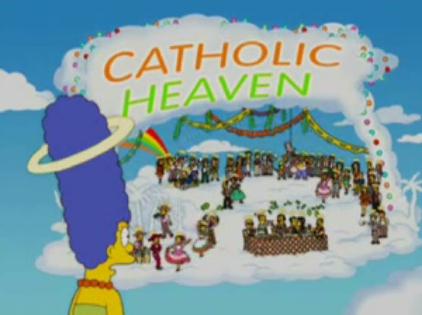
Plus I think the version of Catholic Heaven envisioned in The Simpsons would be really fun as an attraction.
Now what attractions could the Vatican build for progressives? Oh I know – labyrinths since they so love them. Really really complicated labyrinths that take years for them to find their way out. Kind of like the Hotel California “You can check-out any time you like, But you can never leave!” Or maybe fun house mirrors. Well maybe not since they so distort Catholic teaching everything might look normal to them.
Perhaps you can think up an even better ride/theme?
Oh did I say the Dalai Lama?
An electricity company in New Zealand is lighting up the media worldwide with a four-story billboard painting that shows a smiling Pope Benedict XVI blessing a mixed race gay couple, at a time when New Zealand’s parliament is considering whether to legalize same-sex marriage. (source)
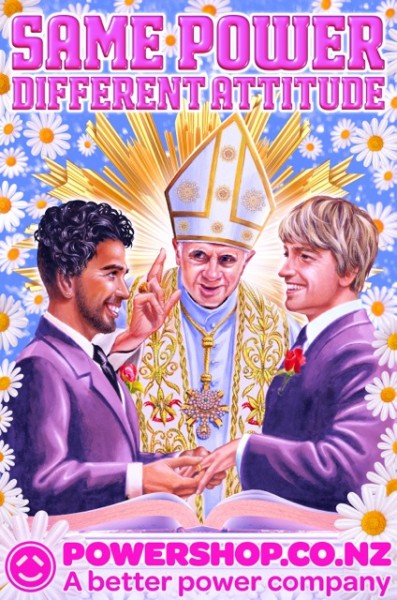
Well I say fight the power! It is rather shocking in the current time and we must offer resistance to this volt fraud.