Sister Mary Ann Walsh, RSM has some solid suggestions for evangelizers using social media.


Archbishop Chaput’s Homily for the Closing Mass of the Fortnight for Freedom.
Archbishop Chaput has bookended the start and end of the Fortnight for Freedom with exceptional speeches that call for the protection of religious freedom along with more importantly the call to holiness of inner conversion and repentance.
I say this for two reasons. Here’s the first reason. Real freedom isn’t something Caesar can give or take away. He can interfere with it; but when he does, he steals from his own legitimacy.
Here’s the second reason. The purpose of religious liberty is to create the context for true freedom. Religious liberty is a foundational right. It’s necessary for a good society. But it can never be sufficient for human happiness. It’s not an end in itself. In the end, we defend religious liberty in order to live the deeper freedom that is discipleship in Jesus Christ. What good is religious freedom, consecrated in the law, if we don’t then use that freedom to seek God with our whole mind and soul and strength?
“Praying the Rosary for Intercession” is a new book by Catherine M. Odell published by OSV. This book like so many that came before it has a standard format. A history of the Rosary followed by meditations for each mystery and lastly specific instructions on praying the Rosary along with guidelines for intentions.
The reflections are mostly pretty good and on target.
What makes this book stand out for this type of book is both its strength and and its weakness. After the scriptural reference and reflection on the mystery follows a section called “The Rosary in our lives”. This section includes personal stories on how the Rosary has affected the lives of people. There are modern conversion stories along with stories on the Saints and their devotion tot the Rosary. This puts the Rosary in the context of people’s lives and thus would be quite helpful for the audience of this book.
The weakness of the “The Rosary in our lives” is not the actual content of it, but the references to some dubious sources and apparitions.
For example four of the stories in this section relate to Medjugorje. The introduction to one of these stories refers to Medjugorje as a place where “some people” think Mary is appearing. Now there is a lot of controversy regarding this alleged apparition and I am definitely in the skeptical if not outright thinking it is a fraud camp. Regardless I think a writer who brings up Medjugorje has a duty to say more than that “some people” accept them. They have a duty to note that both Bishops of Medjugorje have not approved them and that the Bishop’s conference of Yugoslavia also did not approve them. I believe that there are true conversion occurring in Medjugorje since wherever there is the Mass and the Sacraments and people looking for God there are conversions. Even apparitions that were condemned by the Church had movements of conversions surrounding them. So I have no problem with printing stories of conversion regarding Medjugorje, I just think there should be a firm disclosure regarding the current status of Medjugorje in relation to the Church.
The dubious sources I refer to is in one example referring to Dutch professor Fr. Edward Schillebeeckx O.P. in glowing terms. Congregation for the Doctrine of the Faith issued a caution in 1986 that his theories regarding the laity were at odds with the teachings of the Church. Under Cardinal Ratzinger this was somewhat cleared up in interactions by letters to explain himself, but he was drop the reference to lay ministry from any subsequent publications. This is just one of he controversies surrounding him. Fr. Rolheiser is also referenced and I find that he certainly flirts with heterodoxy with an oversexualization of everything. For example he writes on St. Therese who he calls a a very lonely person “More deeply than we long for a sexual partner, we long for moral affinity—our deepest longing is for someone to sleep with morally.” Really that is our deepest longing? So much for “Our hearts our restless until they rest in you.”
I certainly might be too critical on this in that the use of material from these two men were not problematic in themselves. People can read this book to their good, though if it interests them in Medjugorje or the writings of these two men in my mind that is not to the good.
There has been a lot of ink and pixels spilt over the topic of the CDF’s investigation into the LCWR. The large brunt of the media coverage has used the “War on women” narrative as if the fact that the only thing these religious sisters and nuns are guilty of is the crime of being a women and daring to help the poor.
If this narrative is true then why is the Vatican investigating the LCWR and not the parallel group the Council of Major Superiors of Women Religious (CMSWR)? After all they are women also and help the poor.
Why does the Vatican investigate women religious who look like this:

pro-abortion Sisters
or
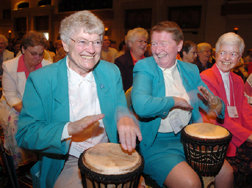
And not ones that look like this:
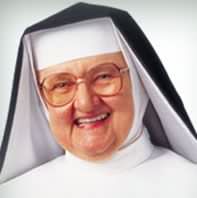
or
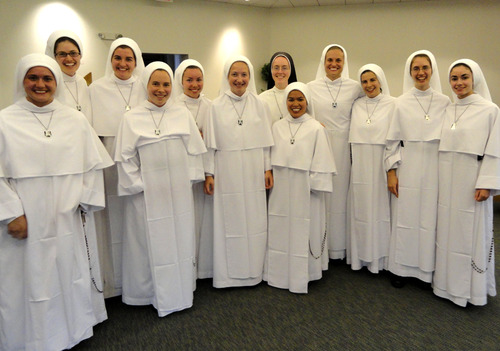
Well the answer might surprise you. It has nothing to do with the fact that orthodox religious women generally wear habit and ones with more dissident tendencies don’t. Nope, no correlation at all.
The real reason the Vatican is “cracking down” on the LCWR and some women theologians in the United States is because they are noticeable as women. Everyone knows the patriarchal all-male hierarchy is totally misogynistic. The thing is that when women religious wear full habits they become invisible to the Vatican and the CDF. Their women parts and hair are totally hidden in their habits and the CDF forgets they are women and thus leave them alone. The LCWR and all the so brave dissident women theologians are instantly viewed obviously as women without the covering habits.
Now these habit-less religious women did try some camouflage by wearing pantsuits, but this did not go far enough to fool the CDF. This did not work even with the attempts at mannish hairstyles.
Here is Sister Simone Campbell making the classic mistake in not hiding herself in a habit and thus opening herself up to crackdowns from CDF troops.
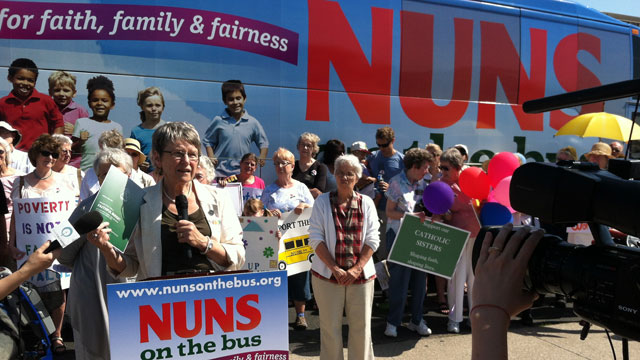
In fact I expect the CDF paratroopers to descend from the skies and put a stop to this bus tour any day now. After all the signs should say “Religious Sisters on a Bus” and not “Nuns on the Bus.” There should certainly be fines for those who continue to confuse the terms nuns and sisters.
You just got to love the priorities of these women religious:
- Federal money for abortion – No need to organize a bus tour.
- Catholics being forced out of adoption and helping victims of human trafficking – Nope no bus tour needed.
- Attack on our religious freedom and forced support of intrinsic evils – No need for a bus tour.
- A Republican budget that is going nowhere – Organize a tour immediately.
They are looking for writers for the New Evangelizers blog.
If you’re interested in sharing your faith and specifically things that tie into New Evangelization, especially how to Know Your Faith, Live Your Faith, and Share Your Faith, they want to hear from you.
Contact Sarah Reinhard at blog@snoringscholar.com or leave a comment on this post at her blog.

This is the 24th volume of The Weekly Benedict ebook which is a compilation of the Holy Father’s writings, speeches, etc which I pull from Jimmy Akin’s The Weekly Benedict. This volume covers material released during the last week for 20 – 29 June , 2012.
The ebook contains a table of contents and the material is arranged in sections such as Angelus, Speeches, etc in date order. The full index is listed on Jimmy’s site.
The Weekly Benedict – Volume 24 – ePub (supports most readers)
The Weekly Benedict – Volume 24 – Kindle
There is an archive for all of The Weekly Benedict eBook volumes. This page is available via the header of this blog or from here.
PEORIA, ILL., June 29 (CNA/EWTN News) .- Bishop Daniel R. Jenky of Peoria says the declaration of Archbishop Fulton Sheen as “venerable” is wonderful news for both the diocese and the Catholic Church in America.
On June 28 the Pope Benedict XVI authorized the decree recognizing the heroic virtues of the much loved U.S. archbishop, author and television evangelist. The move brings Sheen closer to sainthood.
“Fulton Sheen’s zeal, wisdom, and holiness should help us build our faith,” Bishop Jenky said. He thanked God that the Catholic Church has recognized “a son from central Illinois.”
Archbishop Sheen was ordained a priest for the Diocese of Peoria and went on to become a prominent speaker and author. In addition to serving as an auxiliary bishop of New York and Bishop of Rochester, was best known for his weekly radio broadcast “The Catholic Hour” and his later weekly television program “Life is Worth Living.”
The archbishop died in 1979 at the age of 84. His cause for sainthood was opened in 2002.
Msgr. Stanley Deptula, executive director of the Archbishop Fulton John Sheen Foundation in Peoria, said the Catholic Church in America needs “heroes to inspire us to stand up and to fall to our knees.”
“I think in a special way, Venerable Fulton Sheen can be an inspiration and a consolation to our bishops and other Church leaders. He was a man of courage, and priest of prayer.”
In response to the decree, Bishop Jenky will celebrate a thanksgiving Mass on Sept. 9 at the Cathedral of St. Mary in Peoria.
Well yesterday was a slow news day, but I was very happy to see this story source
Though I was also happy to see a story on Bishop Clark having to send in his retirement letter to the Pope. Bishop Clark is of course the Bishop of Rochester who actually has been there so long that the previous bishop was Archbishop Sheen.
I had noticed that TS of Video, meliora, proboque; Deteriora sequor had been reading through Bad Religion: How We Became a Nation of Heretics
This book is sort of a history and critique of Christianity as practiced by Americans especially in the last seventy or so years. His critique is that we are a nation of heretics and that really we have always been a nation of heretics from the foundation of the country. What has changed is the amount of orthodoxy as practiced by the various strains of American Christianity. His use of the word heretics is the more general term of use and not a precise canonical one.
As a critique the history provided is of the major trends and personalities involved along with snapshots of data to help you put it all into context. We see how these religious trends often intersected with societal ones and how more and more they took on political tones. These movements within Christianity as practiced in America paralleled movements of thought from Europe resulting in very American formulations of it along with negative reactions to this. He breaks up these movements into two basic areas of accommodation and resistance and reviews both the Protestant and Catholic sides of it. Accommodation being the various forms predominate in a more liberal Christianity along with resistance like the neo-Orthodox movement. This makes up the first half of the book and provides a very readable summary of this history along with exploring the philosophies and personalities behind it.
The second half of the book looks at the various heresies that are predominant now. The culture and the media’s fascination with some of the so-called lost gospels and other gnostic writings used to beat Christianity shows the old adage about “any stick will do.” From the inept translation of the Gospel of Judas as headed by the National Geographic to so much nonsense that has made it to the History Channel we see how that stick is used. They will call the Catholic Church anti-women while promoting the “Gospel” of Thomas where you have to become a man to go to Heaven.
He also explores those who promote a materialistic prosperity gospel of “Name it and claim it” the Word of Faith movement. I find it no surprise that this movement developed in the U.S. and also not a surprise that it runs parallels to the New Age teaching of the “the law of attraction” as espoused in so many books Oprah promoted. Strains of Dr. Norman Vincent Peale “The Power of Positive Thinking” have taken some strange paths.
New Age emphasis on the “God within” has also made many inroads and entries into not only the popular culture, but also the retreat house. It is almost despairing when books like Elizabeth Gilbert’s “Eat, Pray. Love” which exhibit a toxic selfishness not only becomes a best seller, but a movie also. But when the god is within you than sin is dispelled and whatever you happen to be doing is of course part of the will of the god within for you. Mystical pantheism dressed up in radical selfishness.
I found especially interesting the last chapter “The City on the Hill” which looks in part at the various religious/political intersections and how they have played out in our history. The alternations between messianic and apocalyptic views which more and more are existing in parallel. These intersections were to the good in the Civil Rights movements where we had both sides of the political divide along with the parallel elements in various churches. Ross Douthat analysis of this success of this only highlights the failure of modern religious and political partisanship. This is certainly not a simple “liberal bad, conservatives good” book as I think he gives a fair analysis regarding both sides. I certainly did not agree with all of his analysis, but when I didn’t I was more apt to look at my own ideas and see if perhaps I was mistaken or needed to reevaluate something. The conclusion of the book reflects both his “spirit of pessimism” and a hopeful optimism.
This book has been written in a spirit of pessimism, but for both Americans and Christians, pessimism should always be provisional. Even in an era of disarray, Americans can draw confidence from our nation’s remarkable past, with its stories of expectations confounded, obstacles overcome, declines reversed, and better futures attained. Christians have an even stronger source of confidence: the belief that history has an Author and that the destiny of both their country and their creed is in God’s hands.
Ross Douthat as a Catholic knows that the promise concerning the Church’s protection from the Gates of Hell does not mean a protection of American Christianity as he points out. He does not pretend to predict how this ebbs and flows of Christianity within the context of the United States will play out, but he also knows that there have been many predicted ends for it.
As a writer Ross Douthat is really a joy to read and I especially liked the precision in what he wrote. Some people will use their large vocabulary as a spotlight to show how bright they are. I don’t think that was the case here, but I am glad I read the ebook version where a dictionary definition was only a finger press away. When he did use unfamiliar words I found they were perfected fitted to what he was saying.
You sometimes run across this quote from Gandhi:
“I like your Christ; I do not like your Christians. Your Christians are so unlike your Christ.”
Though I must admit this quote annoys me. While it makes a valid point about the behavior of some Christians and a warning to all of us – I find it too dismissive. I don’t mind at all the reminder that I must be more like Christ, a reminder I can always use.
I am glad that he found so many examples of perfect Hindu’s that did not cause him such alarm for his own faith.
One thing the statement is so dismissive of is the various martyrs and saints – the exemplars of the faith – those who truly followed Christ. They are just passed over because of those who don’t as closely follow Christ. Judging anything by the people who don’t exemplify something is a rather poor test. Like judging mathematics based on poor math students.
It also reminds me of one of Chesterton’s quotes:
“The Christian ideal has not been tried and found wanting. It has been found difficult; and left untried.”
Gandhi himself was influenced by the writings of G.K. Chesterton, at least in regards to Indian independence. I can’t speak to Gandhi’s personal rejection of Christianity – I just don’t find his stated reasons very compelling.
For example:
…to be a good Hindu also meant that I would be a good Christian. There is no need for me to join your creed to be a believer in the beauty of the teachings of Jesus or try to follow His example.
Yeah that is why there were so many Hindus there in the streets of Calcutta helping out the poorest of the poor before Blessed Mother Teresa arrived. Plus Gandhi’s statement makes no sense in that he says he can be a good Christian without trying to follow Jesus’s example. That you admit to a beauty of a teaching you won’t follow just displays a nebulous understanding of the truth of those teachings.
Today being the Feast of St. Josemaria Escriva it is quite appropriate to post a review for Holiness for Everyone: The Practical Spirituality of St. Josemaria Escriva
In the age of speciality where every profession gets narrower and narrower in scope it is easy to apply this to everything. For example when we look at the canonized saints we mainly think of priests and religious since for many reasons related to process they make up the majority of canonized saints. That the holiness of these priests and religious elevated to the altars is a function of their “profession” and that you could be holy too if you got to spend most of your time thinking about God and related “stuff.” It is easy when you fall to say “I am only human”, and forget that the same is true of the saints. Really thought it is much simpler to outsource holiness to the “saints” and just muddle along the best you can as a lay person.
This thought process is totally alien to what the Church teaches about the universal call to holiness.
Therefore in the Church, everyone whether belonging to the hierarchy, or being cared for by it, is called to holiness, according to the saying of the Apostle: “For this is the will of God, your sanctification”. — Lumen Gentium
In Eric Sammons’ new book he looks at what the Church teaches on this mainly through the lens of the spirituality of St. Josemaria Escriva. Since this was a keystone of this saint’s spirituality his writings offer a lot of insight on the universal call to holiness. This book is not just a primer for those interested specifically in Opus Dei, but a book whose scope is indeed universal in application.
Eric starts with the scriptural foundation for this teaching and builds from there. While the phrase “the universal call to holiness” is relatively new in the context of the history of the Church – what it points to isn’t. We might glance over Jesus saying “Be holy, as your Heavenly Father is holy.”, but really we should be stunned by it and not as hyperbole. Really it makes me tremble a bit when I think about it. There is much in scripture that points to this and this has been reiterated throughout history. I think of the Carmelite Doctors of the Church especially in this regard. But the exemplar of this teaching was St. Josemaria Escriva and his insights were echoed in some of the documents of Vatican II. This book focuses on these insights in this regard and especially how we are called to sanctification within our daily work. Specialization often leads us to building compartment and putting God in one and our work in another. St. Josemaria Escriva helps us to remove these compartments and to truly “pray always” as per St. Paul – yes even when earning our daily bread.
I quite enjoyed Eric Sammons’ book as he writes about the history of this universal call, the biography and writings of this saint, and putting it all in an accessible package that goes beyond just “Opus Dei fanboys.” He also proved to me that I really do need to go through the writings of St. Josemaria Escriva as they are so rich.
You can find Eric’s blog here.