With the recent reboot of J.J. Abrams’ Star Trek based on an alternate time line.
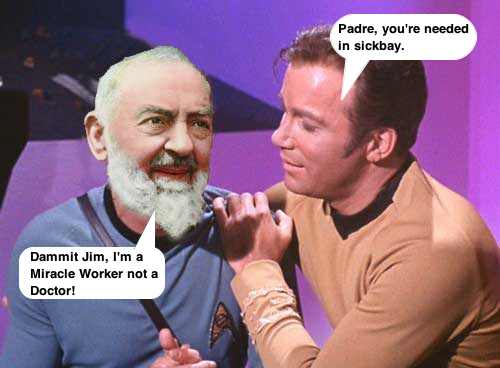


With the recent reboot of J.J. Abrams’ Star Trek based on an alternate time line.
Cosmos-Liturgy-Sex shows something quite interesting in that “States With Funded “Abstinence Only Education” Show Significantly Less Teen Abortions“
Though I a sure opponents of abstinence education would just shout back “Bristol Palin!”
From Fr. Robert Barron’s, “Word on Fire”, excerpt:
Fr. Theodore Hesburgh, the legendary retired President of Notre Dame, was mentioned several times in President Obama’s speech as a model of the dialogue and openness to conversation that he was extolling. Does anyone think for a moment that Fr. Hesburgh, at the height of the civil rights movement, would have invited, say, George Wallace to be the commencement speaker and recipient of an honorary degree at Notre Dame? Does anyone think that Fr. Hesburgh would have been open to a dialogue with Wallace about the merits of his unambiguously racist policies? For that matter, does anyone think that Dr. Martin Luther King would have sought out common ground with Wallace or Bull Connor in the hopes of hammering out a compromise on this pesky question of civil rights for blacks? The questions answer themselves.
Then why in the world does anyone think that we should be less resolute in regard to the heinous practice of abortion which, since 1973, has taken the lives of 43 million children? Why does anyone think that further dialogue and conversation on this score is a good idea? I think those questions answer themselves too
This comparison has been made before but Fr. Barron puts it quite effectively. The culture at one time accepted slavery for the most part. The same happened in the case of the evil of racism and segregation. The consensus changed over time largely due to the efforts of the abolitionists. Anybody who made arguments for slavery or racism now would be properly ostracized for holding such an evil view regardless of their other views. Hopefully one day the same will be true of abortion and that people will look back and wonder how people could have supported such an evil.
The reality now though is that in regards to abortion the culture is very similar to when racism was much more accepted. We are still in the phase when this evil is accepted as something viable to believe in. There was no real common ground between the slave owner and the slave and the same is true for the abortion supporter and the innocent child in the womb. The child being murdered will not be mollified that somehow abortions are somehow suppose to be reduced. When the scalpel, chemical, or suction machine comes to end their life the idea that some government program will make things better will not take away the pain they feel as they are murdered.
It was an unreality when people pretended that a fellow human person could be treated as property or seen as less human or worthy as others. We live in another unreality where human persons are treated as property of the mother and/or looked at as less human or worthy of life.
When people call themselves Catholics and then engage in Obamagetics to justify his support of murdering the innocent they are prostituting themselves to Moloch. They have accepted government funded pottage and forfeited the birth right of others. These modern Esau’s think they have made out on the deal, but they are no less foolish and even worse they provide cover for intrinsic evil.
Funny how it has been the Democratic Party that has been on the wrong side of history so often. Gov. Wallace and Bull Connor were of course Democrats and it was Democrats like Al Gore’s father who tried to defeat the Civil Rights act which was approved larger percent of Republicans (69% of Democrats & 82% of Republicans). People made excuses for them as now just as we have the torture apologists in the Republican party.
It has been the Catholic Church that has been on the right side of moral history. Centuries before the consciences of many saw the evil of slavery the Church had already condemned it and placed excommunications on those involved. In the United States segregation really first saw it’s decline among Catholics in their educational institutions before it became a national issue. At times Catholic supporters of segregation were excommunicated. The same is true in regards to abortion and Jesus through his Church is once again standing up to a culture that would dehumanize others.
The evil of abortion has been helped along by Catholics who are willing to make excuses for their favored candidates instead of condemning the evil they support in the strongest terms. Way too often with Catholics who call themselves both pro-life and Democrat there is always a “but” coming or some relativistic comparison of intrinsic evils with areas that Catholics can prudentially disagree on. What should happen with pro-abortion Democratic politicians is that they should get as little traction as pro-abortion Republican Rudy Giuliani. But Catholics of any political stripe are too often willing to turn a blind eye when it suits them. I say the Hell with any political party that would help me to earn a millstone as hat ware. I will go all Don Quixote pointing at polling booths before I cast a vote for a politician who supports the murder of innocents. Sure voting to choose the lesser evil is an acceptable choice, but you better know what evil is in the first place and to let the Church be your guide in discernment.
I would also like to point out this excellent response to Fr. James Martin S.J. by Carl Olson.
I can almost be happy for the existence of progressive Catholic periodicals since they supply fodder for the master fisker Dale Price.
This time he takes aim at a piece in America Magazine – Seinfeldian Catholicism
I don’t know that it’s much different. That’s part of what led to my conversion is the first time we [he and Callista] went to St. Peter’s together. It’s St. Peter’s. I mean, you stand there and you think, this is where St. Peter was crucified. This is where Paul preached. You think to yourself, two thousand years ago the apostles set out to create a worldwide movement by witnessing to the historic truth they had experienced. And there it is. The last time we were there we were allowed to walk in the papal gardens and you get this sense that is almost mystical.
The moment that finally convinced me [to convert] was when Benedict XVI came here [to the United States] and Callista in the church choir sang for him at the vespers service and all the bishops in the country were there. As a spouse, I got to sit in the upper church and I very briefly saw [Benedict] and I was just struck with how happy he was and how fundamentally different he was from the news media’s portrait of him. This guy’s not a Rottweiler. He’s a very loving, engaged, happy person.
I’d first seen Pope John Paul II when he came to the U.S. when Carter was president and I was a freshman congressman. And I [later] met him as Speaker.
The other sense is that the church has had two of its most powerful popes back to back, in their intellectual ability to engage the secular world on behalf of Christ. And the weight of all that, and going with [Callista] to church every Sunday to the Basilica [in Washington, D.C.], a magnificent church with a wonderful mass. In that sense I felt differently a long time ago, which is why I converted.
And part of me is inherently medieval. I resonate to Gothic churches and the sense of the cross in a way that is really pre-modern.
…The whole effort to create a ruthless, amoral, situational ethics culture has probably driven me toward a more overt Christianity. I’ll give you an example. As a college student at Emory when the Supreme Court ruled that school prayer was unconstitutional [in 1963] after 170 years of American history, I didn’t notice it. As a graduate student at Tulane I probably would have said it’s a good decision.
I’ve now had an additional 40 years to think about it. And I think about the world of my grandchildren. I don’t think American children are healthier, safer, and better off today than they were in 1963. So I have actually become more conservative in response to the failure of the liberal ethos to solve problems.[reference]
From the Jesuit run University of Seattle.
The Institute of Public Service invites you to join a thoughtful conversation about how people of different faiths and backgrounds perceive reproductive justice. The discussion will take place from 6 to 8 p.m. on Thursday, May 21, in Bannan Auditorium (room 102).
Panelists:
Vincent Lachina- state chaplain, Planned Parenthood
Amy Johnson- professional life and parent coach, UCC
Yohanna Kinberg- rabbi, Temple B’nai Torah
Dan Dombrowski- professor of philosophy, College of Arts and Sciences
Jodi O’Brien- professor and chair of sociology, College of Arts and Sciences.
“…The decisions we make about our reproductive and sexual lives, but most especially, the decision to have a child, are among the most important decisions that we, as human beings, can make. Having a child is a precious responsibility that changes our lives forever. The privileged in this world, for the most part, have unfettered access to the reproductive health and education services to decide for themselves when and whether to bear or raise a child. The poor and disadvantaged do not. Thus, the struggle for reproductive justice is inextricably bound up with the effort to secure a more just society. Accordingly, those who would labor to achieve economic and social justice are called upon to join in the effort to achieve reproductive justice and, thereby, help realize the sacred vision of a truly just society for all.”
– Clergymen for Reproductive Justice
It will not surprise you that the “thoughtful conversation” to be held on “reproductive justice” at a Catholic university is composed entirely of pro-abortion speakers.
Hat Tip Dawn Eden
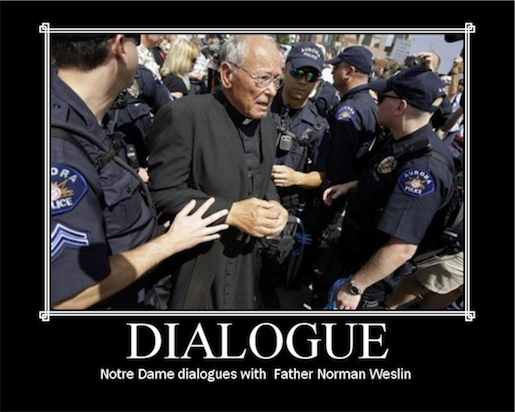
During his interview, Bishop Finn also said, “Dialogue is a means to an end. The purpose of dialogue has to be a change of heart. If I listen well and we each speak the truth, then the dialogue may have a chance of being productive. But I have to have some authentic principled goal in mind… Dialogue is important, but the question is fairly raised, ‘May we negotiate about things that are intrinsic evils?’ and I think the answer is no.” [reference]
You might have heard about some mention of some event that happened yesterday at Notre Dame. I know it has hardly been covered at all, but I thought I would weight in anyway.
After the small talk about the graduating class and going into the threat of “climate change.”
Unfortunately, finding that common ground — recognizing that our fates are tied up, as Dr. King said, in a “single garment of destiny” — is not easy. Part of the problem, of course, lies in the imperfections of man — our selfishness, our pride, our stubbornness, our acquisitiveness, our insecurities, our egos; all the cruelties large and small that those of us in the Christian tradition understand to be rooted in original sin. We too often seek advantage over others. We cling to outworn prejudice and fear those who are unfamiliar. Too many of us view life only through the lens of immediate self-interest and crass materialism; in which the world is necessarily a zero-sum game. The strong too often dominate the weak, and too many of those with wealth and with power find all manner of justification for their own privilege in the face of poverty and injustice. And so, for all our technology and scientific advances, we see around the globe violence and want and strife that would seem sadly familiar to those in ancient times.
Well there is certainly some truth in what he says here. Though he is quite supportive of the strong dominating the weak when it comes to abortion.
Nowhere do these questions come up more powerfully than on the issue of abortion.
As I considered the controversy surrounding my visit here, I was reminded of an encounter I had during my Senate campaign, one that I describe in a book I wrote called The Audacity of Hope. A few days after I won the Democratic nomination, I received an email from a doctor who told me that while he voted for me in the primary, he had a serious concern that might prevent him from voting for me in the general election. He described himself as a Christian who was strongly pro-life, but that’s not what was preventing him from voting for me.
What bothered the doctor was an entry that my campaign staff had posted on my website – an entry that said I would fight “right-wing ideologues who want to take away a woman’s right to choose.” The doctor said that he had assumed I was a reasonable person, but that if I truly believed that every pro-life individual was simply an ideologue who wanted to inflict suffering on women, then I was not very reasonable. He wrote, “I do not ask at this point that you oppose abortion, only that you speak about this issue in fair-minded words.”
Fair-minded words.
After I read the doctor’s letter, I wrote back to him and thanked him. I didn’t change my position, but I did tell my staff to change the words on my website. And I said a prayer that night that I might extend the same presumption of good faith to others that the doctor had extended to me. Because when we do that — when we open our hearts and our minds to those who may not think like we do or believe what we do — that’s when we discover at least the possibility of common ground.
The fact that he thought this was significant gives a good look into his thoughts. He actually considers only toning down the rhetoric as significant. He thought this was an important example to give. Why? He has created an administration staffed with people who believe exactly this – that anybody who opposes abortion is a “right-wing ideologue.” His homeland security issued a report that was suppose to be kept from the public that categorized pro-lifers as a threat. So sanitizing his website achieves exactly nothing. The people associated with him believe this including of course the person who wrote the sentence in the first place. The problem is not with the piece of rhetoric that slipped though, but the overwhelming number of people in his administration that believes exactly this.
The whole email exchange also strikes me as odd. A pro-lifer was willing to vote for Obama knowing his position, but yet was upset by a sentence on his web site. What the Hell? So his support of killing children in the womb was not the problem, but a sentence was?
That’s when we begin to say, “Maybe we won’t agree on abortion, but we can still agree that this is a heart-wrenching decision for any woman to make, with both moral and spiritual dimensions.
Yes we have heard him use this before. How can it be heart-wrenching if according to him it is a perfectly find option. During the campaign he said this was
“above his paygrade”, yet his actions show he sees abortion as a right and not immoral. What he says is just totally empty and it pretends to take abortion seriously and to admit something to pro-lifers without him meaning any of it.
So let’s work together to reduce the number of women seeking abortions by reducing unintended pregnancies, and making adoption more available, and providing care and support for women who do carry their child to term. Let’s honor the conscience of those who disagree with abortion, and draft a sensible conscience clause, and make sure that all of our health care policies are grounded in clear ethics and sound science, as well as respect for the equality of women.”
As pro-lifers often ask “why reduce it if there is nothing wrong with it?” We will just have to wait to see if he is serious about the conscience clause that his administration has been working to strike. Personally I don’t believe a word of what he says here. Especially when he uses the “equality of women” argument as if women can only be equal if they can’t abort their children.
Understand – I do not suggest that the debate surrounding abortion can or should go away. No matter how much we may want to fudge it – indeed, while we know that the views of most Americans on the subject are complex and even contradictory – the fact is that at some level, the views of the two camps are irreconcilable. Each side will continue to make its case to the public with passion and conviction. But surely we can do so without reducing those with differing views to caricature.
Agreed to some extent. There is no real common ground between those who would murder the innocent and those who would prevent it. The debate certainly should be done without caricature and personal attacks. But again considering his nominees and some of the outrageous things they have said in regard to the pro-life movement I guess he is only personally against “caricature”
At the time, Cardinal Joseph Bernardin was the Archbishop of Chicago. For those of you too young to have known him, he was a kind and good and wise man. A saintly man. I can still remember him speaking at one of the first organizing meetings I attended on the South Side. He stood as both a lighthouse and a crossroads – unafraid to speak his mind on moral issues ranging from poverty, AIDS, and abortion to the death penalty and nuclear war. And yet, he was congenial and gentle in his persuasion, always trying to bring people together; always trying to find common ground. Just before he died, a reporter asked Cardinal Bernardin about this approach to his ministry. And he said, “You can’t really get on with preaching the Gospel until you’ve touched minds and hearts.”
HIs reference to Cardinal Bernadin is full of irony considering the Notre Dame scandal. In 1996 the Cardinal turned down an invitation to speak at the Democratic convention because of the party’s pro-abortion stand. Rather contrasts Fr. Jenkins in this regard. The Cardinal saw speaking at the Democratic Convention was not creating common ground, but giving scandal.
One thing this whole scandalous situation reveals was the divide among Catholics. We could almost cue Sen. Edward’s two Americas speech. The “progressive” Catholic commentators and periodicals were solidly in favor of Obama’s invite. This only gives me more proof that they only give lip service to being pro-life. They are willing to sacrifice the unborn just as long as the government programs they like are created. The fact that they can’t understand the scandal that was given shows how little they value the life of those slaughtered with government permissions. When President Obama recently pushed for taxpayer funding of abortion in Washington D.C. I saw this pass without comment in the progressive periodicals. Every day gives more proof that this is an administration that will increase not reduce abortion and yet the usual suspects go on as if nothing is wrong.
We will just have to wait until next year for who Notre Dame decides is an appropriate commencement speaker. Please no politicians of any stripe. There are plenty of great Catholics living their faith that would be far better for this.
Well remember Fr. Jenkins is all about dialogue.
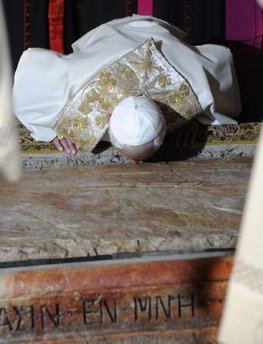
In move reminiscent of Jack Palance performing one-armed push-ups at the Academy Awards to show his physical prowess, the 82 years old Pope today dropped and did 33 push-up at the Tomb of the Holy Sepulchre as a tribute to Jesus.
Gary Macy, a professor of theology at Jesuit-run Santa Clara University, told attendees at a Monday night lecture at the Vanderbilt University Divinity School in Nashville, Tennessee, there is little room for historical doubt that women were ordained in the Catholic Church until about the end of the 12th century.
Macy’s lecture, entitled “A Higher Calling for Women? Historical Perspectives in the Catholic Church,” was given at Benton Chapel on the Vanderbilt campus. The university’s news service described the lecture this way: “The very idea of the ordination of women in the Roman Catholic Church is dismissed by many as contrary to basic church doctrine. Gary Macy, the John Nobili, S.J. Professor of Theology at Santa Clara University, says historical evidence is overwhelming that for much of the church’s history, the ordination of women was a fact.”
Macy has held his post at Santa Clara University since September 2007. Before that, he taught at the University of San Diego for 29 years. “During his years in San Diego, Dr. Macy published several books and over twenty articles on the theology and history of the Eucharist and on women’s ordination,” says the Santa Clara University web site. Among his books is The Hidden History of Women’s Ordination, published in 2007.
According to Macy, until about the mid-12th century, women were ordained as deaconesses, served as bishops, distributed Communion and even heard confessions. “Women were considered to be as ordained as any man… they were considered clergy,” he said. [reference]
And of course we remember some of the writings of those women priests/bishops and the historical record retains plenty of their names. This is why supporters of women’s ordination bring up plenty of facts about specific women priests and bishops. Oh wait. I do wonder about how somebody convinces themselves that this is true and then teaches it as certainty. People though can convince themselves of anything if they want it to be true.
In the past the women’s ordination movement has tried to say that a statue portrays a women bishop when in fact it is a statue of of mother of a bishop. They make this claim because this is pretty much all they have. If the historical record supported the claims of this professor at a Jesuit institution they would have been touting it for quite a while.
The idea that this was a common practice and then changed in the 12 century has a Dan Brown ring to it. This is just kind of nutty. If true we would certainly have seen some documentation about the problem this would have caused. If in the 12th century all of a sudden they said that women’s ordination was not allowed than you would have major problems with the result of priests and bishops ordained by these so-called women bishops and there would have been a lot of turmoil concerning the validity of some lines of bishops. Strangely May mentions this problem as a “theological dilemma.” Of course such a controversy does not exist in the historical record. So much for overwhelming evidence.
In fact the historical record shows something quite different. There were cases of break off heretical groups that did ordain women and there was comments about this by some of the early Church Fathers. There are also plenty of historical records and results of councils concerning deaconesses and the fact that they are not ordained.
Council of Nicaea I
Similarly, in regard to the deaconesses, as with all who are enrolled in the register, the same procedure is to be observed. We have made mention of the deaconesses, who have been enrolled in.this position although, not having been in any way ordained, they are certainly to be numbered among the laity (canon 19 [A.D. 325]).
Council of Laodicea
[T]he so-called “presbyteresses” or “presidentesses” are not to be ordained in the Church (canon 11 [A.D. 360]).
Epiphanius
It is true that in the Church there is an order of deaconesses, but not for being a priestess nor for any kind of work of administration, but for the sake of the dignity of the female sex, either at the time of baptism or of examining the sick or suffering, so that the naked body of a female may not be seen by men administering sacred rites, but by the deaconess (ibid.).
The Apostolic Constitutions (400 AD)
A widow is not ordained; yet if she has lost her husband a great while and has lived soberly and unblamably and has taken extraordinary care of her family, as Judith and Annaóthose women of great reputationólet her be chosen into the order of widows (ibid., 8:25).
A deaconess does not bless, but neither does she perform anything else that is done by presbyters [priests] and deacons, but she guards the doors and greatly assists the presbyters, for the sake of decorum, when they are baptizing women (ibid., 8:28).
Gary Macy ends the article with the parting shot used by so many dissidents.
“The Holy Spirit is alive and well,” said Macy. “And what She wants, She gets.