
The Curt Jester
  • Home
  • About
  • Rome Depot
  • WikiCatechism
  • Free Catholic eBooks
  • Home
  • About
  • Rome Depot
  • WikiCatechism
  • Free Catholic eBooks

The Curt Jester

"It is the test of a good religion whether you can joke about it." GKC

A Pilgrimage to Rome
Other

A Pilgrimage to Rome

by Jeffrey Miller November 20, 2023November 20, 2023
written by Jeffrey Miller

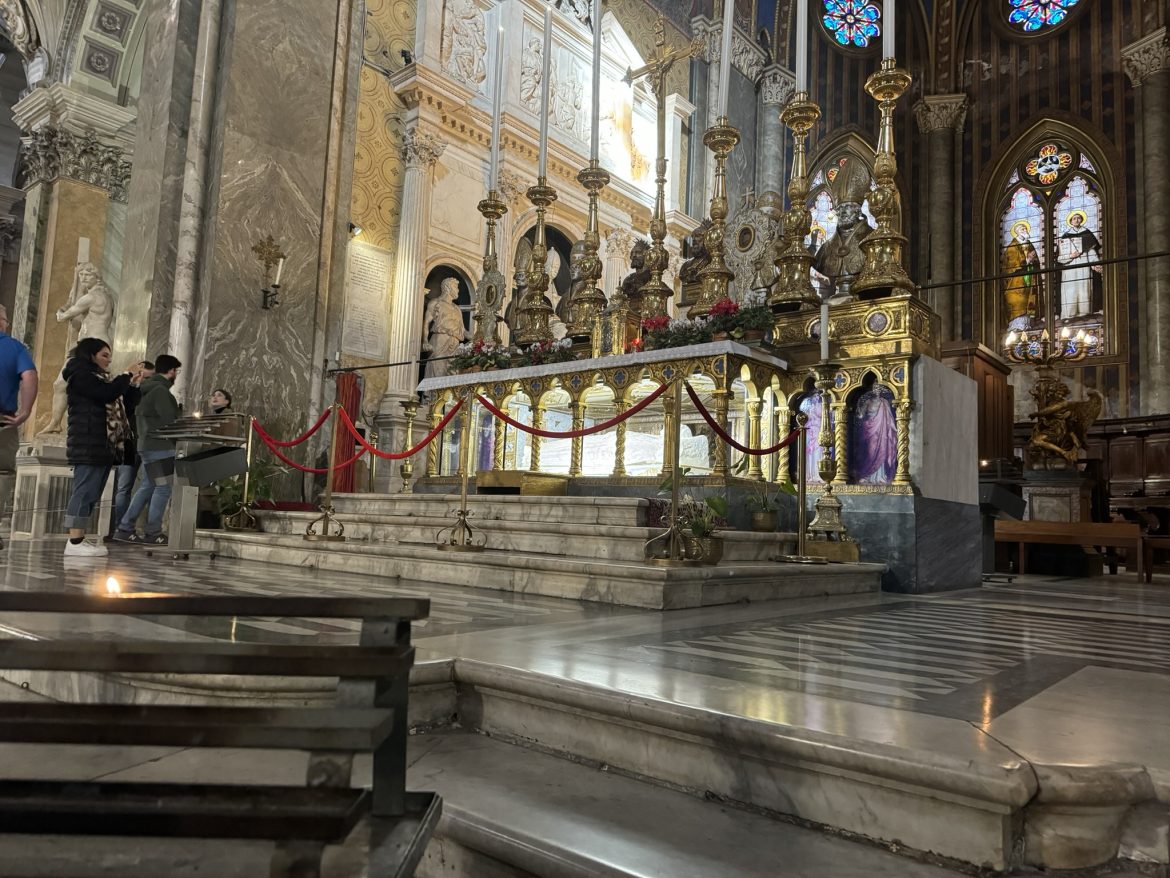
Some months ago, I had heard Catholic Answers mention an upcoming pilgrimage to Rome. I figured this would be a wonderful opportunity to visit there. When I was in the Navy, I had visited various ports in Italy, but never made it to Rome. I would have been interested in the ancient ambiance of Rome, but not the churches there at all. Being an admitted Catholic Answers fan-boy, the thought of going on pilgrimage with Chris Check, Cy Kellitt, and Joe Heschmeyer, along with fellow CA fans, was quite enticing.

Having recently returned from this pilgrimage, it exceeded my high expectations and hopes. I like the idea of travelling, but don’t enjoy having to plan everything out such as what to visit and the scheduling involved.

Their itinerary and destinations impressed me with their careful planning. It’s important to strike a delicate balance between visiting well-known churches and ones that are less popular but still significant. There was a lot of walking involved, along with taking a group bus to some destinations. The Hotel Forum, where we stayed, had an ideal central location adjacent to the Roman Forum. The beauty and atmosphere of this hotel added to the experience.

When I had first seen the itinerary, I did not realize that we would have mass each day as a group at the side chapels of the churches visited. Somehow, I imagined we would attend the parish masses. Obviously, I had not thought about this deeply since many of these locations were not parishes. It was a pleasant surprise to hear Mass as a group in so many beautiful side chapels. We were there, not just to wonder at the beauty and to absorb the history of these churches, but to pray and worship God.

In part, this is easier said than done. So much of what I saw was overwhelming, with so much to absorb. I tended towards gawking at first with feeble attempts at prayer while doing so. It took me a couple of days to have some balance and not to waste this opportunity for prayer. Even if it was the distracted prayer, part and parcel of the human condition. I found the awe-inspiring beauty would almost shame me into prayer.

The historic aspects of what I was seeing were also daunting, I have a tendency to atomize history as a collection of facts, not usually coherent with other collections of facts that occurred around the same time. What I had read about the history of the Church and Western Civilization had no real concreteness in my mind, it was just data. Seeing this in person anchored me more into this history. Witnessing the various relics and bodies of the saints brought this home to me even more.

Some years ago, I had seen a picture of the reliquary with the skull of one of the St. Valentine’s. I would tongue-in-cheek post this on social media with the caption “Happy Valentine’s Day!” Seeing this reliquary in person on a side altar was another story. That this is something real and not just a piece of history or a character from a story. I would experience and repeat this reaction multiple times on this pilgrimage. For example, when visiting the Necropolis with the bones of St. Peter under the Vatican Basilica. I knew in some detail the intricate story of the finding of these bones during the reign of Pius XII, but going on the Scavi tour connected me to the start of the Church that just book-reading could not do.

I will also only briefly touch on the masterpieces of art that we saw and how seeing them in the context of their surroundings is so different than seeing them in a coffee table book. I was not prepared to see Gian Lorenzo Bernini’s “Ecstasy of Saint Teresa” in person. We had just had mass in the same church it is in when we walked over to see it. I had seen representations of this statue in so many Carmelite books, but I was kind of in a daze, seeing it in person. This presentation of the transverberation is so striking (pun intended as always).

I am trying to give only general impressions here and not to describe every church we visited and the impact they all had on me and the various levels of reaction I had. This was a pilgrimage primarily ordered towards visiting the churches of Rome and not the various major tourists sights. We walked by some of these and they were discussed, such as the Colosseum (really amphitheater, as Chris Check would remind us.) The organizers designed the pilgrimage with enough time to visit such sights as we desired.

I have nothing but acclaim for the staff of Catholic Answers and the work they did to set this up. Most days, as part of the package, we would all eat together for lunch or dinner with other meals on our own. Although many of us would also group for these meals. I expected I would enjoy meeting and conversing with other people on this pilgrimage. Those whose lives were changed for the good because of the mission of Catholic Answers. I heard a lot of significant stories regarding how CA affected them and their families. This was such an important part of the pilgrimage as we got to know each other. The conversations were both good and knowledgeable. These are people well-aware of the challenges facing the Church who are also aware of the joy of being a disciple of Christ. There were serious conversations, but not rants.

In day-to-day life, I am rather isolated. I work from home and my daily visits to my parish usually involve very little conversation. To discuss church history, theology, philosophy, etc, is quite the treat for me. Finding the various depths of knowledge among them was a delight. Although, my self-ego reaction is subsequently wanting to study more since my areas of knowledge are often only skin-deep. Seriously, I would pay to go on a pilgrimage just to be with such people. I suspected I would really enjoy being able to spend some time with Joe Heschmeyer, despite his being funnier and smarter than me. I could easily be a Heschmeyer-groupie (hopefully not in a cringe way).

In short, if you ever can go on a Catholic Answers pilgrimage, I would fully suggest you do, especially their Rome pilgrimage. Chris Check has so much insight on the history of Rome and the churches we visited. I also have a lot of praise for our tour director Angela, which CA had requested because of their previous experience with her professionalism. Also our guide, Elena, who was a hoot!

I wish I was a skilled enough writer to convey what I experienced, the group comradery, and how well thought-out and executed this pilgrimage was.

One last note. From the stories I heard from others, it is a salutary reminder that evangelization and helping others in the joy of finding Jesus in the fullness of the Church is something we all take part in.

November 20, 2023November 20, 2023 1 comment
0 FacebookTwitterGoogle +Pinterest
The Weekly Francis

The Weekly Francis – Volume 483

by Jeffrey Miller November 8, 2023November 8, 2023
written by Jeffrey Miller
pope-francis2-300x187

The Weekly Francis is a compilation of the Holy Father’s writings, speeches, etc., which I also cross-post on Jimmy Akin’s blog.

This version of The Weekly Francis covers material released in the last week, from 2 November 2023 to 8 November 2023.

Angelus

  • 5 November 2023 – Angelus

General Audiences

  • 8 November 2023 – General Audience – Cycle of catechesis. The passion for evangelization’ the apostolic zeal of the believer. 25. Madeleine Delbrêl. The joy of faith among non-believers

Homilies

  • 2 November 2023 – Commemoration of all the faithful departed (Rome War Cemetery)
  • 3 November 2023 – Eucharistic Celebration in memory of the late Supreme Pontiff Benedict XVI, and the Cardinals and Bishops deceased during the year

Speeches

  • 4 November 2023 – To the participants in the meeting organized by the Catholic Charismatic Renewal International Service (CHARIS)
  • 6 November 2023 – To a Delegation of the Conference of European Rabbis

Papal Instagram

  • Franciscus
November 8, 2023November 8, 2023 0 comment
0 FacebookTwitterGoogle +Pinterest
Punditry

The Weekly Francis – Volume 481

by Jeffrey Miller October 19, 2023October 19, 2023
written by Jeffrey Miller
pope-francis2-300x187

The Weekly Francis is a compilation of the Holy Father’s writings, speeches, etc., which I also cross-post on Jimmy Akin’s blog.

This version of The Weekly Francis covers material released in the last week, from 19 September 2023 to 18 October 2023.

Angelus

  • 15 October 2023 – Angelus

Apostolic Exhortations

  • 15 October 2023 – ‘C’est la confiance’’ Apostolic Exhortation of the Holy Father on confidence in the merciful love of God for the 150th anniversary of the birth of Saint Teresa of the Child Jesus and the Holy Face (15

General Audiences

  • 18 October 2023 – General Audience – Catechesis. The passion for evangelization’ the apostolic zeal of the believer. 23. Saint Charles de Foucauld, the beating heart of charity in the hidden life

Messages

  • 19 September 2023 – Message of the Holy Father to the participants in the Leadership Summit of the Collegio San Carlo in Milan [Milan, 13–14 October 2023]
  • 21 September 2023 – Message of the Holy Father to mark the bicentenary of the death of the Servant of God Pius VII
  • 6 October 2023 – Message of the Holy Father to the participants in the Coldiretti Villagge
  • 16 October 2023 – Message for World Food Day 2023

Speeches

  • 14 October 2023 – To participants in the conference promoted by the Missionaries of San Carlo (Scalabrinians)

Papal Instagram

  • Franciscus
October 19, 2023October 19, 2023 0 comment
0 FacebookTwitterGoogle +Pinterest
The Weekly Francis

The Weekly Francis – Volume 480

by Jeffrey Miller October 12, 2023
written by Jeffrey Miller
pope-francis2-300x187

The Weekly Francis is a compilation of the Holy Father’s writings, speeches, etc., which I also cross-post on Jimmy Akin’s blog.

This version of The Weekly Francis covers material released in the last week, from 2 October 2023 to 11 October 2023.

Angelus

  • 8 October 2023 – Angelus

General Audiences

  • 11 October 2023 – General Audience – Catechesis. The passion for evangelization’ the apostolic zeal of the believer. 22. Saint Josephine Bakhita’ witness of the transforming power of Christ’s forgive

Messages

  • 6 October 2023 – Message of the Holy Father to the participants in the Fourth Annual Meeting of ‘The Economy of Francesco’

Speeches

  • 2 October 2023 – To participants in the General Chapter of the Missionaries of the Sacred Hearts of Jesus and Mary
  • 2 October 2023 – To participants in the General Chapter of the Little Sisters of Jesus
  • 7 October 2023 – To the Members of the Brotherhood of Our Lady of Montserrat (Spain)

Papal Instagram

  • Franciscus
October 12, 2023 0 comment
0 FacebookTwitterGoogle +Pinterest
Punditry

The Weekly Francis – Volume 479

by Jeffrey Miller October 5, 2023October 5, 2023
written by Jeffrey Miller
pope-francis2-300x187

The Weekly Francis is a compilation of the Holy Father’s writings, speeches, etc., which I also cross-post on Jimmy Akin’s blog.

This version of The Weekly Francis covers material released in the last week, from 8 September 2023 to 4 October 2023.

Angelus

  • 1 October 2023 – Angelus, 1st October 2023

Apostolic Exhortations

  • 4 October 2023 – ‘Laudate Deum’’ Apostolic Exhortation to all people of good will on the climate crisis

Homilies

  • 30 September 2023 – Ecumenical prayer vigil
  • 30 September 2023 – Ordinary Public Consistory for the creation of new Cardinals
  • 4 October 2023 – Holy Mass with the new Cardinals and the College of Cardinals – Opening of the Ordinary General Assembly of the Synod of Bishops

Letters

  • 8 September 2023 – Letter of the Holy Father on the occasion of the adoption of the Agreement on the Status of the Resident Papal Representative and the Office of the Resident Papal Representative of the Holy See in Vie

Messages

  • 29 September 2023 – Message of the Holy Father for the International Day of Awareness of Food Loss and Waste
  • 1 October 2023 – Message of the Holy Father to mark the 180th anniversary of the founding of the Pontifical Society of the Holy Childhood (1st October 2023)

Speeches

  • 29 September 2023 – To the members of the ‘Familia da Esperança’ association
  • 4 October 2023 – Opening of the Works of the XVI Ordinary General Assembly of the Synod of Bishops

Papal Instagram

  • Franciscus
October 5, 2023October 5, 2023 0 comment
0 FacebookTwitterGoogle +Pinterest
The Weekly Francis

The Weekly Francis – Volume 478

by Jeffrey Miller September 28, 2023September 28, 2023
written by Jeffrey Miller

pope-francis2-300x187

The Weekly Francis is a compilation of the Holy Father’s writings, speeches, etc., which I also cross-post on Jimmy Akin’s blog.

This version of The Weekly Francis covers material released in the last week, from 24 August 2023 to 27 September 2023.

Angelus

  • 17 September 2023 – Angelus
  • 24 September 2023 – Angelus

General Audiences

  • 20 September 2023 – General Audience – Catechesis. The passion for evangelization’ the apostolic zeal of the believer. 21. Saint Daniel Comboni, apostole for Africa and a prophet of mission
  • 27 September 2023 – General Audience – The Apostolic Journey to Marseille for the ‘Rencontres Méditerranéennes’

Homilies

  • 23 September 2023 – Apostolic Journey to Marseille’ Holy Mass at the ‘Vélodrome Stadium’

Messages

  • 24 August 2023 – Message of the Holy Father to the participants in the Ecumenical Symposium in Pannonhalma Abbey, Hungary
  • 12 September 2023 – Message of the Holy Father to Cardinal Peter K.A. Turkson on the occasion of the Conference on Pacem in Terris, organized by the Academy of Social Sciences [19–20 September 2023]

Speeches

  • 15 September 2023 – To the Participants in the Fifth World Congress of Benedictine Oblates
  • 16 September 2023 – To the Participants in the ‘Christmas Contest’
  • 16 September 2023 – To the pilgrims from Korea
  • 16 September 2023 – To the members of the Carabinieri Corps
  • 18 September 2023 – Audience with employees of the Vatican Pharmacy, on the occasion of the 150th anniversary of its founding
  • 18 September 2023 – Address of the Holy Father Francis at the ‘Clinton Global Initiative 2023’ [New York, 18–19 September 2023]
  • 18 September 2023 – To participants in the meetings organized by the Rogationists of the Heart of Jesus and the Daughters of Divine Zeal
  • 22 September 2023 – Apostolic Journey to Marseille’ Greeting to journalists on the flight to Marseille
  • 22 September 2023 – Apostolic Journey to Marseille’ Marian Prayer with the Diocesan Clergy in the Basilica of ‘Notre Dame de la Garde’
  • 22 September 2023 – Apostolic Journey to Marseille’ Moment of Reflection with Religious Leaders near the Memorial dedicated to sailors and migrants lost at sea
  • 23 September 2023 – Apostolic Journey to Marseille’ Final Session of the ‘Rencontres Méditerranéennes’ at the ‘Palais du Pharo’
  • 23 September 2023 – Apostolic Journey to Marseille’ Press Conference on the return flight to Rome
  • 25 September 2023 – To the Delegation of the ‘Consejo Latinoamericano del Centro de Investigación y Formación para la Protección del Menor’ (Ceprome)

Papal Instagram

  • Franciscus
September 28, 2023September 28, 2023 0 comment
0 FacebookTwitterGoogle +Pinterest
HumorNews

Our Lady of the Rosary Catholic Church purchases former bank

by Jeffrey Miller September 18, 2023September 18, 2023
written by Jeffrey Miller

CHARLOTTESVILLE, Va. (WVIR) – One religious group in Crozet is taking a unique space and turning it into its own.

Our Lady of the Rosary Catholic Church is taking the former Bank of American in Crozet and transforming it into their new church home.

They recently placed a bid on the building and should be closing on it in the coming weeks.

“It’s a bank building, and so we’re gonna have a lot of work ahead of us to make it into a church… make it something recognizable as a church inside and out,” said Msgr. Tim Keeney. “We’re hoping that on the feast of Our Lady of the Rosary, which is Saturday, October 7, we potentially could have our first mass in here.”

The church says that they will make small renovations so that they can still meet there, while fixing the building. Source

This is a mission parish in Crozet, Virginia, which is currently meeting in a Baptist church.

I hope they keep some of the iconic bank aspects. For example, they could rename a consecrated strong room, the “Deus Vault.”

  • When a new parishioner registers, they get a toaster, or maybe an air fryer. Their advertisements could pun on friar.
  • The Offertory could be done by pneumatic tube [1]
  • Could advertise, meet Jesus ATM (At The Mass)
  • Deposit of faith

Bank aspects to not include.

  • Drive through Communion [2]
  • Offering car loans. Although an exception could be made for a Fiat.
  • Don’t advertise the homilies as having “little or no interest.”

  1. Idea suggested by a reader on my Facebook page.  ↩
  2. ibid  ↩
September 18, 2023September 18, 2023 0 comment
0 FacebookTwitterGoogle +Pinterest
My Reflection on Sunday’s Gospel # Matthew 18:21–35
Scripture

My Reflection on Sunday’s Gospel # Matthew 18:21–35

by Jeffrey Miller September 16, 2023
written by Jeffrey Miller

Matthew 18:21–35

21 Then Peter came up and said to him, “Lord, how often will my brother sin against me, and I forgive him? As many as seven times?” 22 Jesus said to him, “I do not say to you seven times, but seventy times seven.
23 “Therefore the kingdom of heaven may be compared to a king who wished to settle accounts with his servants. 24 When he began to settle, one was brought to him who owed him ten thousand talents. 25 And since he could not pay, his master ordered him to be sold, with his wife and children and all that he had, and payment to be made. 26 So the servant fell on his knees, imploring him, ‘Have patience with me, and I will pay you everything.’ 27 And out of pity for him, the master of that servant released him and forgave him the debt. 28 But when that same servant went out, he found one of his fellow servants who owed him a hundred denarii, and seizing him, he began to choke him, saying, ‘Pay what you owe.’ 29 So his fellow servant fell down and pleaded with him, ‘Have patience with me, and I will pay you.’ 30 He refused and went and put him in prison until he should pay the debt. 31 When his fellow servants saw what had taken place, they were greatly distressed, and they went and reported to their master all that had taken place. 32 Then his master summoned him and said to him, ‘You wicked servant! I forgave you all that debt because you pleaded with me. 33 And should not you have had mercy on your fellow servant, as I had mercy on you?’ 34 And in anger his master delivered him to the jailers, until he should pay all his debt. 35 So also my heavenly Father will do to every one of you, if you do not forgive your brother from your heart.”[1]


It might come across here that Peter is really trying to be magnanimous, but it falls short in contrast to God’s forgiveness of us. This should be something we can all relate to. That when we consciously try to give of ourselves that it often falls short of fully given of ourselves. This is even more true when we see such a dissimilarity between our giving of ourselves and what God has done for us. This might seem to be even more true when we accept it was grace given and then accepted that moved us to action first. Yet, this should move us towards thanksgiving and gratitude and not annoyance at our seeming feeble attempts to love our neighbor.

Jesus does not rebuff Peter for not thinking big enough, but through a parable, helps him to broaden his view and to get an inkling of how God forgives. Another aspect is that Peter’s statement is informed by scripture and he is trying to draw parallels from it.

For example, Brant Pitre notes:

And you can almost hear here an allusion to the Old Testament, which talks about the sevenfold vengeance of Cain in Genesis 4. So if you remember in Genesis 4, it tells the story of Cain slaying his brother and what God says is that “if anyone tries to take vengeance on Cain, vengeance shall be taken upon him sevenfold ❲or seven times as much❳.” So what Peter is presenting here is like an antithesis, an opposite. Instead of sevenfold vengeance of Cain in the Old Testament, it’s sevenfold forgiveness.[2]

St. Thomas Aquinas, in his commentary on Matthew, draws another parallel and quotes other Church Fathers:

It is as though He were to say: Till seven times belongs to weakness, but more belongs to malice. For that reason, he asks if he should forgive till seven times. Likewise, he knew that which is said in IV Kings 5, namely, that Eliseus commanded Naaman to wash himself seven times in the Jordan; for that reason, he thought that he should forgive seven times. Jesus saith to him: I say not to thee, till seven times; but till seventy times seven times. This seven times that He says can be taken in one way as by addition, so that the sense is not seven times, but seven times and seventy times. Or it can be taken as by multiplication, so that the sense is seven times seventy: and Jerome explains this passage in that way.

According to the first exposition, which is Augustine’s, it is given to be understood that we ought to pardon all, because Christ pardoned all sins.14 “Bearing with one another and forgiving one another, if any have a complaint against another. Even as the Lord hath forgiven you, so do you also” (Col. 3, 13). Or it can be said that the finite number stands for an infinite number, as in the Psalms, “The word which he commanded to a thousand generations” (104, 8).

According to Jerome, the explanation is the same; nevertheless, the meaning of the number is added. For, by seven,15 perfection is signified, and by a hundred, which is ten multiplied by ten, the Decalogue is signified. The first number that passes ten is eleven. And because by seven a totality is signified, for that reason, the totality of sins is signified; it is at though He were to say: Whatsoever sins your brother shall committed against you, forgive him. Hence, according to Jerome, it seems that He wishes to say, that a man can forgive more than he can offend.[3]

There is also the numerical significance of Jesus’ initial reply, as explained by John Bergsma:

I depart here from the translation used in the Mass. To me, “seventy times seven” seems to be the more accurate translation of the Greek. Furthermore, it is likely that the number is a symbolic allusion to a famous prophetic passage, Daniel 9:25, which decreed “seventy sevens” (my translation) of years from the time of Daniel to the coming of the Messiah.

Seventy times seven is four hundred and ninety. The number four hundred and ninety is ten times forty-nine, and forty-nine is the number of the Israelite Jubilee cycle (See Lev 25:8–9). In ancient Israel, on the fiftieth year after a cycle of forty-nine years, the nation observed a year of rest in which all debts were forgiven and all indentured servants set free (Lev 25:10).[4]

The parable Jesus gives is so rich and multi-layered. It would have been edifying as an example of God’s comprehensive and overwhelming forgiveness of us with just verses 18:23–28. This parable includes a shocking twist that after the unpayable debt of the servant is forgiven, the servant was not willing to do the same. For, a relatively small debt, he will resort to violence to retrieve the debt.

From the Catholic Commentary on Sacred Scripture on Matthew:

The king’s mercy stands in stark contrast to the servant’s harshness in the second scene. The forgiven servant demands that one of his fellow servants pay back a debt the NAB describes as a much smaller amount. Literally, this smaller debt is only one hundred denarii—about a hundred days’ wages, which is 600,000 times smaller than the first servant’s debt. Shockingly, the first servant uses violence to pressure his fellow servant, seizing him and starting to choke him.[5]

It outraged the master when told about the servant’s behavior .

And in anger his master delivered him to the jailers, until he should pay all his debt.[6]:

John Bergsma reflects on this:

I have usually understood the delivery over to the jailers/torturers “until he should pay back the whole debt” as a reference to hell, on the assumption that it is impossible to pay your debt when you are in jail, and thus you will never leave, just as hell is eternal.

Michael Barber, however, has made the intriguing observation that perhaps the phrase “until he should pay back the whole debt” is meant in earnest: eventually, the man will pay off his debt and be released. Michael points out several Rabbinic texts that indicate a Jewish belief in a place of temporary punishment. In light of such texts, another interpretive option becomes possible: the delivery of the man over to the jailers refers to purgatory.[7]

God’s forgiveness of us and our redemption is a central component of the Good News. Love seeks to forgive, to restore communion among persons, and anything that separates us. No surprise that this message in Jesus’ statement at the end of this Gospel paragraph reflects what is in the Our Father. Forgiveness is to be passed on and not stopping with us; where we treat it as something deserved and not shared.

Peter Kreeft, in his commentary on this passage, has many wise things to say on this, but I especially appreciated this:

The only path that leads somewhere, like a birth canal into new life, is forgiveness.[8]

Sources

Catholic Productions, Commentaries by Brant Pitre
The Word of the Lord: Reflections on the Sunday Mass Readings for Year A – John Bergsma
St. Thomas Aquinas, Commentary on the Gospel of St. Matthew
The Gospel of Matthew (Catholic Commentary on Sacred Scripture)
Peter Kreeft, Food for the Soul: Reflections on the Mass Readings Cycle A
English Standard Version Catholic Edition
– Photo by Ben White on Unsplash


  1. English Standard Version Catholic Edition (2019). Augustine Institute.  ↩
  2. Catholic Productions, Brant Pitre, 24th Sunday in Ordinary Time  ↩
  3. Commentary on the Gospel of St. Matthew, Dolorosa Press  ↩
  4. The Word of the Lord: Reflections on the Sunday Mass Readings for Year A, John Bergsma, 24th Sunday in Ordinary Time  ↩
  5. The Gospel of Matthew, Catholic Commentary on Sacred Scripture, Edward Sri and Curtis Mitch  ↩
  6. English Standard Version Catholic Edition (2019). Augustine Institute.  ↩
  7. The Word of the Lord: Reflections on the Sunday Mass Readings for Year A, John Bergsma, 24th Sunday in Ordinary Time  ↩
  8. Peter Kreeft, Food for the Soul: Reflections on the Mass Readings Cycle A  ↩
September 16, 2023 0 comment
0 FacebookTwitterGoogle +Pinterest
The Weekly Francis

The Weekly Francis – Volume 477

by Jeffrey Miller September 14, 2023September 14, 2023
written by Jeffrey Miller
pope-francis2-300x187

The Weekly Francis is a compilation of the Holy Father’s writings, speeches, etc., which I also cross-post on Jimmy Akin’s blog.

This version of The Weekly Francis covers material released in the last week, from 5 September 2023 to 14 September 2023.

Angelus

  • 10 September 2023 – Angelus

Apostolic Letter

  • 14 September 2023 – Decree appointing the Pontifical Delegate to the Pontifical Urbanian University in Rome

General Audiences

  • 13 September 2023 – General Audience – Catechesis. The passion for evangelization’ the apostolic zeal of the believer. 20. Blessed José Gregorio Hernández Cisneros, doctor of the poor and apostle of

Messages

  • 5 September 2023 – Message of the Holy Father to the participants in the International Prayer Meeting for Peace organised by the Community of Sant’Egidio [Berlin, 10–12 September 2023]
  • 8 September 2023 – Message of the Holy Father, signed by Cardinal Secretary of State Pietro Parolin, on the occasion of International Literacy Day

Speeches

  • 7 September 2023 – To the Members of the Italian Biblical Association
  • 9 September 2023 – To the Members of the Family Promotion Association ‘Incontro Matrimoniale’
  • 11 September 2023 – To His Holiness Baselios Marthoma Mathews III Catholicos of the East and Malankara Metropolitan of the Malankara Orthodox Syrian Church
  • 11 September 2023 – To the Italian National Association of Mutilated and Invalid Workers (ANMIL)
  • 14 September 2023 – To the Participants in the Twenty-sixth Pauline Ecumenical Colloquium

Papal Instagram

  • Franciscus
September 14, 2023September 14, 2023 0 comment
0 FacebookTwitterGoogle +Pinterest
My Reflection on Sunday’s Gospel Matthew 18:15–20
Scripture

My Reflection on Sunday’s Gospel Matthew 18:15–20

by Jeffrey Miller September 10, 2023September 9, 2023
written by Jeffrey Miller

Matthew 18:15–20

15 “If your brother sins against you, go and tell him his fault, between you and him alone. If he listens to you, you have gained your brother. 16 But if he does not listen, take one or two others along with you, that every charge may be established by the evidence of two or three witnesses. 17 If he refuses to listen to them, tell it to the church. And if he refuses to listen even to the church, let him be to you as a Gentile and a tax collector. 18 Truly, I say to you, whatever you bind on earth shall be bound in heaven, and whatever you loose on earth shall be loosed in heaven. 19 Again I say to you, if two of you agree on earth about anything they ask, it will be done for them by my Father in heaven. 20 For where two or three are gathered in my name, there am I among them.”[1]

It is simple to pull some general rules regarding those cases where we might need to rebuke our brother. It is important to understand the context of what is being said here, as Brant Pitre reminds us:

… it’s important to read this passage in light of the whole chapter. The whole chapter is a discourse of Jesus to his disciples. So he is speaking in particular to his students, to his disciples, to the men who have left their former lives behind and have become his followers, his students who travel with him every day to learn from him. He is speaking to the apostles in other words, and that’s clear if you look at the earlier verses in the Gospel of Matthew 18. So in Matthew 18:15, when Jesus says “if your brother sins against you,” he’s not talking about two siblings in a family. He’s talking about a brother within the community of his disciples. He is talking about conflicts between his followers, and in particular between the disciples themselves within the circle of the apostles. So whenever we read those words of his, what he’s describing then is a process of fraternal correction within the Church.[2]

You can see the ecclesial context here when you consider the wording “brother sins against you.” It is very specific about “against you” and not the broader of a brother sinning, but not against you personally. There is a sense where every sin is a sin against God and also a sin against the community. No sin is just in isolation, affecting only the person who missed the mark.

King David illustrates this here:

Against you, you only, have I sinned
and done what is evil in your sight,
so that you may be justified in your words
and blameless in your judgment. (Psalm 51:4)[3]

The Catechism broadens the point:

CCC §1868 Sin is a personal act. Moreover, we have a responsibility for the sins committed by others when we cooperate in them:

— by participating directly and voluntarily in them;
— by ordering, advising, praising, or approving them;
— by not disclosing or not hindering them when we have an obligation to do so;
— by protecting evil-doers.[4]

In these three steps there is a lot that is unsaid regarding how you decide to rebuke your brother in the first place. Prayer must be involved first and the questions to consider. Are you in the right, considering the sin you are condemning? When you rebuke someone, it’s important to consider your relationship with them and how likely they are to accept your criticism. But, prudence does not mean saying nothing because it will be uncomfortable to you.

St. Thomas Aquinas, in his commentary on this passage, writes:

If thy brother shall offend against thee, go, etc.; “With them that hated peace I was peaceable” (Ps. 119, 7). Should you forgive first? No; but first you ought to go and rebuke him: hence, He does not command us to forgive just anyone, but the repentant. Likewise, He says, Rebuke, not ‘scold’ or ‘exasperate’: and show the offense briefly. If he acknowledges his offense, you ought to forgive him; hence, it is said, “Instruct such a one in the spirit of meekness” (Gal. 6, 1).
…
But does a man sin who omits to make this correction? Augustine says: “If you do not correct, you become worse by keeping silence, than he became by sinning.”

But although this is true, because all are bound to correct, someone might say that it is only fitting for prelates who are bound by their office, but it is fitting for others out of charity. Sometimes, the Lord permits the good to be punished with the wicked. Why? It is because they did not correct the wicked. Nevertheless, Augustine says that sometimes we ought to refrain from correcting, “if you fear that they will not be emended by this correction, but will be made worse.” Likewise, if you fear to correct lest it lead to a persecution of the Church, you do not sin if you do not correct. If, however, you abstain from correcting lest you be harmed in temporal goods, lest trouble come upon you, or some such thing, you sin; “Rebuke a wise man, and he will love thee” (Prov. 9, 8).[5]

The order these principles are laid out in, have much wisdom. John Bergsma writes how often we get this order wrong:

This principle applies to all life within the Church. When offended, however, our tendency is first to go and tell all our friends and anyone else who will listen about how so-and-so did something outrageous to us. This spreads the circle of the offense while making no progress toward reconciliation. It also starts a cycle of gossip and escalating exaggeration.[6]

Some might read the consequence when they will not listen “even to the Church” as rather harsh. One thing to remember is that in Matthew, this paragraph is placed right after the parable of the lost sheep. The context is always to bring somebody who has strayed home. A medicinal recipe to use when all other efforts have failed and to ultimately bring healing.

I like what Dr. Brant Pitre says here in his commentary as he expands on this idea:

So when Jesus says “tell it to the church” here, he is referring to the assembly of believers, and not just to the assembly of believers, but in particular to the assembly of authoritative leaders of those believers, because you can see here what he says is “if he refuses to listen even to the church,” then what’s the penalty? “Let him be to you as a Gentile and a tax collector.” What does that mean? Well effectively what it means is you treat him as cut off from the community of disciples.

In fact, as some scholars have pointed out, if you say treat the person like a Gentile or a tax collector, there is both a negative and a positive dimension. The negative dimension is that that person is excommunicated, they are cut off from the Church, they are cut off from the body of believers. The positive dimension though is how do you treat gentiles and tax collectors? How did Jesus and the apostles treat them? Well they evangelized them, they shared the good news with them. So it doesn’t mean that person necessarily is permanently cut off, what it means is that they need to be evangelized again. They need the gospel to be re-presented to them so that they can be called to repentance and then re-integrated into the community. That would be a second implication of his use of the language of gentile and tax collector in this particular context. So there is both excommunication but also evangelization implied by these two expressions that Jesus uses for an impenitent or unrepentant sinner within the Church.[7]

The Gospel passage talks about the future role of the disciples in the Church. The Ignatius Catholic Study Bible summarises this:

18:18 whatever you bind … loose: In 16:19, Peter was invested with Christ’s authority as the visible head of the Church. A derivative—but subordinate—authority is given also to the apostles as royal ministers in the kingdom. Jesus’ authority in this context is related to Church discipline; by extension, it is also a sacramental authority to forgive sins (cf. Jn 20:23; CCC 553 ,CCC 1444).[8]

From there, Jesus teaches them more regarding the communal nature of the Church and again how Jesus is there with us always in the Body of Christ.

Peter Kreeft writes about the efficacy of prayer:

There’s no catch to it. Jesus means exactly what he says. Take him at his word. He says: “Ask and it will be given to you; seek and you will find; knock and the door will be opened to you. For everyone who asks, receives; and the one who seeks, finds; and to the one who knocks, the door will be opened” (Matt. 7:7–8). He promises to answer all our prayers, to satisfy all the desires of our hearts. He doesn’t promise how or when he will answer, because his way and his timing are much better and wiser than ours. He sometimes has to answer our shallow desires with a no to answer our deeper desires with a yes. And he sometimes has to take time to give us good things, because life is more like a farm, which takes time to grow crops, than like a machine, which gives you instant results from pushing a button. But he promises to answer every prayer of every faithful heart. And he infallibly keeps his promises. Our part is to believe and to wait in faith. We say, “Seeing is believing,” but Jesus says, “Believing is seeing.” We say we won’t believe it in our souls until we see it with our eyes, but Jesus says that if we believe it in our souls we will eventually see it with our eyes, because every good desire will be fulfilled eventually, if not in this world then in the next. That’s what he promises: “Everyone who asks, receives; and the one who seeks, finds; and to the one who knocks, the door will be opened.”[9]

We magnify prayer when we come to pray together in community, from a small to a larger group.

Sources

  • Catholic Productions, Commentaries by Brant Pitre
  • English Standard Version Catholic Edition
  • Catechism of the Catholic Church, 2nd Edition
  • St. Thomas Aquinas, Commentary on the Gospel of St. Matthew
  • The Word of the Lord: Reflections on the Sunday Mass Readings for Year A – John Bergsma
  • Peter Kreeft, Food for the Soul: Reflections on the Mass Readings Cycle A
  • The Ignatius Catholic Study Bible꞉ The New Testament
  • Photo by Ben White on Unsplash

  1. English Standard Version Catholic Edition (2019). Augustine Institute.  ↩
  2. Catholic Productions, Brant Pitre, 23rd Sunday in Ordinary Time  ↩
  3. English Standard Version Catholic Edition (2019). Augustine Institute.  ↩
  4. Catholic Church. (2000). Catechism of the Catholic Church (2nd Ed). United States Catholic Conference.  ↩
  5. Commentary on the Gospel of St. Matthew, Dolorosa Press  ↩
  6. The Word of the Lord: Reflections on the Sunday Mass Readings for Year A, John Bergsma, 23rd Sunday in Ordinary Time  ↩
  7. Catholic Productions, Brant Pitre, 23rd Sunday in Ordinary Time  ↩
  8. Ignatius Catholic Study Bible: New Testament  ↩
  9. Peter Kreeft, Food for the Soul: Reflections on the Mass Readings Cycle A,, 23rd Sunday in Ordinary Time  ↩
September 10, 2023September 9, 2023 0 comment
0 FacebookTwitterGoogle +Pinterest
Newer Posts
Older Posts

About Me

Jeff Miller is a former atheist who after spending forty years in the wilderness finds himself with both astonishment and joy a member of the Catholic Church. This award-winning blog presents my hopefully humorous and sometimes serious take on things religious, political, and whatever else crosses my mind.

Conversion story

  • Catholic Answers Magazine
  • Coming Home Network

Appearances on:

  • The Journey Home
  • Hands On Apologetics (YouTube)
  • Catholic RE.CON.

Blogging since July 2002

Recent Posts

  • A Litany of Gratitude

  • The Spiritual Life and Memes

  • What is your distance from Jesus on the Cross?

  • Feast of St. Thomas, Apostle

  • Gratitude and Generosity

  • “The Heart and Center of Catholicism”

  • Post-Lent Report

  • Stay in your lane

  • Echoing through creation

  • Another Heaven

  • My Year in Books – 2024 Edition

  • I Have a Confession to Make

  • A Mandatory Take

  • Everybody is ignorant

  • Sacramental Disposal, LLC

  • TL;DH (Too Long;Didn’t Hear)

  • A Shop Mark Would Like

  • The Narrow Way Through the Sacred Heart of Jesus

  • Time Travel and Fixing Up Our Past

  • The Weekly Leo

  • The Weekly Leo

  • The Weekly Leo

  • The Weekly Leo

  • The Weekly Leo

Meta

I also blog at Happy Catholic Bookshelf Entries RSS
Entries ATOM
Comments RSS
Email: curtjester@gmail.com

What I'm currently reading

Subscribe to The Curt Jester by Email

Endorsements

  • The Curt Jester: Disturbingly Funny --Mark Shea
  • EX-cellent blog --Jimmy Akin
  • One wag has even posted a list of the Top Ten signs that someone is in the grip of "motu-mania," -- John Allen Jr.
  • Brilliance abounds --Victor Lams
  • The Curt Jester is a blog of wise-ass musings on the media, politics, and things "Papist." The Revealer

Archives

About Me

Jeff Miller is a former atheist who after spending forty years in the wilderness finds himself with both astonishment and joy a member of the Catholic Church. This award winning blog presents my hopefully humorous and sometimes serious take on things religious, political, and whatever else crosses my mind.
My conversion story
  • The Curt Jester: Disturbingly Funny --Mark Shea
  • EX-cellent blog --Jimmy Akin
  • One wag has even posted a list of the Top Ten signs that someone is in the grip of "motu-mania," -- John Allen Jr.
  • Brilliance abounds --Victor Lams
  • The Curt Jester is a blog of wise-ass musings on the media, politics, and things "Papist." The Revealer

Meta

I also blog at Happy Catholic Bookshelf Twitter
Facebook
Entries RSS
Entries ATOM
Comments RSS 2.0" >RSS
Email: curtjester@gmail.com

What I'm currently reading

Subscribe to The Curt Jester by Email

Commercial Interuption

Podcasts

•Catholic Answers Live Subscribe to Podcast RSS
•Catholic Underground Subscribe to Podcast RSS
•Catholic Vitamins Subscribe to Podcast RSS
•EWTN (Multiple Podcasts) Subscribe to Podcast RSS
•Forgotten Classics Subscribe to Podcast RSS
•Kresta in the Afternoon Subscribe to Podcast RSS
•SQPN - Tons of great Catholic podcasts Subscribe to Podcast RSS
•The Catholic Hack Subscribe to Podcast RSS
•The Catholic Laboratory Subscribe to Podcast RSS
•The Catholics Next Door Subscribe to Podcast RSS
•What does the prayer really say? Subscribe to Podcast RSS

Archives

Catholic Sites

  • Big Pulpit
  • Capuchin Friars
  • Catholic Answers
  • Catholic Lane
  • Crisis Magazine
  • New Evangelizers
  • Waking Up Catholic

Ministerial Bloghood

  • A Jesuit’s Journey
  • A Shepherd’s Voice
  • Ad Majorem Dei Gloriam
  • Adam’s Ale
  • Archbishop Dolan
  • Bonfire of the Vanities
  • Cardinal Sean’s Blog
  • Da Mihi Animas
  • Domine, da mihi hanc aquam!
  • Father Joe
  • Fr. Roderick
  • Godzdogz
  • Laus Crucis
  • Omne Quod Spirat, Laudet Dominum
  • Orthometer
  • Priests for Life
  • Servant and Steward
  • Standing on My Head
  • The hermeneutic of continuity
  • This Week at Vatican II
  • Waiting in Joyful Hope
  • What Does The Prayer Really Say?

Bloghood of the Faithful

  • A Catholic Mom Climbing the Pillars
  • A Catholic Mom in Hawaii
  • A Long Island Catholic
  • A Wing And A Prayer
  • Acts of the Apostasy
  • Ad Altare Dei
  • AdoroTeDevote
  • Against the Grain
  • Aggie Catholics
  • Aliens in this world
  • Always Catholic
  • American Chesterton Society
  • American Papist
  • Among Women
  • And Sometimes Tea
  • Ask Sister Mary Martha
  • auntie joanna writes
  • Bad Catholic
  • Bethune Catholic
  • Big C Catholics
  • Bl. Thaddeus McCarthy's Catholic Heritage Association
  • Catholic and Enjoying It!
  • Catholic Answers Blog
  • Catholic Fire
  • Catholic New Media Roundup
  • Charlotte was Both
  • Christus Vincit
  • Confessions of a Hot Carmel Sundae
  • Cor ad cor loquitur
  • Courageous Priest
  • Creative Minority Report
  • CVSTOS FIDEI
  • Dads Called to Holiness
  • Darwin Catholic
  • Defend us in Battle
  • Defenders of the Catholic Faith
  • Disputations
  • Divine Life
  • Domenico Bettinelli Jr.
  • Dominican Idaho
  • Dyspectic Mutterings
  • Ecce Homo
  • Ecclesia Militans
  • Eve Tushnet
  • Eye of the Tiber
  • feminine-genius
  • Five Feet of Fury
  • Flying Stars
  • For The Greater Glory
  • Get Religion
  • GKC’s Favourite
  • God’s Wonderful Love
  • Gray Matters
  • Happy Catholic
  • Ignatius Insight Scoop
  • In Dwelling
  • In the Light of the Law
  • InForum Blog
  • Jeff Cavins
  • Jimmy Akin
  • John C. Wright
  • La Salette Journey
  • Laudem Gloriae
  • Lex Communis
  • Life is a Prayer
  • Man with Black Hat
  • Maria Lectrix
  • Mary Meets Dolly
  • MONIALES OP
  • Mulier Fortis
  • Musings of a Pertinacious Papist
  • My Domestic Church
  • Nunblog
  • Oblique House
  • Open wide the doors to Christ!
  • Over the Rhine and Into the Tiber
  • Patrick Madrid
  • Pro Ecclesia * Pro Familia * Pro Civitate
  • Recta Ratio
  • Saint Mary Magdalen
  • Sonitus Sanctus
  • Southern-Fried Catholicism
  • St. Conleth's Catholic Heritage Association
  • Stony Creek Digest
  • Testosterhome
  • The Ark and the Dove
  • The B-Movie Catechism
  • The Crescat
  • The Daily Eudemon
  • The Digital Hairshirt
  • The Four Pillars
  • The Inn at the End of the World
  • The Ironic Catholic
  • The Lady in the Pew
  • The Lion and the Cardinal
  • The New Liturgical Movement
  • The Pulp.it
  • The Sacred Page
  • The Sci Fi Catholic
  • The Scratching Post
  • The Weight of Glory
  • The Wired Catholic
  • Two Catholic Men and a Blog
  • Unam Sanctam Catholicam
  • Video meliora, proboque; Deteriora sequor
  • Vivificat
  • Facebook
  • Twitter
  • Instagram
  • Pinterest
  • Email
  • Reddit
  • RSS

@2026 - www.splendoroftruth.com/curtjester. All Right Reserved. Designed and Developed by PenciDesign


Back To Top