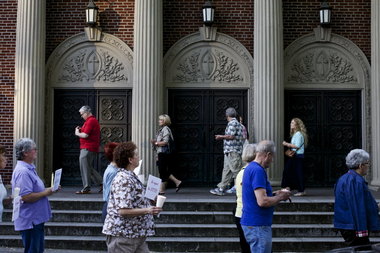
Cardinal Timothy Dolan discusses his decision to invite President Obama to the Al Smith fundraising dinner.
So, my correspondents ask, how can you justify inviting the President? Let me try to explain.
For one, an invitation to the Al Smith Dinner is not an award, or the provision of a platform to expound views at odds with the Church. It is an occasion of conversation; it is personal, not partisan.
Two, the purpose of the Al Smith Dinner is to show both our country and our Church at their best: people of faith gathered in an evening of friendship, civility, and patriotism, to help those in need, not to endorse either candidate. Those who started the dinner sixty-seven years ago believed that you can accomplish a lot more by inviting folks of different political loyalties to an uplifting evening, rather than in closing the door to them.
Three, the teaching of the Church, so radiant in the Second Vatican Council, is that the posture of the Church towards culture, society, and government is that of engagement and dialogue. In other words, it’s better to invite than to ignore, more effective to talk together than to yell from a distance, more productive to open a door than to shut one. Our recent popes have been examples of this principle, receiving dozens of leaders with whom on some points they have serious disagreements. Thus did our present Holy Father graciously receive our current President of the United States. And, in the current climate, we bishops have maintained that we are open to dialogue with the administration to try and resolve our differences. What message would I send if I refused to meet with the President?
Finally, an invitation to the Al Smith Dinner in no way indicates a slackening in our vigorous promotion of values we Catholic bishops believe to be at the heart of both gospel and American values, particularly the defense of human dignity, fragile life, and religious freedom. In fact, one could make the case that anyone attending the dinner, even the two candidates, would, by the vibrant solidarity of the evening, be reminded that America is at her finest when people, free to exercise their religion, assemble on behalf of poor women and their babies, born and unborn, in a spirit of civility and respect.
Some have told me the invitation is a scandal. That charge weighs on me, as it would on any person of faith, but especially a pastor, who longs to give good example, never bad. So, I apologize if I have given such scandal. I suppose it’s a case of prudential judgment: would I give more scandal by inviting the two candidates, or by not inviting them?
No matter what you might think of this particular decision, might I ask your prayers for me and my brother bishops and priests who are faced with making these decisions, so that we will be wise and faithful shepherds as God calls us to be?
In the end, I’m encouraged by the example of Jesus, who was blistered by his critics for dining with those some considered sinners; and by the recognition that, if I only sat down with people who agreed with me, and I with them, or with those who were saints, I’d be taking all my meals alone.
I can understand the Cardinal’s reasoning and can even agree with to some extent. This though is not simply eating with sinners, it is inviting somebody to a fundraiser for an organization that could be financially ruined by the HHS Mandate and put out of business and has been the most ardently pro-abortion President in history. Mainly what his eminence id not address was the fact that two previous Cardinals did indeed not invite Presidents or Presidential nominees because of their stands. Are these two Cardinals to then be criticized for not “eating with sinners”?
I still don’t agree with the decision (if it matters), but I applaud the Cardinal for addressing his reasons on his blog.