The Curt Jester
  • Home
  • About
  • Rome Depot
  • WikiCatechism
  • Free Catholic eBooks
  • Home
  • About
  • Rome Depot
  • WikiCatechism
  • Free Catholic eBooks

The Curt Jester

"It is the test of a good religion whether you can joke about it." GKC

Liturgy

Chatty and noisy worship

by Jeffrey Miller May 15, 2008
written by Jeffrey Miller

Archbishop Mark Coleridge of Canberra issued a letter on the liturgy for Pentecost Sunday as the Australian bishops began full implementation of the new General Instruction for the Roman Missal This is quite a wonderful letter and he touches on so many aspects on the Mass and how it is celebrated that I am totally in agreement with. I also really like the tone of the letter in while he is correcting some abuses and areas that need improvement in the celebration of the sacred liturgy he is mainly reflecting and teaching on the reform of the Mass and how it should be celebrated. [Via Overhead in the Sacristy]

The new version of General Instruction is one of a number of indications that the
Church is moving into a new phase of the ongoing journey of liturgical renewal, the roots of
which reach back to the Second Vatican Council and beyond. In earlier times, it seemed that
the process of liturgical renewal begun by the Council was complete. But that is not the case.
The journey of liturgical renewal, we can now see, is only in its early phases, and the
appearance of the General Instruction is one indication of this. Other still more important
indications will be the appearance in the not too distant future of the new translation of the
Roman Missal and the new translation of the Lectionary. Now is the time, the Spirit is saying
to the Church, to take stock of the liturgical renewal of the last forty years, to discern as
clearly as possible what has succeeded and what has failed, and to make adjustments in the
light of that discernment.

This means that all of us will have to be open to learn, and that is not always easy. Over
recent decades, liturgical habits have taken hold, some of which have been beneficial, others
detrimental to the celebration of the liturgy. It is never easy to break the hold of bad habits,
especially when we do not see them as bad. Openness to learn always involves humility, a
preparedness to recognise that I do not know all the answers. In the case of the liturgy, that
humility involves a preparedness to learn from the Church, to whom alone the liturgy
belongs; and in the new General Instruction and the new translations of the Missal and
Lectionary, it is the voice of the whole Church, the Bride of Christ, that we hear.

He then goes on and makes some general observations on several subjects.

Silence Our worship generally has become very chatty, to the point where one of the challenges
now is to allow silence to play its part in the liturgy. This might begin with our places of
worship. Where once our churches were places of silence for the sake of prayer in the
presence of the Blessed Sacrament, the custom has arisen in more recent years for people to
talk freely in the churches, certainly before and after Mass. The same is true of the sacristy:
where once silence was the rule (again for the sake of prayer and recollection) often now the
sacristy has become a noisy and distracting place. Once was too that the priest was expected
to pray the prescribed prayers as he vested for Mass, and this was one factor which
contributed to an air of silence in the sacristy. I wonder would it be possible to encourage an
air of silence or at least quiet in sacristies before Mass, and to make our churches places
where there is a silence which supports prayer. Of course there are times when one has to talk in a sacristy or a church, but it is a question of the prevailing atmosphere. In that sense, I am
speaking more about prayer than about silence for its own sake. …

On language:

The style of language used at Mass will change when the new translation of the Roman
Missal appears, perhaps late in 2009. It will be a more elevated and sacral idiom, which may
feel strange at first. But it is important to realise that the language of the liturgy was never
everyday language; it was always more elevated and even slightly old-fashioned. That is
because it is ritual language. For the celebrant to say at the start of Mass, Good morning,
everyone and for the people to reply Good morning, Father is everyday language which in
other contexts would be perfectly appropriate. But in the liturgical context it is out of place
because it misunderstands ritual and the language that it requires. It can suggest a casual or
informal approach to the liturgy which focuses more on the priest and the people than on their
common worship of God. Therefore, in this new phase of renewal, another thing we need to
understand better is the kind of idiom appropriate for worship.

He says perfectly why this type of language seems so out of place for me. The "good mornings" and "have a nice day" are so casual that they disrupt and set the wrong tone for the sacred mysteries as we once again return to Calvary in that one sacrifice that brought us our redemption. Even worse is the practice of some priests to poll the congregation at the end of Mass as to who is visiting, has birthdays, or anniversaries. This is liturgically jarring for me to go from Golgotha to a warm up act at a comedy club.Good intentions of why this is being done aside, it transforms the role of the priest being In Persona Christ to his being a Master of Ceremonies and to create an artificial sense of community that ends up downplaying our real community with all of our prayers being directed in worship to God. When we are in union with Christ and his Church as we receive Communion that is when we are in the fullest sense community.

The Bishop has so much to say that I just direct you to his full letter where he also writes about sacred music, the body as in regard to gestures, beauty, and creativity. Towards the end he also gives specific directions in the Order of Mass and then a some reflections on Communion services. His letter really covers a lot of area and even addresses the excessive use of Extraordinary Ministers of Holy Communion, lay preaching, etc.

As a side note considering that the Bishop is Australian I found his "The Sign of
Peace is not just a hearty G’day to the world; …" pretty funny to my American ears.

May 15, 2008 8 comments
0 FacebookTwitterGoogle +Pinterest
Book Review

Shepherd's Voice Series

by Jeffrey Miller May 14, 2008
written by Jeffrey Miller

Basilica Press has a series of booklets called Shepherds Voice where bishops in a question answer format cover a specific topic. I reviewed the first two books in the series before and I will be looking at the next three in the series now.

Draw Near to Me, O Lord: Heartfelt Prayers for Everyday Life by Cardinal Arinze is mostly a prayer book with prayers covering a range of circumstances. The book starts off with a concise introduction to prayer and addresses the various types of prayer. The rest of the booklet is full of prayers that the Cardinal has written himself. Now his prayers are not great works of prose or crafted as poems, but very straightforward prayers. He covers quite a large range of everyday subject dealing with for example prayers before driving your car, thanking God for a new job, various ones dealing with the virtues, marriage, vocational discernment, children. There are prayers for all phases of life and everything from the more mundane to more serious prayers. What I like about his prayers is that they are open to every part of life, just as we should be open to prayer for every part of life and that there is no part of our day that should be excluded from prayer. Cardinal Arinze obviously takes St. Paul’s injunction to pray always and this book is helpful in helping us to do the same.

If you are going to have a booklet on vocations it is harder to imagine a better bishop for the subject then Bishop Fabian Bruskewitz whose dinky diocese manages to have more priestly vocations than diocese magnitudes of sizes larger. God’s Plan for You: Understanding Your Personal Vocation does not disappoint in this regard. This book though is not priestly vocation centric and really covers the whole topic of vocation. Starting from everyone’s vocation to holiness he goes on to deal with vocations to the married life, to the single life, and to the priestly and consecrated life. The range of questions he questions he answers covers discernment to each of these vocation, and to what these vocations mean, and other aspects of answering the call to God’s plan for you. For a 42 page book I am really amazed at how much ground he covers and how succinctly he answers the questions. So often when we talk about vocations we just use this word as a shortcut to mean priestly vocations. This booklet doesn’t make that mistake and so it’s audience is pretty much for everybody. In my opinion I hope this book becomes widely used because I consider it outstanding and extremely useful both for parents and for young adults.

The next book in the series concentrates on the vocation to marriage. What God has Joined: A Catholic Teaching on Marriage by Kevin W. Vann is another home run. This is a great catechism on marriage and is one of the longer books in the Shepherds Voice series. Though it is a very manageable 63 page. This booklet should be given to everybody preparing for marriage within the Catholic Church. It covers the deep theological meaning of marriage, sexual morality, living the sacrament of marriage, tough questions concerning marriage, and finally marriage preparation. Bishop Vann has also done an excellent job in discussing all of these topics. You get the fullness of what the Church teaches on marriage in a manner that should be easily understood. All of the common questions that most people would have are answered and you can see the unity of the theology of what the Church teaches. There is so much misunderstanding when it comes to human sexuality and marriage and it is lovely to see these subject coherently written about in the light of the truth.

I have been quite enthused about all of the books in this series and I love the fact that the faith is taught fully in a manner that is easily digestible. Having an short question with an answer ranging only a couple of paragraphs is not daunting to most people and ensures that these books if given out will actually be read. I kept the first two books in the series in my desk for easy reference since I found them useful when wanting the references on a topic they covered.

May 14, 2008 3 comments
0 FacebookTwitterGoogle +Pinterest
Liturgy

In the inbox

by Jeffrey Miller May 14, 2008
written by Jeffrey Miller

Jeffrey (and all the people on your blog; you may publish this if you wish),

I am writing for two reasons:

1) to assure individuals (who spend too much time on the internet) that my previous and only contribution to a blog (supporting Tom Stehle for using the eucharistic acclamations from Mass of Creation) on April 1st was genuine, and to say that

2) I pray for us all, (especially) for those who think my prayers might not be heard as well as theirs. Don’t we all want God’s Reign to come? My music is not at the heart of what we seek and do as Christians. What we sing is not as important as how we live.

If you need a reason to verify this, or if you (or anyone who reads your blog) would like to communicate with me for any reason, my e-mail is

Quietbreezemusic@aol.com

Blessings to you in this wonderful season of Pentecost (when all voices and cultures were understood and heard by the grace of the Holy Spirit).

I have no illusions about the qualiity or the longevity of my music but, as i said, earlier, I trust God’s Spirit to “hold our faith together” into the future.

As you will probably appreciate, I won’t respond to any blogs again. It is hard to engage with people who dislike you so much.

What I would ask is that, if you want to put this on your blog, please give me the gift of publishing it in its entirety, without any additional italics or boldface.

God’s peace (that passes all understanding),

Marty Haugen

This email is a reference to a previous post of mine when Marty Haugen posted at Catholic Sensibility.

Well that was interesting, if rather strange such as the assertion that those who don’t think his music is appropriate for Mass think that his prayers prayers might not be heard as well as ours. While he has certainly been a lightning rod I certainly can’t remember anybody making such an assertion. I really can’t blame him for starting out a little snarky with “who spend too much time on the internet” considering how much snark has been aimed in his direction. But he seems a bit thin skinned since in his original email he had said that God’s people had suffered because the Catholic Church won’t ordain women. I guess it is okay to attack our faith, but wrong if we question the appropriateness of his music during the Mass. I really don’t hate his music and think it is fine as far as Praise and Worship music goes outside of Mass, though I might quibble about the lyrics at time.

As a side note I was going to post on Jimmy Akin’s Why is Christian Art so bad, but I don’t want to get any emails from Thomas “Painter of Blight” Kinkade.

May 14, 2008 27 comments
0 FacebookTwitterGoogle +Pinterest
Punditry

Atheist dogma

by Jeffrey Miller May 14, 2008
written by Jeffrey Miller

It is always interesting to see the media news cycle when it comes to Vatican reporting. The latest story on the Vatican’s head astronomer about the possibility of aliens in God’s creation. For them this fits their perfect template because they think it is such an amazing admission and one that is suppose to undermine faith in Jesus from their point of view. They also don’t care that this is a repeat story and forget that this is not exactly a new topic.

They don’t understand that the great thing about being Catholic is how much freedom we have. We are totally free to speculate on the existence of extraterrestrials other than Angels and the possibility of life on other planets. We can also be greatly skeptical about this too. Either way we are totally free to do so. When I was an atheist I was really not free to believe that there was no other intelligent life in the universe. To accept such an hypothesis would have forced me to think about our uniqueness. In a random universe where life is just the result of pure chance it is dogmatic for an atheist to believe that in a universe of billions and billions of worlds that life would have to develop on worlds other than ours. This is an area where atheists just have faith that alien life must exist and it is no surprise that Muldur’s poster in the X-Files contains a sort of creed ‘I want to Believe’ Mark Shea said the other day "… Atheism Tends to be an Interlude between Exhaling Biblical Belief and Inhaling Something Else." A supernatural vacuum must be filled by something.

As an atheist I was also not free to disbelieve in evolution and Darwinism specifically. As a Catholic I am free to do so or not to do so based on where the evidence leads me.

As an atheist I was not free to believe in Marian apparitions. As a Catholic I am totally free to believe or disbelieve them based again on where the evidence leads me.

As a Catholic even areas of theology that are dogmatic I enjoy a greater freedom since truth is one of the more freeing things they are. Being free from errors in these areas gives me the freedom to believe and do as I ought. The truth is everybody is dogmatic on something and I had plenty of my own dogmas as an atheist. As G.K. Chesterton said "In truth, there are only two kinds of people; those who accept dogma and know it, and those who accept dogma and don’t know it"

May 14, 2008 19 comments
0 FacebookTwitterGoogle +Pinterest
News

Warning! Geoffrey Robinson

by Jeffrey Miller May 13, 2008
written by Jeffrey Miller

Canberra, May. 13, 2008 (CWNews.com) – The Australian Catholic bishops’ conference has issued a public statement warning of "doctrinal difficulties" in a book by the retired bishop.

Bishop Geoffrey Robinson, who was an auxiliary bishop of the Sydney archdiocese for 20 years prior to his retirement in 2001, is the author of Confronting Power and Sex in the Catholic Church: Reclaiming the Spirit of Jesus. Bishop Robinson is currently on a promotional tour, speaking about the book to audiences in the United States.

At their May meeting, the Australian bishops warn that Confronting Power calls into question "the authority of the Catholic Church to teach the truth definitively." The book reflects "Bishop Robinson’s uncertainty about the knowledge and authority of Christ himself," the bishops report.

The bishops’ statement goes on to note problems with the bishop’s book on "among other things, the nature of Tradition, the inspiration of the Holy Scripture, the infallibility of the Councils and the Pope, the authority of the Creeds, the nature of the ministerial priesthood and central elements of the Church’s moral teaching."

The Australian bishops express their gratitude for the work Bishop Robinson did before his retirement, particularly his work with victims of sexual abuse. "However," their statement continues, "people have a right to know clearly what the Catholic Church believes and teaches."

Article

I guess Bishop Robinson is the Australian version of Bishop Gumbleton. Bishop Gumbleton was also an auxiliary bishop for 20 plus years (around 27) and seems to have a similar attitude on church teaching and involvement with victims of sexual abuse.

May 13, 2008 3 comments
0 FacebookTwitterGoogle +Pinterest
Link

Redemption for aliens

by Jeffrey Miller May 13, 2008
written by Jeffrey Miller

Podcaster extraordinaire Fr. Roderick has recently started blogging and today he translates an article of an interview with Vatican astronomer Rev. Jose Gabriel Funes that appeared in the Osservatore Romano.

The Star Wars Ewok Gospel goes perfectly with this story.

May 13, 2008 7 comments
0 FacebookTwitterGoogle +Pinterest
Vocations

Factor or not?

by Jeffrey Miller May 12, 2008
written by Jeffrey Miller

We all know the story of when Moses returned to his people in Egypt to lead them to the promised land. The Pharaoh being annoyed at Moses’ request decides that the Jewish people have it too easy and so decides that they must gather their own straw in addition to cranking out the same number of bricks as per the normal quota . We all see the unfairness of this of requesting the same amount with smaller resources.

But do we see this unfairness when it comes to vocations to the priestly and religious life? We have smaller families and have no more children than is average among the secular culture and yet we wonder why the number of priest and religious are reduced. We demand that we have the same percentage of vocations to the priestly and religious life as when Catholics showed much more generosity when it came to having children.

Now I realize this criticism is an oversimplification and that there are many factors involved when it comes to men and women answering their vocations, but surely this is a factor. Just looking at history we see so many that answered the call to their vocations were often not the first or second born. Now I am not just talking about the rare cases like St. Catherine of Sienna who was the 23rd out of 25 children, but as a generality. Surely the contraceptive culture and the culture of death has had a toll on vocations? Though of course we can’t limit God in what he will do in answer to our own selfishness when it comes to vocations.

There is also just the psychological aspect where parents of smaller families are going to be much less likely to encourage a priestly or religious vocation since they might be more focused on grandchildren or their children having a career. This does not mean that to be a good Catholic you must have a dozen children or so since their is valid discernment in spacing children using legitimate means based on serious reasons to do so.

So while much of the so-called vocation crisis is people with vocations to other than the married or single life not answering the call, is this not a factor? God does not give us statistics (a perfect being would have nothing to do with statistics) on this or anything else so we can never know for sure what the effect is since God is very generous even when we are not.

May 12, 2008 21 comments
0 FacebookTwitterGoogle +Pinterest
Punditry

Lay homilists

by Jeffrey Miller May 12, 2008
written by Jeffrey Miller

Father Terry Rassmussen, pastor of St. Joseph in New Hope, finished reading, closed the Book of the Gospels, and stepped away from the ambo. From the congregation, Ginny Untiedt stepped forward.

Clad in a white robe, Untiedt bowed as Father Rassmussen laid his hands on her head and blessed her. She looked up, walked to the ambo and began preaching for the last time.

As many as 29 parishes in the Archdiocese of St. Paul and Minneapolis have used lay preachers at Mass during the past 25 years. In January, however, Archbishop Harry Flynn instructed pastors to discontinue the practice. He gave his retirement date – May 2 – as the time by which parishes should develop "a pastoral plan" to end lay preaching at Mass.

In his January letter to pastors, Archbishop Flynn referenced the 2004 Vatican instruction "Redemptionis Sacramentum," which called eucharistic lay preaching – a non-ordained person reflecting on the Gospel reading at the place in Mass usually reserved for a homily by a priest or deacon – a liturgical abuse.

…Many lay preachers have expressed "enormous grief and anger" over the directive to stop the practice, said Patricia Hughes Baumer, who co-founded the lay preaching training organization Partners in Preaching with her husband, Fred, in 1997.

Proponents of lay preaching argue that canon law allows the practice and that both the congregation and pastors benefit from hearing Gospel reflections from diverse voices.

Well I guess it is about time. I am not sure exactly why a "pastoral plan" was needed since a liturgical abuse shouldn’t be phased out, but eliminated. What exactly would a plan require other than that the priest or deacon deliver the homilies? Though I guess it can be a prudential decision because of the negative reaction. I just don’t understand how this practice could ever have been allowed in the first place and over such a long period of time.

Especially since it was not Redemptionis Sacramentum that changed this. This instruction only reiterated that this was indeed a liturgical abuse. The 1983 code of Canon Law specifically says:

Canon 767

+1. Among the forms of preaching the homily is preeminent; it is apart of the liturgy itself and is reserved to a priest or to a deacon;

And no doubt the previous Code of Canon Law never allowed this practice either.

So whoever these unnamed proponents of lay preaching are that appeal to Canon Law they are not quite telling the truth.

The truth is that lay preaching is not prohibited, after all we are all part of the great commission to go out into the whole world and to preach the good news. It is just that lay people can’t do it during Mass. So on Sunday or any other time you go to Mass you can preach the Gospel pretty much 23/7. The great apologist Frank Sheed stood up on his soapbox in Hyde Park and preached up a storm. People gifted with preaching the faith can certainly find opportunities and forums to do so. Just because you can’t do it during the Mass doesn’t mean that you can’t preach the Gospel. This is just part of the same false idea I have talked about before that if you are not doing some activity directly in a Church or as part of the diocese/parish that it somehow doesn’t count.

Though I would suspect that many of these lay homilists were not quite faithful to the Church. If you just ignore Canon Law and the instructions of the Church more than likely that you will get homilies that ignore what the Church teaches for the sake of "diverse views."

May 12, 2008 35 comments
0 FacebookTwitterGoogle +Pinterest
Parody

All that YAZ

by Jeffrey Miller May 11, 2008
written by Jeffrey Miller

Paul Cat at the always funny blog Alive and Young let me know about the YAZ: Step up and go beyond contest. YAZ is a contraceptive that not only works to prevent babies, helps with pre-menstrual emotional problems, cures acne, and makes people like you! The contest is looking for talented designers to create a new YAZ Pill Pack.
Well since I have always been willing to lend a hand to marketing for Planned Parenthood and other outfits
her are my submissions.

YAZ is a great new birth control option approved by the FDA and we know just how careful the FDA is unless their is political pressure to make a decision. YAZ like most birth control uses estrogen to make your body think it’s pregnant. Surely making your body think it is pregnant 24/7/365 times how many years you use it could not cause future problems.

It also uses progestin just in case an egg gets fertilized and becomes a human embryo. Those human embryo’s are sneaky things that try to stay alive and reach the uterus to actually continue to grow. We can’t have that happen so progestin helps to cause changes in the cervical mucous to trap those sneaky embryos from reaching their goal. Think of it as flypaper for embryos. The stuck human embryo slowly starves to death and you have a nice backup if the actual contraceptive part fails.

We are introducing several new pill packages to help you to dispense YAZ in a fun manner.

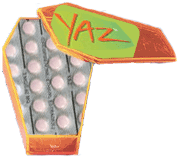
Check out the YAZ Coffin pill pack. This is a cool reminder for those pesky embryos that managed to make their way through the chemical obstacle course you have setup in your body.

It is also an iconic reminder of your own mortality. So why not go out and fornicate, commit adultery, or just live a selfish life for tomorrow you may die. And if you are going to die anyone why not go alone?

Moloch is one cool dude and he has been accepting human sacrifices for a real long time. In the old days people offered child sacrifice in the hope that Moloch would reward them with material things. Some things never change in some ways and today people don’t want to sacrifice anything and a baby could complicate their life and prevent them from buying the things they want for themselves. But if an embryo manages to survive YAZ will sacrifice that child for your material benefit.

Besides using YAZ PEZ is just a fun way to dispense our pills.

Now if the first two pill dispensers are too morbid for you and you don’t like to be reminded of chemical abortions being a backup method for YAZ and other hormonal contraceptives you will just love are "No Baby" Key chain pill dispenser. After all that is why you use YAZ on the first place because you want no baby. Just because God designed the sexual act to be both procreative and unitive you say the heck with that. After all what could God our creator know about human happiness in the first place. Besides if you wanted to be pro-creative you would buy some watercolors or modeling clay. You can also use your "No Baby" Key chain pill dispenser as a contraceptive fetish. We treat contraceptives as fetishes in the first place because we give them magical medical powers that cause them to work without any side effects or long term damage. Who wants to read those pages of size four print on those inserts that come with YAZ in the first place?

With YAZ you can continue to develop your contraceptive mentality that opposes life while at the same time curing mild cases of acne! Wow!

May 11, 2008 14 comments
0 FacebookTwitterGoogle +Pinterest
Book Review

Literary Giants, Literary Catholics

by Jeffrey Miller May 11, 2008
written by Jeffrey Miller

Recently finished Literary Giants, Literary Catholics by Joseph Pearce. I always enjoyed hearing him speak when I have heard him on Catholic radio and finally got around to getting one of his books. It now looks like I need to buy the rest of his books. I can’t say I normally read with pleasure 400+ pages of essays, but I certainly did in this case.
The book largely covers converts to the Church, especially from England, whose lives are often remembered by their literary output.
So there is coverage of John Henry Cardinal Newman, Chesterton, Belloc, Ronald Knox, T.S. Eliot, J.RR.Tolkien, Oscar Wilde, Roy Cambell, Evelyn Waugh, and a slew of others.

The first part deals with tradition and conversion in modern English literature along with the landscape of the 20th century. From there we go on to The ChesterBelloc (I loved this section), The Wasteland which deals with the war poets and the ultramodern poets and other literary stars, a section dealing with the Inklings, and finally various essays that take as their launching pad the literary converts, but also goes into other subjects. Each of these section contain a large number of essays and while there is a lot of overlap between them, it is a positive overlap. Joseph Pearce is a fine literary writer himself and even though his specialty is biographies he has great insights into these writers and is able to write quite wonderfully about them.

It really is rather amazing how many converts there were that came from the literary world, especially the high number of conversions from the writers known as the Decadents. It is also interesting how much consternation this caused among other writers who were shocked at people like T.S. Eliot entering Anglicanism and Evelyn Waugh entering the Church. We really don’t have anything comparable today of large number of literary authors entering the Church, but then again we hardly have anything comparable to the quality of these authors in the literary world in the first place. These people surely are literary giants.

I am a bit ashamed to say that if I myself had never entered the Church I might never had read any of these authors in the first place. I kept myself pretty much in a SF, fantasy, and horror ghetto and only occasionally delved into other genres. Coming into the Church I would find these other writers mentioned quite often and so started reading these authors. It is hard to imagine life without these authors now who have become like old friends to me. Though there are plenty of other authors referenced in the book that I will also need to familiarize myself with.

What I so enjoy about Pearce’s writing is his enthusiasm on the subject and he pulls you in along with him into the topic at hand. It is an enthusiasm based on a deep knowledge of the authors filled with a wealth of biographical details to help you better understand their work. Highly recommended.

May 11, 2008 7 comments
0 FacebookTwitterGoogle +Pinterest
Newer Posts
Older Posts

About Me

Jeff Miller is a former atheist who after spending forty years in the wilderness finds himself with both astonishment and joy a member of the Catholic Church. This award-winning blog presents my hopefully humorous and sometimes serious take on things religious, political, and whatever else crosses my mind.

Conversion story

  • Catholic Answers Magazine
  • Coming Home Network

Appearances on:

  • The Journey Home
  • Hands On Apologetics (YouTube)
  • Catholic RE.CON.

Blogging since July 2002

Recent Posts

  • The Weekly Leo

  • A Litany of Gratitude

  • The Spiritual Life and Memes

  • What is your distance from Jesus on the Cross?

  • Feast of St. Thomas, Apostle

  • Gratitude and Generosity

  • “The Heart and Center of Catholicism”

  • Post-Lent Report

  • Stay in your lane

  • Echoing through creation

  • Another Heaven

  • My Year in Books – 2024 Edition

  • I Have a Confession to Make

  • A Mandatory Take

  • Everybody is ignorant

  • Sacramental Disposal, LLC

  • TL;DH (Too Long;Didn’t Hear)

  • A Shop Mark Would Like

  • The Narrow Way Through the Sacred Heart of Jesus

  • Time Travel and Fixing Up Our Past

  • The Weekly Leo

  • The Weekly Leo

  • The Weekly Leo

  • The Weekly Leo

Meta

I also blog at Happy Catholic Bookshelf Entries RSS
Entries ATOM
Comments RSS
Email: curtjester@gmail.com

What I'm currently reading

Subscribe to The Curt Jester by Email

Endorsements

  • The Curt Jester: Disturbingly Funny --Mark Shea
  • EX-cellent blog --Jimmy Akin
  • One wag has even posted a list of the Top Ten signs that someone is in the grip of "motu-mania," -- John Allen Jr.
  • Brilliance abounds --Victor Lams
  • The Curt Jester is a blog of wise-ass musings on the media, politics, and things "Papist." The Revealer

Archives

About Me

Jeff Miller is a former atheist who after spending forty years in the wilderness finds himself with both astonishment and joy a member of the Catholic Church. This award winning blog presents my hopefully humorous and sometimes serious take on things religious, political, and whatever else crosses my mind.
My conversion story
  • The Curt Jester: Disturbingly Funny --Mark Shea
  • EX-cellent blog --Jimmy Akin
  • One wag has even posted a list of the Top Ten signs that someone is in the grip of "motu-mania," -- John Allen Jr.
  • Brilliance abounds --Victor Lams
  • The Curt Jester is a blog of wise-ass musings on the media, politics, and things "Papist." The Revealer

Meta

I also blog at Happy Catholic Bookshelf Twitter
Facebook
Entries RSS
Entries ATOM
Comments RSS 2.0" >RSS
Email: curtjester@gmail.com

What I'm currently reading

Subscribe to The Curt Jester by Email

Commercial Interuption

Podcasts

•Catholic Answers Live Subscribe to Podcast RSS
•Catholic Underground Subscribe to Podcast RSS
•Catholic Vitamins Subscribe to Podcast RSS
•EWTN (Multiple Podcasts) Subscribe to Podcast RSS
•Forgotten Classics Subscribe to Podcast RSS
•Kresta in the Afternoon Subscribe to Podcast RSS
•SQPN - Tons of great Catholic podcasts Subscribe to Podcast RSS
•The Catholic Hack Subscribe to Podcast RSS
•The Catholic Laboratory Subscribe to Podcast RSS
•The Catholics Next Door Subscribe to Podcast RSS
•What does the prayer really say? Subscribe to Podcast RSS

Archives

Catholic Sites

  • Big Pulpit
  • Capuchin Friars
  • Catholic Answers
  • Catholic Lane
  • Crisis Magazine
  • New Evangelizers
  • Waking Up Catholic

Ministerial Bloghood

  • A Jesuit’s Journey
  • A Shepherd’s Voice
  • Ad Majorem Dei Gloriam
  • Adam’s Ale
  • Archbishop Dolan
  • Bonfire of the Vanities
  • Cardinal Sean’s Blog
  • Da Mihi Animas
  • Domine, da mihi hanc aquam!
  • Father Joe
  • Fr. Roderick
  • Godzdogz
  • Laus Crucis
  • Omne Quod Spirat, Laudet Dominum
  • Orthometer
  • Priests for Life
  • Servant and Steward
  • Standing on My Head
  • The hermeneutic of continuity
  • This Week at Vatican II
  • Waiting in Joyful Hope
  • What Does The Prayer Really Say?

Bloghood of the Faithful

  • A Catholic Mom Climbing the Pillars
  • A Catholic Mom in Hawaii
  • A Long Island Catholic
  • A Wing And A Prayer
  • Acts of the Apostasy
  • Ad Altare Dei
  • AdoroTeDevote
  • Against the Grain
  • Aggie Catholics
  • Aliens in this world
  • Always Catholic
  • American Chesterton Society
  • American Papist
  • Among Women
  • And Sometimes Tea
  • Ask Sister Mary Martha
  • auntie joanna writes
  • Bad Catholic
  • Bethune Catholic
  • Big C Catholics
  • Bl. Thaddeus McCarthy's Catholic Heritage Association
  • Catholic and Enjoying It!
  • Catholic Answers Blog
  • Catholic Fire
  • Catholic New Media Roundup
  • Charlotte was Both
  • Christus Vincit
  • Confessions of a Hot Carmel Sundae
  • Cor ad cor loquitur
  • Courageous Priest
  • Creative Minority Report
  • CVSTOS FIDEI
  • Dads Called to Holiness
  • Darwin Catholic
  • Defend us in Battle
  • Defenders of the Catholic Faith
  • Disputations
  • Divine Life
  • Domenico Bettinelli Jr.
  • Dominican Idaho
  • Dyspectic Mutterings
  • Ecce Homo
  • Ecclesia Militans
  • Eve Tushnet
  • Eye of the Tiber
  • feminine-genius
  • Five Feet of Fury
  • Flying Stars
  • For The Greater Glory
  • Get Religion
  • GKC’s Favourite
  • God’s Wonderful Love
  • Gray Matters
  • Happy Catholic
  • Ignatius Insight Scoop
  • In Dwelling
  • In the Light of the Law
  • InForum Blog
  • Jeff Cavins
  • Jimmy Akin
  • John C. Wright
  • La Salette Journey
  • Laudem Gloriae
  • Lex Communis
  • Life is a Prayer
  • Man with Black Hat
  • Maria Lectrix
  • Mary Meets Dolly
  • MONIALES OP
  • Mulier Fortis
  • Musings of a Pertinacious Papist
  • My Domestic Church
  • Nunblog
  • Oblique House
  • Open wide the doors to Christ!
  • Over the Rhine and Into the Tiber
  • Patrick Madrid
  • Pro Ecclesia * Pro Familia * Pro Civitate
  • Recta Ratio
  • Saint Mary Magdalen
  • Sonitus Sanctus
  • Southern-Fried Catholicism
  • St. Conleth's Catholic Heritage Association
  • Stony Creek Digest
  • Testosterhome
  • The Ark and the Dove
  • The B-Movie Catechism
  • The Crescat
  • The Daily Eudemon
  • The Digital Hairshirt
  • The Four Pillars
  • The Inn at the End of the World
  • The Ironic Catholic
  • The Lady in the Pew
  • The Lion and the Cardinal
  • The New Liturgical Movement
  • The Pulp.it
  • The Sacred Page
  • The Sci Fi Catholic
  • The Scratching Post
  • The Weight of Glory
  • The Wired Catholic
  • Two Catholic Men and a Blog
  • Unam Sanctam Catholicam
  • Video meliora, proboque; Deteriora sequor
  • Vivificat
  • Facebook
  • Twitter
  • Instagram
  • Pinterest
  • Email
  • Reddit
  • RSS

@2026 - www.splendoroftruth.com/curtjester. All Right Reserved. Designed and Developed by PenciDesign


Back To Top