
The Curt Jester
  • Home
  • About
  • Rome Depot
  • WikiCatechism
  • Free Catholic eBooks
  • Home
  • About
  • Rome Depot
  • WikiCatechism
  • Free Catholic eBooks

The Curt Jester

"It is the test of a good religion whether you can joke about it." GKC

Punditry

God Squad

by Jeffrey Miller August 16, 2010
written by Jeffrey Miller

Father Luke Strand of Holy Family Catholic Church in Fond du Lac, Wis. wasn’t looking for attention from corporate America; he simply wanted to promote vocations to the priesthood. Instead, he’s facing a cease-and-desist letter from Minnesota-based electronics retailer Best Buy over his Volkswagen Beetle.

The black VW sports a “God Squad” decal on the door that’s similar in appearance to the logo used by Best Buy’s Geek Squad computer technicians.

Best Buy says that Father Strand’s use of the logo violates its trademarks.

“This was a really difficult thing for us to do because we appreciate what Father Strand is trying to accomplish with his mission,” Paula Baldwin, Best Buy spokesperson, told the Milwaukee Journal Sentinel. “But at the end of the day, it’s bad precedent to let some groups violate our trademark while pursuing others.”

Father Strand mentioned the cease-and-desist order during the 9:30 a.m. Mass at St. Mary’s Catholic Church on August 8, but cannot discuss the details of the case.

Then-Deacon Strand, received the car in 2007 from Father Quinn Mann of the Diocese of Green Bay. Not only does the car sport the God Squad logo, but also the websites thinkpriest.org and cyexpeditions.org on the fenders. His license plate reads GODLVYA, and the very front of the Beetle has a white paint stripe to match his priestly collar.

“It stimulates a lot of conversation,” Father Strand told the Fond du Lac Reporter in 2009. “People don’t always know when the right time is to start a conversation about faith questions. The church is alive, young and vibrant. This is a new and creative way to bring the faith I love into everyday life.”

Blogger Brian Osborne, of Geek.com, said that Best Buy has “created a public relations nightmare…the kind that could only come as a result of a company suing a priest,” and that the company is now facing the “backlash” from its decision.

Baldwin said that Best Buy is working with Strand to try to alter the God Squad logo in a way that will still work for him without infringing on the Geek Squad trademark.

“We’re confident that together we’ll come up with a good solution for everyone,” said Baldwin. [Source]

Now if this priest started charging outlandish prices for minor spiritual tuneups and giving crappy service than I could see a case for copyright infringement. A priest offering services for free without trying to sell you an extended warranty will in no way get confused with the Geek Squad despite having a logon on a VW.
August 16, 2010 8 comments
0 FacebookTwitterGoogle +Pinterest
Punditry

Obedience

by Jeffrey Miller August 16, 2010
written by Jeffrey Miller

CLEVELAND — Members of a Cleveland church that was ordered closed have defied their Roman Catholic bishop with a Mass celebrated in a warehouse by a priest on leave.

Several hundred people attended Sunday’s service led by Rev. Robert Marrone. His congregation at the closed St. Peter Church had been warned by Bishop Richard Lennon to avoid setting up a breakaway church.

Members upset by the closing describe themselves as traditional Catholics challenging the shutdown, not their faith. The bishop says a renegade congregation can lead to disunity.

The eight-county Cleveland diocese has closed or merged 50 parishes, blaming declining numbers of priests, parishioners and finances. [Source]

Because it is traditional to disobey your bishop and to have Mass in a warehouse.

There have been multiple instances of this type of behavior throughout the country where people are more attached to their parish then they are to the Church. I can certainly understand the pain when a parish closes for people who have a deep attachment to that parish. But ultimately the local Bishop gets to make these decisions even if you think his reasoning for closing a parish is faulty. In many cases it is simply because of demographic shifts and sometimes possibly for less than stelar reasons. The parishioners of some more traditional parishes slated for closure have felt that the reason for closure was because it was a more traditional parish. There have also been cases of parishioners petitioning Rome to overturn a closing. The Vatican though has always responded by siding with the local ordinary and it is hard to imagine a case where this would not be so.

If you are obedient only when it suits you then you are not obedient. We have to be obedient to our local Bishop even when we prudently disagree with him. When I was in the military I learned I had to obey a lawful order from an officer regardless of what I thought of that officer or the order. The same goes here in that a lawful order from a bishop which would be one that does not contravene either the moral or Church law should be followed. During the period of time when they are considering a parish closing is the time to try to convince the bishop otherwise in a respectful manner. Sure it is a tragedy that a church in 1853 and the oldest church building in continuous use in the Diocese of Cleveland has been closed down. It is a greater tragedy for the priest and parishioners of this closed down parish to act in such a way.

August 16, 2010 3 comments
0 FacebookTwitterGoogle +Pinterest
Software

Liturgy of the Hours Apps

by Jeffrey Miller August 15, 2010August 15, 2010
written by Jeffrey Miller

On my way into the Church as I was exploring a devotional prayer life i started to pray The Little Office of the Blessed Virgin Mary. This is similar to the Liturgy of the Hours in format but with limited readings. After finding that I liked this style of prayer of praying during parts of the day and that it was something I could actually stick with I soon turned to the Four Volume Set of the Liturgy of the Hours which I bought one volume at a time. Learning to pray the Liturgy of the Hours is not the simplest task, but the St. Joseph Guide to the Liturgy of the Hours put out annually is a good way to be able to learn to do so. Though paging through the book for the different hours of prayer and marking them with ribbons is functional but messy. In this technological age we are getting lazier and lazier and I for one wished for an electronic version of the LOTH that would let me concentrate more on praying than flipping through the volumes.

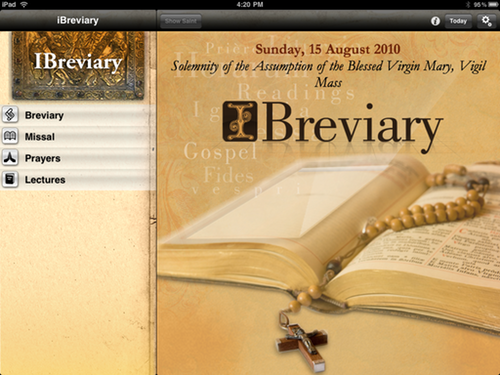
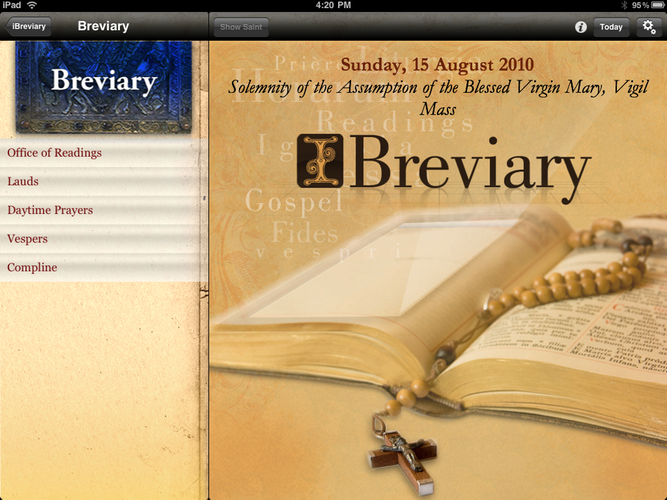
When iBreviary was originally released for the iPhone/iPod Touch for first .99 cents and then later free this need was answered for me. So from the time this app was released I retired my 4-Volume set of the LOTH for the electronic version. I was fairly satisfied with this app, but when the iPad was announced I figured that the screen on the iPad would be perfect for the Breviary and there would be much less page scrolling involved. Just last week iBreviaryPro was released on iTunes and it is a significant upgrade to the previous versions.


Mostly on the iPad I prefer landscape mode and all the screenshots are in landscape mode. Though it work
s in portrait mode also.

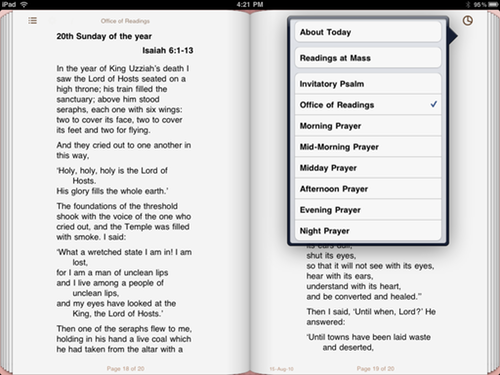
The formatting of the screen is much improved over previous versions where the word could be haphazard at times. In previous versions you had to download each day and so if you were away from the internet for a period of time you were out of luck. The new version now lets you cache a period of 10 days which is a welcome change.

Switching the various Hours is quite easy via the sidebar.

The new version also include the complete Missal for the celebration of Mass. Also added are new sections for Saints and Prayers.

What is especially nice about iBreviaryPro is the support for Italian, French, Spanish, English, and Latin and that the texts used as far as I know match the official texts. The English text was identical to the English version of the Liturgy Hours I had in the 4-Volume set.

For the price of free you really can’t beat iBreviaryPro and if you had ever wanted to start reading the Liturgy of the Hours it is a great way to start since you don’t have to worry about mechanics, but can just start reading and praying. Also very cool is that the app was created by an Italian Priest, Don Paolo Padrini. No doubt we will see future improvements.

This though is not the only Liturgy of the Hours app available. When I first got my iPad I was disappointed to find that iBreviaryPro had not yet been updated to the iPad and I really wanted an iPad version of the Liturgy of the Hours. When the Apple App store first opened there was an LOTR app right from the start called Universalis and many people will be acquainted with their website. Unfortunately they charged $40 dollars for the app and they had no lite version to see if you liked it ahead of time. $40 bucks was pretty steep for an iPhone/iPod Touch app in a field where $10 is expensive so I passed that one right up. On the day the iPad was released they also had a version for the iPad and they had lowered the price to $27 which is still steep in my opinion, but I decided to buy it.

The original iPad version of Universalis was fairly good, but a bit buggy. It was also lacking hymns and antiphons which iBreviaryPro supported. Later upgrades fixed these problems and one of the latest releases gave me a feature that I really wanted.

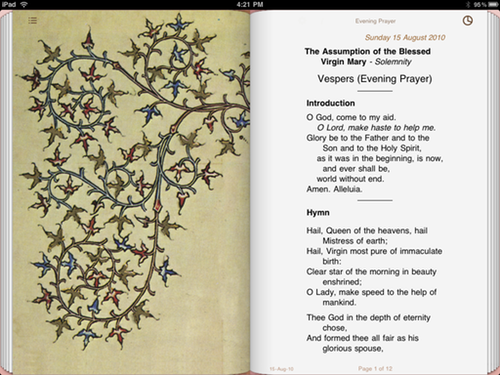
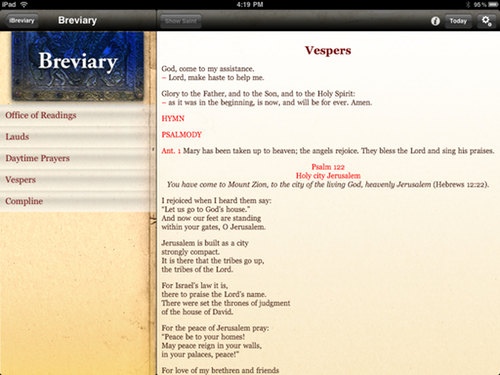
Every book reader app allows you to tap on the screen or swipe in a direction to change pages. I really wanted this feature instead of having to keep scrolling down to finish an Hour. This might be more evidence of laziness, but it is a more exact way to advance through the text. In addition Universalis in Landscape Mode pretty much copied the layout that iBooks uses in show two facing pages at a time. Having read plenty of books via iBooks this way I was thrilled to see that Universalis had imitated this feature. The page turning animation is not as slick as Apples’ version, but good enough. To navigate between the hours you simply click the clock icon and select the required Hour.

As you can see Antiphons and Hymns are now fully supported and the rendering of the text and format is quite nice. One of the best features of Universalis is that you never have to download anything other than the app. All text is included for the liturgical cycles. In addition there are some other nice settings not found in iBreviaryPro. For example because man Diocese in the U.S. move feast days to Sunday such as the Ascension you are able to set this so that the correct texts are displayed.

Unfortunately there is no multi-language support and this is for English users only. It does though liturgical calendars for UK, USA, Canada, Australia, New Zealand. The translation used is not the same as in the printed version of the LOTH. You can select though to use the NAB, Jerusalem Bible, and the Grail Psalms are used.

The app has gone done to $24.99 and you can also get the free Catholic Calendar application to preview the full version.

So for now my LOTH app of choice is Universalis because of the page rendering of text, but I keep both versions on my iPad. iBreviary Pro is great when you read the Liturgy of the Hours in public and must use the same text as everybody else.

There are still improvements I would like to see in both versions. Being able to set the text and background colors or to set the contrast would be a welcome feature for both apps since depending on where you have your contrast set the black on white can be a bit glaring. iBooks has a Sepia mode which I really like and is easy on the eyes.

iBreviaryPro and Universalis are both excellent full featured apps and so this is a great thing for Catholics that we have this available to us. There are different features in both apps, but depending on your requirements you can select which one to fill your needs.

For those with Android devices you can also find iBreviary available.

Most of all if you are curious about praying the Liturgy of the Hours, no time is better than now to jump right in. It is a cool feeling to know that you are joining in with the Church and praying the same Hours that the priests and religious are also praying.

August 15, 2010August 15, 2010 13 comments
0 FacebookTwitterGoogle +Pinterest
Punditry

20th anniversary of Ex corde Ecclesiae

by Jeffrey Miller August 15, 2010
written by Jeffrey Miller

On the Solemnity of the Assumption, August 15, 2010, The Cardinal Newman Society (CNS) will commemorate the 20th anniversary of Pope John Paul II’s apostolic constitution on Catholic higher education, Ex corde Ecclesiae. CNS has written an extensive Timeline and Background of Ex corde Ecclesiae to mark the anniversary and shed light on the importance of this historic Church constitution.

“The requirements of Ex corde Ecclesiae are of continuing importance for Catholic colleges and universities in 2010,” said CNS President Patrick J. Reilly. “We are still in the midst of the educational crisis to which Ex corde responded 20 years ago, and we await full implementation of the constitution’s ‘norms’ in the U.S. In order to rediscover the Catholic identity of their colleges and universities, presidents and board members must revisit the vital message of this landmark document.”

Reilly continued, “A new generation of Catholic administrators, professors and students are already reaping the fruit of strong Catholic identity brought about by adherence to Ex corde. Catholic colleges and universities included in our Newman Guide to Choosing a Catholic College have worked to integrate the principles of Ex corde into every aspect of their institutions.”

“On this anniversary, CNS and its more than 20,000 members continue to pray that more Catholic university leaders will embrace Ex corde Ecclesiae and courageously stand up for Catholic teaching in a world that is so desperately searching for the Truth.”

On August 15, 1990, Pope John Paul II responded to the decades-long crisis in Catholic higher education by issuing the apostolic constitution Ex corde Ecclesiae. The document, which has the binding effect of Church law, was the first official Catholic Church document defining the essential relationship between Catholic institutions of higher education and the Church.

Inspired by the message of Ex corde Ecclesiae, Patrick J. Reilly and other recent Catholic college graduates founded The Cardinal Newman Society in 1993 to seek the faithful implementation of the apostolic constitution in the United States.

Ex corde Ecclesiae’s guidelines include:
· the requirement for any official action of a Catholic university to be in harmony with its Catholic identity;

· the responsibility of all Catholic university professors and administrators to promote, or at least to respect, the institution’s Catholic identity;

· the need of all professors of Catholic theology to have a “mandate” from the local bishop to teach; and

· the requirement that Catholic professors should be in the majority at a Catholic university.
In 1999, the U.S. bishops approved clear guidelines to implement Ex corde. Since then, it is evident that most of Catholic higher education is still undergoing the crisis that Ex corde was issued to address.

CNS continues to report on the abuses of Catholic identity that take place across the United States every year. Recent examples such as Notre Dame’s bestowal of an honorary doctorate of law upon pro-abortion President Barack Obama, the increasing support for abortion and gay “marriage” among Catholic students, and the fact that nearly one in eight Catholics leave the Church by their graduation from Catholic colleges demonstrate that the “educational emergency,” in Pope Benedict XVI’s words, is still prevalent.

Two years ago, during his visit to the United States of America, Pope Benedict XVI convened a meeting of Catholic college and university presidents in Washington, D.C., where he echoed key themes of Ex corde on the importance of Catholic identity. The Holy Father told the Catholic presidents that the current “crisis of truth” is rooted in a “crisis of faith.”

In 2011, the U.S. bishops are scheduled to conduct a review of the implementation of Ex corde Ecclesiae over the past 10 years since their particular guidelines for American institutions went into effect. Details for this review have not yet been made public.

CNS narrates the story of Ex corde Ecclesiae and its implementation in the Timeline and Background of Ex corde Ecclesiae. [Source]

Amazing turnaround at Catholic institutions since this document was released. The bishops had quite a difficult time responding to all the requests for the mandatum for every professor of Catholic theology as required in the 1983 Code of Canon Law. I am really happy that every official action of Catholic institutions is in accord with it’s Catholic Identity now. If it wasn’t for this obedience to Ex corde Ecclesiae who knows what would have happened – perhaps annual performances of The Vagina Diaglogues or invitations to radically pro-abortion speakers. Or think about all the students who could have gotten a very inferior view of Church teaching due to theology professors not faithful to the Church and the damage that would have caused.

I was also amazed at how this turnabout came about since initially these Catholic institutions tried to stick to the party line of Academic Freedom to resist Ex corde Ecclesiae. When this happened Catholic parents decided not to send their children to any school which was not in conformance with Ex corde Ecclesiae. Catholic School alumni also stopped promoting those schools who did not conform and would not donate a dime until they did conform to Church teaching. Plus all the bishops who threatened to pull Catholic institution from the list of Catholic institutions and to not allow them to claim Catholic identity unless they could also claim obedience to the Church.

[This is the part where the dream sequence ends and we return to the reality where only Catholic institutions who were already faithful to the Church implemented Ex corde Ecclesiae and the rest screamed Academic Freedom]

August 15, 2010 3 comments
0 FacebookTwitterGoogle +Pinterest
Punditry

Lost sheep

by Jeffrey Miller August 14, 2010
written by Jeffrey Miller

Cary McMullen the religion editor for The Ledger wrote a post on Anne Rice that I generally agree with.

There is an old saying, attributed to Cyril of Alexandria (supposedly one of those anti-science, anti-feminist dead white guys): “Outside the church there is no salvation.” Now before Anne Rice starts to get huffy, I think what Cyril meant is that the church has been the (decidedly flawed) custodian of the gospel. How would Rice even know about Jesus if it hadn’t been for the millions of faithful people who sometimes at the cost of their own lives openly declared that they were in fact Christians and dedicated themselves to perpetuating the only organization that has Jesus as the subject of the simple statement that he is Lord?

Rice’s memory is awfully short. And contrary to what she thinks, by rejecting the church she is in danger of rejecting Jesus as well.

First off what St. Cyrill actually said was ” ‘mercy is not obtainable outside the holy city’.” The dogma of Extra Ecclesiam Nulla Salus means much more than that the Church is the custodian of the Gospel, but does not mean as much as the rigorists would have it say. Regardless this is a side point. I would certainly agree with anybody who rejects the Church is in danger of rejecting Jesus if in fact they haven’t already done so by rejecting his Church. As Sy Cyprian said “He cannot have God as his Father who does not have the Church as his mother.”

What I totally disagree with was the headline for this article “Church Won’t Miss Rice.” If the Angels rejoice when one lost sheep is returned, surely they are unhappy about every single sheep that is lost even if the sheep posts on Facebook that they are getting lost on purpose. While I totally disagree with Anne Rice’s reasons for leaving the Church which I find quite juvenile, I want her and everybody else for that matter within the Catholic Church and the Body of Christ does miss Anne Rice. Every person is God’t unique creation and they are intended to live with him forever. Anne Rice’s separating herself from the Church means she is separating herself from the sacraments means she is separating herself from the various helps in the Christian life that Jesus intended.  Jesus gave us the Church to lead us to salvation and to reject his Church  is to reject his will.

August 14, 2010 6 comments
0 FacebookTwitterGoogle +Pinterest
Book Review

The Godless Delusion

by Jeffrey Miller August 12, 2010
written by Jeffrey Miller

The Godless Delusion: A Catholic Challenge to Modern Atheism is a fairly new book by Patrick Madrid and Kenneth Hensley. While the title says it is a Catholic Challenge, the book really makes the arguments against atheism via logic and natural theology and does not rely on either scripture or sacred tradition. Of course the authors are Catholics and sections of the Catechism are used throughout to further highlight a point.

The laser focus of this book is to deconstruct the philosophy of materialism/naturalism. As much as atheists like to make their case that their atheism is based on reason and science, it really relies on the philosophy of materialism that denies that anything immaterial can exist. It starts out by contrasting the worldview of materialism and the theist worldview and then covering the so-called new atheists.

I thought the section on understanding atheists was a little too narrow in actually helping you to understand atheists. They talk about the tensions that the philosophy of naturalism creates for the atheist and they seem to imply that atheist in their heart of hearts understand why this tension exists in their denial of God. But understanding atheists really has the same problem as understanding people in that people are so varied and their reasons for the philosophies they hold can fall into various areas. St. Thomas Aquinas in his Summa Theologica only listed two objections to the existence of God and they were generally the problem of evil and the ability of science to explain things. When I was an atheist I was one generally under the second objection in that for me science was my guide to truth and anything not currently understood by science will be understood in the future. A Catholic might reply on a deep piece of theology that it is a mystery, while the atheist will say that something not understood is just a mystery for now. Most of my years as an atheist I never had any doubt that materialism was true and that belief in God was nothing but a superstition to overcome with reason. Science explained everything for me so in my heart of hearts I did not feel those tensions. I trusted materialism unfortunately without thinking about the flaws of materialism and I never looked at what theists had to say on the subject. As a atheist there is a pride in saying you are following reason and truth, but really many atheists are seriously looking for truth and the atheist worldview is downright depressing – we have no purpose and we die and that’s it. C.S. Lewis said ‘A young man who wishes to remain a sound atheist cannot be too careful of his reading.’and that was so for me. Many atheists probably fall in the same camp in that they never take seriously that their can be a rational argument for God. No doubt there are atheists who live a tension with God in that they are really defying God more than not believing in him or do not want to look at the case for God because they realize they would have to change. So I think this section could have been a little broader understanding of the motives for atheists. In general what they were saying was accurate in that there are real tensions in belief in materialism and when I came to understand what they were it brought me out of atheism into no man’s land for awhile.

Materialism in this book is rightly mocked in a good natured way as the show the myriad inconsistencies. The third chapter starts of the real meat of this book as it looks at morality and the fact that materialism can’t explain it. When materialists try to explain morality they really are trying to explain it away. They will pin it on something that is a ever-moving target and will deny any absolutes in this area. While atheists can be and often are good and moral people, it is not because of philosophy of materialism — but despite it. They look at each of the arguments used to define an ethic that atheists advance and frankly demolish them.

Later on they go into area of epistemology and how materialism is unable to provide a serious explanation for knowledge and reason. Kind of like the joke where the scientist creates life out of dirt and God tells him to create his own dirt. Proponents of materialistic determinism tell us we have no free will while trying to use reason to cause our brain chemical/electrical processes that we have no control over to their cause. The picture on the cover of the book shows a man sitting on a tree limb cutting off the limb he is sitting on. This really illustrates the materialist’s problem is that they have to borrow from the theists to argue their case. The last half of the book shows exactly why this is so in that atheism eliminates knowledge.

I found this to be a well-argued book and written in such a way as to be accessible to pretty much every reader.I don’t know how many atheists would take the time to read this book. Every time I see a book against atheism on Amazon the reviews are extremely negative and obviously written by people who had not read one page of the book or replied to any arguments contained within. Reason is not used and flaming replies full of hyperbole are used. On goodreads.com this book was given 1 star and the 1 star reviews were just polemics. If you read the comments at ex-atheist and recent Catholic John C. Wright’s blog when he talks about materialism you see much of the same. People obviously angered that a SF writer could stoop to believing in God and then to dare to use reason against their arguments. Though I must admit to being entertained by the atheists who accept the natural conclusions of naturalism and yet not see how it undermines their arguments. This book is certainly an excellent resource for those who want to refine their argument when talking with atheists or to just get a firm understanding of just how contradictory radical materialism is. For those honest atheists who consider truth more important than congratulating themselves by calling themselves brights — then this is well worth reading. I certainly wish that I had been introduced to the arguments contained within this book much sooner in my own life.

This review was written as part of the Catholic book reviewer program from The Catholic Company. Visit The Catholic Company to find more information on The Godless Delusion and be sure to check out their great selection of Mary statues while you are there.

August 12, 2010 1 comment
0 FacebookTwitterGoogle +Pinterest
Other

Fundraising

by Jeffrey Miller August 10, 2010
written by Jeffrey Miller

August 10, 2010 5 comments
0 FacebookTwitterGoogle +Pinterest
Link

Catholic New Media Celebration

by Jeffrey Miller August 10, 2010
written by Jeffrey Miller

Last weekend the 3rd Catholic New Media Celebration was held in Boston Archdiocese Pastoral Center to a sold out audience. I was unable to go this year but was able to watch much of the CNMC live via USTREAM or watch the bits I missed on video afterwards. It has been quite interesting to watch the CNMC grow from its conception to three successful years bringing together Catholics to learn how to use the new media in evangelization and as an opportunity to get together. There were so many people attending that I would love to be able to meet and talk to myself that it was bittersweet watching from afar.

The Archdiocese of St. Louis has a good post up on their site with plenty of links in regards to the CNMC and to other sites containing links. Links to video’s of individual events are also included.

While they had plenty of excellent speakers I would pick out Thomas Peters of American Papist in this regard. I found the content of his speech very good with lots of food for thought even for long term bloggers. [Video] The blogging panel had an representative range of bloggers and I thought it was informative and fun. [Video]

The Keynote speech was by Lino Rulli host of “The Catholic Guy Show” on the The Catholic Channel and he really gave an amazing speech that had lots to say about Catholic Media. Lino is very funny as he described his career in both secular and Catholic media, but while being funny he was also making some very serious points about Catholic Media and the truth that far too often Catholic Media has not been very professional and often just does not compete when it comes to reaching out to an audience. Often Catholic Media is just sub par professionally. G. K. Chesterton’s “if something’s worth doing, it’s worth doing badly.” is often applied incorrectly by Catholics since Chesterton said this in defense of hobbies. I started my blog with this quote, though my blog is a hobby. The reality is that Catholics using media to evangelize must see that excellence is extremely important or else you end up with a ghetto mentality of only reaching out towards those already converted. Look at the state of so much filmmaking by Christians where excellence in filmmaking out seems to fall by the wayside. Filming, writing, talking about the truth should not be undermined by a lack of artistic merit. The best Catholic Media is great because it is professional, not just because it is Catholic media.

Another thing Lino talked about was people’s reactions to him and the number of negative comments he gets from The Catholic Guy show which they consider too irrelevant and not pious enough. I listen to his show via the podcast highlights of his show and I enjoy it very much. Though like with all humor it isn’t for everybody. I have a feeling though Lino gets comments from the same people who complain about the picture of nuns with rifles in my header. Some just think that the intersection of the faith and humor should be an overpass instead where they never meet.

You can watch his Keynote here.

August 10, 2010 3 comments
0 FacebookTwitterGoogle +Pinterest
NewsTheology

Who created God?

by Jeffrey Miller August 9, 2010August 12, 2010
written by Jeffrey Miller

Retired hedge fund titan Robert W. Wilson lost his faith in God years ago, yet he believes in Catholic schools and gave $5.6 million to the Roman Catholic Archdiocese of New York this summer.

It’s the latest of many gifts from Wilson to the city’s Catholic hierarchy and educators, this one aimed at funding the Catholic Alumni Partnership, a program he founded that helps elementary schools track down their 750,000 alumni and recruit them as donors.

“Most of what the Catholic schools teach are the three Rs,” said Wilson, 83, in a phone interview, referring to reading, writing and arithmetic. “And they do it better than the union-controlled inner-city schools.”

Wilson, a Detroit native, said he began questioning the existence of God after enrolling in Amherst College in Massachusetts to study economics.

“Religious people say you couldn’t have our surrounding environment without the Creator, but then who created the Creator?” Wilson said.

Wow, nobody ever saw that flaw before.  All those theists that came before us overlooked this item.  I am stunned and guess I will have to become an atheist once again because of this unsurmountable bit of logic.

Well not really, but it does interest me that this would be offered as a proof.  Though this is an answer you often get and I use to make the same errors myself by making similar statements and never checking  to see what a theist might say in reply.  As an atheist it is easy to assume that the other side has absolutely nothing going for it in the area of reason and besides we call ourselves “Brights” – so there.  The same atheist smugness that I use to have is fairly easy to detect.  Of course believers can be as equally smug against atheists and forget that faith is a gift.  One of my favorite quotes on this subject:

…both the believer and the unbeliever share, each in his own way, doubt and belief, if they do not hide from themselves and from the truth of their being. Neither can quite escape either doubt or belief; for the one, faith is present against doubt; for the other, through doubt and in the form of doubt. It is the basic pattern of man’s destiny only to be allowed to find the finality of his existence in this unceasing rivalry between doubt and belief, temptation and certainty. Perhaps in precisely this way doubt, which saves both sides from being shut up in their own worlds, could become the avenue of communication. It prevents both sides from enjoying complete self-satisfaction; it opens up the believer to the doubter and the doubter to the believer; for one, it is this share in the fate of the unbeliever; for the other, the form in which belief remains nevertheless a challenge to him. – then-Cardinal Josef Ratzinger “Introduction to Christianity”

Now getting back to the “Who created God” argument. This argument is usually a response to the first two of St. Thomas Aquinas’ five ways of knowing God exists. Asking who then created God makes sense at first if you just see God as just another chain in the event in an order of efficient causes. Though the argument of motion and efficient causes are arguments used within the material universe and simply would not apply to the concept of God being outside of time and space. Living in a material universe where we experience time it is of course very difficult to make sense of God being outside of time and space. The material universe requires a first efficient cause. Telling an atheist that God’s existence in the first place is a mystery is not exactly a satisfying reply, but then again the atheist having to say the same thing about the existence of matter being a mystery even if they don’t use those words amounts to the same. But if matter has always than it also means that matter has existed for an infinite amount time, but it is self-evident that an infinite amount of time could not have passed.

Ironically we can thank God for Robert W. Wilson and his contributions. I just pray that he might think a bit deeper into why he is an atheist and that there might actually be Sed Contra arguments otherwise.

Update: Here is a post on The Deeps of Time on the same question well worth reading.

August 9, 2010August 12, 2010 8 comments
0 FacebookTwitterGoogle +Pinterest
News

Thinking About God Calms Believers, Stresses Atheists

by Jeffrey Miller August 8, 2010
written by Jeffrey Miller

Researchers have determined that thinking about God can help relieve anxiety associated with making mistakes. However, the finding only holds for people who believe in a God.

The researchers measured brain waves for a particular kind of distress response while participants made mistakes on a test.

Those who had been prepared with religious thoughts had a less prominent response to mistakes than those who hadn’t.

“Eighty-five percent of the world has some sort of religious beliefs,” says Michael Inzlicht, who cowrote the study with Alexa Tullett, both at the University of Toronto-Scarborough.

“I think it behooves us as psychologists to study why people have these beliefs; exploring what functions, if any, they may serve.”

With two experiments, the researchers showed that when people think about religion and God, their brains respond differently—in a way that lets them take setbacks in stride and react with less distress to anxiety-provoking mistakes.

Participants either wrote about religion or did a scrambled word task that included religion and God-related words.

Then the researchers recorded their brain activity as they completed a computerized task—one that was chosen because it has a high rate of errors.

The results showed that when people were primed to think about religion and God, either consciously or unconsciously, brain activity decreases in areas consistent with the anterior cingulate cortex (ACC). The ACC is associated with a number of things, including regulating bodily states of arousal and alerting us when things are going wrong.

Interestingly, atheists reacted differently. When they were unconsciously primed with God-related ideas, their ACC increased its activity. The researchers suggest that for religious people, thinking about God may provide a way of ordering the world and explaining apparently random events and thus reduce their feelings of distress. [article]

Not exactly a surprising result.

August 8, 2010 3 comments
0 FacebookTwitterGoogle +Pinterest
Newer Posts
Older Posts

About Me

Jeff Miller is a former atheist who after spending forty years in the wilderness finds himself with both astonishment and joy a member of the Catholic Church. This award-winning blog presents my hopefully humorous and sometimes serious take on things religious, political, and whatever else crosses my mind.

Conversion story

  • Catholic Answers Magazine
  • Coming Home Network

Appearances on:

  • The Journey Home
  • Hands On Apologetics (YouTube)
  • Catholic RE.CON.

Blogging since July 2002

Recent Posts

  • The Weekly Leo

  • A Litany of Gratitude

  • The Spiritual Life and Memes

  • What is your distance from Jesus on the Cross?

  • Feast of St. Thomas, Apostle

  • Gratitude and Generosity

  • “The Heart and Center of Catholicism”

  • Post-Lent Report

  • Stay in your lane

  • Echoing through creation

  • Another Heaven

  • My Year in Books – 2024 Edition

  • I Have a Confession to Make

  • A Mandatory Take

  • Everybody is ignorant

  • Sacramental Disposal, LLC

  • TL;DH (Too Long;Didn’t Hear)

  • A Shop Mark Would Like

  • The Narrow Way Through the Sacred Heart of Jesus

  • Time Travel and Fixing Up Our Past

  • The Weekly Leo

  • The Weekly Leo

  • The Weekly Leo

  • The Weekly Leo

Meta

I also blog at Happy Catholic Bookshelf Entries RSS
Entries ATOM
Comments RSS
Email: curtjester@gmail.com

What I'm currently reading

Subscribe to The Curt Jester by Email

Endorsements

  • The Curt Jester: Disturbingly Funny --Mark Shea
  • EX-cellent blog --Jimmy Akin
  • One wag has even posted a list of the Top Ten signs that someone is in the grip of "motu-mania," -- John Allen Jr.
  • Brilliance abounds --Victor Lams
  • The Curt Jester is a blog of wise-ass musings on the media, politics, and things "Papist." The Revealer

Archives

About Me

Jeff Miller is a former atheist who after spending forty years in the wilderness finds himself with both astonishment and joy a member of the Catholic Church. This award winning blog presents my hopefully humorous and sometimes serious take on things religious, political, and whatever else crosses my mind.
My conversion story
  • The Curt Jester: Disturbingly Funny --Mark Shea
  • EX-cellent blog --Jimmy Akin
  • One wag has even posted a list of the Top Ten signs that someone is in the grip of "motu-mania," -- John Allen Jr.
  • Brilliance abounds --Victor Lams
  • The Curt Jester is a blog of wise-ass musings on the media, politics, and things "Papist." The Revealer

Meta

I also blog at Happy Catholic Bookshelf Twitter
Facebook
Entries RSS
Entries ATOM
Comments RSS 2.0" >RSS
Email: curtjester@gmail.com

What I'm currently reading

Subscribe to The Curt Jester by Email

Commercial Interuption

Podcasts

•Catholic Answers Live Subscribe to Podcast RSS
•Catholic Underground Subscribe to Podcast RSS
•Catholic Vitamins Subscribe to Podcast RSS
•EWTN (Multiple Podcasts) Subscribe to Podcast RSS
•Forgotten Classics Subscribe to Podcast RSS
•Kresta in the Afternoon Subscribe to Podcast RSS
•SQPN - Tons of great Catholic podcasts Subscribe to Podcast RSS
•The Catholic Hack Subscribe to Podcast RSS
•The Catholic Laboratory Subscribe to Podcast RSS
•The Catholics Next Door Subscribe to Podcast RSS
•What does the prayer really say? Subscribe to Podcast RSS

Archives

Catholic Sites

  • Big Pulpit
  • Capuchin Friars
  • Catholic Answers
  • Catholic Lane
  • Crisis Magazine
  • New Evangelizers
  • Waking Up Catholic

Ministerial Bloghood

  • A Jesuit’s Journey
  • A Shepherd’s Voice
  • Ad Majorem Dei Gloriam
  • Adam’s Ale
  • Archbishop Dolan
  • Bonfire of the Vanities
  • Cardinal Sean’s Blog
  • Da Mihi Animas
  • Domine, da mihi hanc aquam!
  • Father Joe
  • Fr. Roderick
  • Godzdogz
  • Laus Crucis
  • Omne Quod Spirat, Laudet Dominum
  • Orthometer
  • Priests for Life
  • Servant and Steward
  • Standing on My Head
  • The hermeneutic of continuity
  • This Week at Vatican II
  • Waiting in Joyful Hope
  • What Does The Prayer Really Say?

Bloghood of the Faithful

  • A Catholic Mom Climbing the Pillars
  • A Catholic Mom in Hawaii
  • A Long Island Catholic
  • A Wing And A Prayer
  • Acts of the Apostasy
  • Ad Altare Dei
  • AdoroTeDevote
  • Against the Grain
  • Aggie Catholics
  • Aliens in this world
  • Always Catholic
  • American Chesterton Society
  • American Papist
  • Among Women
  • And Sometimes Tea
  • Ask Sister Mary Martha
  • auntie joanna writes
  • Bad Catholic
  • Bethune Catholic
  • Big C Catholics
  • Bl. Thaddeus McCarthy's Catholic Heritage Association
  • Catholic and Enjoying It!
  • Catholic Answers Blog
  • Catholic Fire
  • Catholic New Media Roundup
  • Charlotte was Both
  • Christus Vincit
  • Confessions of a Hot Carmel Sundae
  • Cor ad cor loquitur
  • Courageous Priest
  • Creative Minority Report
  • CVSTOS FIDEI
  • Dads Called to Holiness
  • Darwin Catholic
  • Defend us in Battle
  • Defenders of the Catholic Faith
  • Disputations
  • Divine Life
  • Domenico Bettinelli Jr.
  • Dominican Idaho
  • Dyspectic Mutterings
  • Ecce Homo
  • Ecclesia Militans
  • Eve Tushnet
  • Eye of the Tiber
  • feminine-genius
  • Five Feet of Fury
  • Flying Stars
  • For The Greater Glory
  • Get Religion
  • GKC’s Favourite
  • God’s Wonderful Love
  • Gray Matters
  • Happy Catholic
  • Ignatius Insight Scoop
  • In Dwelling
  • In the Light of the Law
  • InForum Blog
  • Jeff Cavins
  • Jimmy Akin
  • John C. Wright
  • La Salette Journey
  • Laudem Gloriae
  • Lex Communis
  • Life is a Prayer
  • Man with Black Hat
  • Maria Lectrix
  • Mary Meets Dolly
  • MONIALES OP
  • Mulier Fortis
  • Musings of a Pertinacious Papist
  • My Domestic Church
  • Nunblog
  • Oblique House
  • Open wide the doors to Christ!
  • Over the Rhine and Into the Tiber
  • Patrick Madrid
  • Pro Ecclesia * Pro Familia * Pro Civitate
  • Recta Ratio
  • Saint Mary Magdalen
  • Sonitus Sanctus
  • Southern-Fried Catholicism
  • St. Conleth's Catholic Heritage Association
  • Stony Creek Digest
  • Testosterhome
  • The Ark and the Dove
  • The B-Movie Catechism
  • The Crescat
  • The Daily Eudemon
  • The Digital Hairshirt
  • The Four Pillars
  • The Inn at the End of the World
  • The Ironic Catholic
  • The Lady in the Pew
  • The Lion and the Cardinal
  • The New Liturgical Movement
  • The Pulp.it
  • The Sacred Page
  • The Sci Fi Catholic
  • The Scratching Post
  • The Weight of Glory
  • The Wired Catholic
  • Two Catholic Men and a Blog
  • Unam Sanctam Catholicam
  • Video meliora, proboque; Deteriora sequor
  • Vivificat
  • Facebook
  • Twitter
  • Instagram
  • Pinterest
  • Email
  • Reddit
  • RSS

@2026 - www.splendoroftruth.com/curtjester. All Right Reserved. Designed and Developed by PenciDesign


Back To Top