In this second volume Nancy Brown has once again chosen and adapted some of G.K. Chesterton’s Father Brown stories for younger readersThe Father Brown Reader II: More Stories from Chesterton

Now if somebody was to craft a podcast just for me than it would be the new podcast “A Good Story is Hard to Find” with the tagline “Two Catholics talking about books, movies, and the traces of “one Reality” they find there.”
Julie from Happy Catholic and Scott Danielson a contributor to SFFaudio start by discussing a Zombie novel “The Reaper are the Angels” by Alden Bell and it was a good conversation indeed and I look forward to future episodes.
Julie is on another book fast this year – that is she is trying not to buy any books and instead rely only on the library and review copies. The irony is that they start off with a book that I have added to my wish list to buy. Oh well another year as a book glutton.
I had reviewed the new book by Abby Johnson yesterday and at the end I had a couple questions about her spiritual journey and how she now regarded contraception since they were unanswered in the book.
Turns out the Ignatius Press edition has extra material the edition of the book I bought did and includes a forward by Fr. Frank Pavone. I was very glad to learn the following:
Johnson and her husband have grown in their faith during the past year, and are now preparing to enter the Catholic Church in the near future. She said that one of the final obstacles, in the course of her Catholic conversion, had been the Church’s teaching on the immorality of all artificial methods of birth control.
Planned Parenthood’s mentality toward contraception, as she explained, stuck with her for a period of time even after she rejected abortion. Even as she became interested in the Catholic Church, she clung to the notion that artificial birth control was an advance for women and society. But she kept an open mind, studying Pope John Paul II’s “Theology of the Body” and other sources of Church teaching.
Abby Johnson’s final decision to reject contraception, like her change of mind on abortion, occurred suddenly, and because of something she saw.
This time, however, the sight that changed her mind was not a child’s death within the clinic walls, but quite the opposite. An experience in a Catholic church, she said, finally made her understand the fullness of the Church’s teaching on sexuality.
This time, the vision of a child was not shocking, but profoundly life-affirming.
“One day, we were sitting in Mass … I was sitting behind this woman, who I don’t know, and this little infant.” Gazing at that child, she finally understood the Church’s insistence on marriages remaining open to new life.
“It was just clear to me, like a switch had gone off, that we had to stop contracepting.” [Source]
Welcome home Doug and Abby Johnson!
The version of the book I downloaded from Amazon was from SaltRiver a which is part of Tynedale House Publishers a Protestant publishing firm. Too bad they did not include her change of heart about contraception since the book left the topic hanging. Again too bad Ignatius Press did not have an eBook version on day one.
About.com’s 2011 Readers’ Choice Awards will showcase the best products, features and services in multiple categories, from technology to hobbies to parenting to religion. Nominations are now open, and will be accepted from 12:00 A.M. EST on January 13, 2011, until 11:59 P.M. EST on February 4, 2011.
On the About.com Catholicism GuideSite, we are accepting nominations in the ten categories listed below. Nominations can be entered in each of the categories using a single nomination form, though you can feel free to leave some of the fields blank; you are not required to make a nomination in every category. If you want to make more than one nomination in a particular category, simply fill the nomination form out twice.
Feel free to nominate yourself or your product for any of the appropriate awards, and spread the news to your friends. Finalists are chosen based on popularity, as long as they meet the eligibility requirements listed in each category.
Up to five finalists in each category will be announced on February 11, and voting will run from February 11 through March 8. (To be notified automatically when voting opens, simply sign up for the About.com Catholicism Newsletter). The winners will be announced on March 15.
Awards are for [Best Catholic …] blog, podcast, site, Facebook page, Twitter user, iPad App, iPhone App, Newspaper, Magazine, etc.
In 2009 it made the national news that Abby Johnson the director of a Planned Parenthood in Texas had resigned and went to the Coalition for Life for help. Now it was easy to celebrate this a a victory on the pro-life front and a mark in our column. It is easy to forget the person behind the story sometimes and the new book Unplanned: The Dramatic True Story of a Former Planned Parenthood Leader’s Eye-Opening Journey across the Life Line
I am a sucker for a conversion story and so bought and downloaded this book just after it came out. I also sat down and read the book in basically one sitting. When you first hear the story you wonder how can a director of a Planned Parenthood clinic have her world turnaround after assisting during an ultrasound guided abortion. Surely she would know what was going on in her clinic? How did a young woman from a small town and pro-life family come to work for Planned Parenthood in the first place?
The book starts with her heart-wrenching description of the ultrasound guided abortion she was called in to assist with. Through her years at Planned Parenthood at first as a volunteer, then counselor, and later directory and even Employee of the Year for Planned Parenthood she did not assist with abortions normally. Her shock at what she saw on the ultrasound and the babies obvious attempt to escape the suction device destroyed the lies she had been taught and had passed on to so many others. She was a person who believed that abortion was no great thing and should be rare, but that it was still needed for difficult situations. She truly though that Planned Parenthood did much good with their exams and birth control. That she was even doing God’s work. What she witnessed that day changed her life forever.
She then goes on to describe the years that led up to that day and how at Texas A&M she was first asked to volunteer at a clinic and that while she wasn’t thrilled about the abortion part bought into the whole abortion rights rhetoric of choice and the days of back alley abortions and how they were helping women’s health. She also describes the circumstances of her own two abortions and their effect on her.
Later on the book she describes how she felt that her conscience had been locked up and how it was that so much of what she did was contrary to what she believed or else had serious qualms about it, but that she would let other factors over ride that. Pro-abortion rhetoric is effective because it is conscience numbing in that it can make things sound so much better than they are and present evils as not only something good, but as the only right conclusion. All of us as sinners know about how we have minimized some sin and made excuses for it. We make excuses that could never stand a bright light without them shattering apart. Excuses we might even later laugh at and wonder how we could have thought such a thing. Abby’s book gives us light in seeing how somebody who deeply cared about other women and only wanted to do her best for them could come into the fallacy of the pro-abortion lies.
What I loved most about this book is humanization. Dehumanizing your enemy is always a constant temptation. The conflict between the clinic workers and pro-life protesters are between two groups one on each side of the fence and the fence is a dividing line throughout the book. She writes of her friends her worked at the clinic and the tensions involved because of the protesters. She also writes about the Christian love she experienced from so many of the protesters who treated her with love even as she became the clinics director. How they reached out to her – especially the members of the Coalition for Life. She also notes that while she did not feel animosity against the protesters that she was also use to using the rhetoric passed on to her from the Planned Parenthood office describing these peaceful protesters in less than peaceful terms. Though as the book notes, not all the protesters were peaceful and their were some misguided zealots who did harm to the pro-life cause and that the other pro-lifers would try to reign in.
I found the writing style of the book to be both gripping and heavily personal where you almost consider yourself to become a voyeur on her life. This book could not have been easy to write where old wounds had to be reopened and redressed. By the end you feel you have known her for years and you just rejoice in her conversion and her apparent joy in leaving her old life behind. She is someone who had always believed in God and when getting married had gone back to steady attendance at church with her husband who was solidly pro-life. She relates the back and forth conversations she had with her husband and her parents who were not happy with her job at all – but never let her job stop them from loving her. Also interesting she was kicked out of one pro-life Protestant church when they found out about her job and then later when she became national news the members of her pro-abortion Episcopalian church also let their displeasure known about her leaving Planned Parenthood.
After she finally left the clinic with the assistance of the Coalition for Life she was sued by Planned Parenthood who wanted a restraining order placed on her. The story actually became national news when Planned Parenthood issued a Press Release about this restraining order. She was not expecting the national attention and thought a interview on a local TV station was going to be the extent of the publicity. Towards her end as director of the clinic she was coming more in conflict with Planned Parenthood leadership as she discovered that they wanted her to increase abortions, simply because they were more profitable. The book finishes with the trial, the results of the trial, and her subsequent work speaking for 40 Days for Life.
There is so much in this book this I so enjoyed. The frank discussion of her thought processes over the years, her relationships with others, and the difficulties she encountered when she realized how wrong and blind she had been. Her treatment by the pro-life community in her years working there is an example for all to follow. Many other clinic employees, clinic directors, or even abortion doctors have been befriended by pro-lifers show truly showed them Christ by their example.
This book as a spiritual biography is a quite worthwhile read and an excellent insight into those who work at abortion clinics. This book isn’t meant as just a pro-life apologetic covering every aspect of the abortion debate covering topics like the personhood of the child or the statistics of abortion. That being said the ending of the book left some things ambiguous for me. For example after she had gone to the Coalition for Life she had told them that she was still for birth control. I would have liked to know by the ending if this was still the case since things like the pill having an abortafacient mechanism are never mentioned. Considering that she herself got pregnant three times while contraception I was certainly curious about this aspect. Generally I would have liked to see some counters to some of false history and statistics on back alley abortions she had learned. But I can understand while this was not done in a very personal autobiography where the focus of her story was a conversion story.
I have felt in the past that we needed a pro-life equivalent of what Uncle Tom’s Cabin did for the slavery abolition movement. While this book is not exactly that – it is something close and I hope that it will be a book that becomes very popular. Everybody in the book are humanized – the child in the womb, abortion workers, pro-life protesters. There is not a stereotype of a person to be found in this book.
Note: Available at Ignatius Press. Unfortunately they did not have an eBook version so I bought it elsewhere.
Update: Turns out the Ignatius Press edition of this book covers some of my questions and I happy to learn that Doug and Abby Johnson are entering the Catholic Church and that they both oppose contraception now.
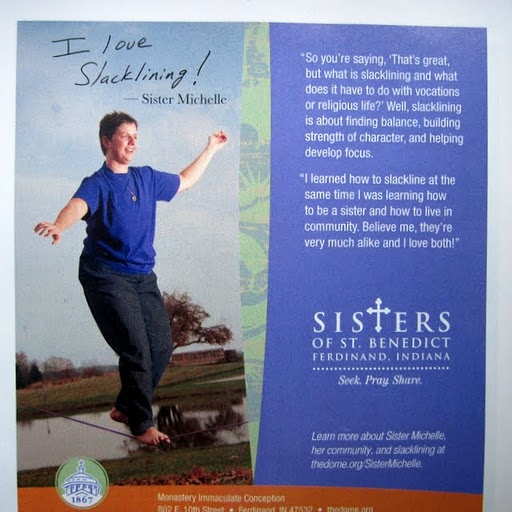
Wow what a stunning vocation campaign. I hope they got extra phone lines and increased internet bandwidth to deal with the increased traffic. In no time this aging order of habit-less nuns will be busting at the scenes with scores of vibrant young people. This ad in connection with their website devoid of religious iconography and mentions of Jesus, Mary, and the Saints will certainly help to get women to discern their religious vocation to follow God unreservedly. Plus if you join this order you can have hobbies and such – who knew? No doubt there are plenty of women thinking of devoting themselves wholly to Jesus and the only thing holding them back was the idea that they could not engage in a hobby like slacklining.
Or just maybe this poster is a fitting tombstone for this order.
Hat tip: Rich Leornard
As with pretty much all people I was saddened to hear of the reports of the mass murder in Arizona, just as I am when I hear of any such occurrence. It is quite natural for people to wonder at motives when an apparent political assassination is also involved, but experience has shown me this to be common but misplaced.
Too bad we often look for motives instead of praying for the victims and their family and loved ones. John Kroll, Gabe ZImmerman, Christina Taylor,
Dorwin Stoddard, Phyllis Scheck, and Dorthy Murray were all murdered by this one individual along with others seriously injured including Congresswoman Gabrielle Giffords. To no credit to myself, I at least had the grace to remember to pray when I first saw this story, but still wondered about motive afterwards. Though I also realized motives in these cases are difficult to analyze. Though it does not take a prophet to realize that such acts are of seriously disturbed persons, as was true in this case.
I was also saddened to see the Wellstonian treatment of this story soon after it was reported. I refer to the funeral of the tragic death of Paul Wellstone that was hijacked and turned into a political event attacking Republicans. Using tragedies to promote political agendas is about as classless as you can get. I guess I was not surprised to find the the supposed causation was Sarah Palin. Naively I thought this stupidity would go away once more was known about the killer. Now I am no Palin fanboy in that there are some things I admire about her and some things I don’t, but the irony of blaming a political climate of hate on Sarah Palin using hateful rhetoric seems to be lost on the accusers.
The accusations say more about the accusers than anything. I think it was in Orthodoxy when G.K. Chesterton wrote, and I paraphrase, that an insane person is not somebody who had lost there reason, but someone who only had there reason left. As with most of Chesterton’s paradoxes this is another one that makes more sense as you think about it and reading about Jared Loughner’s rants on literacy and grammar among other things – further shows Chesterton’s insight.
Now if you want to show causation in what you call a political climate of hate it seems to me that using a disturbed individual as proof does nothing of the kind. To show such evidence you would want to point to common people committing acts of violence in response to political rhetoric. History is full of such acts. I would add another definition to Einstein’s’ definition of insanity in that using a seriously disturbed individual for proof of causation is also insanity.
For example Unibomber Theodore Kazinski and Discovery Channel gunman James Lee were both heavily influenced by Vice President Al Gore’s books in response to the “act now” rhetoric he used. But the real causation was that both of these men were disturbed and that while Gore should be accurate in his environmental consequences, he is in no real way responsible for the actions of these two men. The mystery of evil is indeed a mystery and thinking you can analyze the psyche of the deranged and draw a connection of points between cause and action is the daydream of the materialist.
I also don’t care about lists of hateful words and actions Democrats have said or done or that they had also used bull-eyes and targets to represent congressional districts to defeat. There words and actions also have a lack of causation when it comes violence in the political sphere. While there is some related violence, the case can’t really be made for direct political rhetoric causation.
There is some question as to how the Culture of Death affects violence and the cheapening of life. Certainly the abortion attitude has depersonalized the child in the womb as a thing that can be destroyed at will. Abortion, euthanizes, ESCR, ect; further cheapens human life and nihilistic killers in a Culture of Death is an expected outcome. Though again direct causation between this attitude and individual acts is not easily proven.
One of the things that annoys me the most about the charges is that once more information was know and the murderer turned out to be a left-wing disturbed individual unhappy with his Congresswoman not being Democrat enough for him – the charges remained the same. As more information comes in it is the part of our human reason to revise our projections – if we fail to do so we are not using reason. Instead we are wearing political lenses that cause myopia.
“The words ‘mother’ and ‘father’ will be removed from U.S. passport applications and replaced with gender neutral terminology, the State Department says.
‘The words in the old form were ‘mother’ and ‘father,’” said Brenda Sprague, deputy assistant Secretary of State for Passport Services. ‘They are now ‘parent one’ and ‘parent two.’….
Allan Sherman would certainly have had a problem rhyming his classic song if he lived in politically correct Obama Administration where everything must bow to same-sex rights groups.
So are we allowed to call the people behind the decision, “Idiot 1”, “Idiot 2”, etc.
Hat Tip Father John Mallow, SDB
Maybe not everybody gets excited by 500+ pages of articles concerning Catholic doctrine and history, but I do. When I received Catholic Controversies: Understanding Church Teachings and Events in History
This book contains the best articles culled from solid sources and written by the best of the Catholic writers. The book is divide up in multiple sections with one or more articles per section along with a couple page introduction to the articles in that section. These introductions form a nice summary of the information with bulleted information that both prepares you and is useful to reference later.
Catholic Controversies is a very good reference in that if there is some subject you want to brush up on or have further questions on you can likely find a related article or you can look at the further reading suggested. Whether the subject is the Church and science, history such as the Inquisition, Natural Law, Doctrine, or the fine points of embryonic stem cells I found the articles to really be best in class. Where these articles were originally published is also referenced and I think that you can find many of the articles referenced available on the web which is quite useful in passing on information to others.
The information presented is totally faithful to the magisterium of the Church and have not quibbles at all about the information presented. Though a couple of the articles were shorter than I might want and in the case of the history of the Protestant “reformation” I would like to have seen more than one article on the subject, but still the suggested reading is there.
So whether you are like me and want fat books containing good articles concerning the faith or want a collection of articles to refer to as you need, I would highly recommend Catholic Controversies.