The Curt Jester
  • Home
  • About
  • Rome Depot
  • WikiCatechism
  • Free Catholic eBooks
  • Home
  • About
  • Rome Depot
  • WikiCatechism
  • Free Catholic eBooks

The Curt Jester

"It is the test of a good religion whether you can joke about it." GKC

Other

Obedience

by Jeffrey Miller February 14, 2011
written by Jeffrey Miller

One of the books I am currently reading is St. Teresa of Avila’s “The Book of the Foundations”. After reading so many news stories and articles from dissidents it is so cleansing to read this great saint. The comparisons between modern pant suit nuns and this Doctor of the Church are hard not to notice, though the comparisons are more in the order of an antithesis.

If you read or hear a progressive religious sister use the word Mother – the following word is almost certainly to be Earth. St. Teresa of Avila though had no problems talking of Mother Church with devotion and love. The way she talks of obedience is also a joy to hear and that the only problems with obedience she encountered was with who own Nuns to take something to literally when it came to an instruction from an Abbess.

Obedience was rightly seen as being of high importance for anybody trying to grow in holiness. The type of obedience where answered immediately even if you were not totally onboard with what you were told to do. The type of obedience where you only do what you agree with is no obedience at all. Being in the military I learned this type of obedience which was often difficult when given an order by some junior officer that you knew was just plain stupid. Though obedience in the Church is also like obedience in the military in that in the military you have to obey a lawful order and that it is your duty go not obey an unlawful order.

Progressives seem to be proud of their disobedience. Recent National Catholic Reporter headline “144 theologians confront hierarchy” where German theologians demand women’s ordination etc. When it comes to the magisterium they describe it like it was the enemy and words like hierarchy are loaded with so much sneer they require a warning label from the Surgeon General. Yes, denying an infallible teaching of the ordinary magisterium is to be met as good news. The good news or Gospel of Dissent. Progressives talk of the conscience like the saints talked of Holy Obedience. Only problem is that following an improperly informed conscience is too much like obedience to your self-will. Informing your conscience and adhering to Mother Church gives you the opportunity to die to will and to be obedient to the truth.

Reading St Teresa of Avila I can find many ways that I can improve my own obedience like trusting more in Jesus. She tells several stories involving trust in Jesus where she was impressed by somebody else’s virtue in this regard compared to her own. It is so easy to worry about problems and not to place your trust in Jesus through prayer to help to resolve some issue and instead to worry about how you were personally going to fix it.
February 14, 2011 2 comments
0 FacebookTwitterGoogle +Pinterest
Book Review

A Cry of Stone

by Jeffrey Miller February 12, 2011February 12, 2011
written by Jeffrey Miller

I just finished “A Cry of Stone” by Michael D. O’Brien which is part of his loose series “Children of the Last Days”. I have now read all of his fiction except “Island of the World” which I am sure I will get to. As with all of his books I certainly enjoyed it even though an O’Brien novel is usually anything but fast-paced.

A Cry of Stone is the fictional account of the life of a native artist, Rose Wâbos. Abandoned as an infant, Rose is raised by her grandmother, Oldmary Wâbos, in the remotest regions of the northern Ontario wilderness. The story covers a period from 1940 to 1973, chronicling Rose’s growth to womanhood, her discovery of art, her moving out into the world of cities and sophisticated cultural circles.

The reason this book was the last in the series I read is because the basic plot doesn’t sound very enticing. People often name the “Father Elijah” novel as their favorite O’Brien novel and I think partly it is because the apocalyptic plot is so intriguing and such an antithesis to the badly written and never ending Left Behind novels. A Cry of Stone though is now my favorite novel of his even if it does not contain the excitement of “Father Elijah.” O’Brien as a novelist is much like O’Brien the painter and iconographer. Icons portray a spiritual reality seemingly distorted in our eyes full of symbolic meanings. An Icon is not painted overnight and takes time to properly display these symbolic meanings. O’Brien’s novels are much the same in that they are character driven following the main character over their life and you come to feel you really know the person and their spiritual life and this is done with a rich palette.

A Cry of Stone is also for me is O’Brien’s deepest novel and the character Rose Wâbos is so developed that I often felt I was reading more of an autobiography from a saint than I was reading a fictionalized novel. More like I was reading Saint Augustine’s “Confessions”. The story of native Rose Wâbos as she struggle through childhood with a developing deformity and being raised by her grandmother as she develops fully into an artist in her adulthood covers so many stages of her life and really shows life as a pilgrimage. In fact to really sum up the plot in one sentence.

Now I rejoice in my sufferings for your sake, and in my flesh I complete what is lacking in Christ’s afflictions for the sake of his body, that is, the church. Colossians 1:24

Rose learns to take the many afflictions she has in her life and to unite them with Christ. Though this is a constant struggle even with her deep devotion to Christ as the “beating heart” and really portrays the temptations so common in life and especially in trying to fully live the spiritual life. Often this book led me to a sort of contemplative novel reading where I was so often drawn back during my day into thinking about the spiritual life and prayer at a deeper level.

Though it is not only the main character Rose who you come to know and love. There is a landscape of rich characters throughout the novel. No not characters, bigger than life — but ones full of life. Her grandmother, the teacher, the artist couple, the doll making sisters, and so forth are more than just plot devices, but people you come to care about and once again drawing you away from just reading a novel. There are common O’Brien elements within such as the anti-religous bureaucrats and the attitudes from others that Christianity is something for the past and that secularism is king. Criticism of the art world and so-called modern art is another thread shared by other novels in this series. This is certainly an area where I am fully in agreements with O’Brien’s criticisms.

The title of this novel also has a meaning at several levels and is a theme throughout. Even as you come to find the title in it’s explicit meaning — you also see how it is a common thread.

I am also reviewing the Audiobook version of this novel. At about 33 hours this Audiobook put out by Ignatius Press is an unabridged version of the 800 plus page novel. Kevin O’Brien of Theatre of the Word once again has done the reading for Ignatius Press. I have been quite impressed with Kevin’s work and the other Audiobooks I have recently reviewed he did. He has surpassed himself with this reading though. If I had the power to give Kevin the Oscar for his performance I would. I’ve listened to a fair amount of Audiobooks and Kevin’s various voices go beyond what I have heard in the past. When Rose is being drawn to prayer or crying out, Kevin does his best work and like the novel itself I feel a real person doing this. His voice for the artist who becomes a father to Rose is also especially deserving of praise and adds a perfect dimension to the man portrayed as if obviously this would be the voice of that character. I am not saying this just because Kevin was nice enough to send me some of his narration work he did for Ignatius Press.

The audiobook version is available at Ignatius Press for download.

Note: The Audiobook length on Ignatius Press’ site is 8:24:17. I don’t know if that is an error of if this was an abridged version. Of course they also have the paper copy and ebook versions of this book.

February 12, 2011February 12, 2011 1 comment
0 FacebookTwitterGoogle +Pinterest
HumorTheology

Inbox Zero

by Jeffrey Miller February 9, 2011
written by Jeffrey Miller

With the recent intersection of technology and confession with the confession app, I was thinking of a different technology parallel.

“Inbox Zero” is an idea developed by Merlin Mann of 43Folders.com and looks at the skills, tools, and attitude needed to empty your email inbox. So the term of Inbox Zero has become rather well known as a goal many people have. Many people struggle with responding and managing their email.

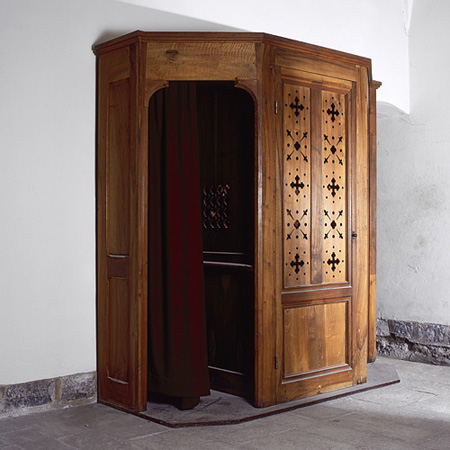
People also struggle with sin and when you don’t deal with it, it builds up and up and soon goes out of control. A nightly examination of conscience is a good way to keep track of your spiritual life and to make sure that it does not become cluttered with sin. But how do you clear away the sins?

Sinbox Zero

Yes going to confession and confession all of yours sins after a good examination of conscience is the perfect way to get your sins down to zero and to receive the grace to help you to keep it that way.

Now if only temptations could be handled like a good spam folder where temptations are trashed before they get to you. But then again, confession and growing in holiness does enable a temptation filter that improves efficiency from a life of living the sacraments.

February 9, 2011 3 comments
0 FacebookTwitterGoogle +Pinterest
Apologetics

The Telephone Game

by Jeffrey Miller February 9, 2011
written by Jeffrey Miller

So often when someone wants to disparage Apostolic Tradition or even scripture itself they will give the example of the Telephone Game as a sort of self-evident proof.

As a proof it is rather silly. When a message does get distorted at the end of the chain – we know it got distorted from a comparison to the original message. This type of correction occurs also in real life which is why there are some amazing examples of history passed down from generation to generation that was never written down, but verifiable none-the-less. Plus the idea of whispering something in someone’s ear is an example of the passing down of tradition is even sillier. The early Church did not have a hard time distinguishing between scripture and tradition passed down and the various distortions of it that occurred via the various heresies. The faith had spread to enough points that it was not possible to pass on something as Apostolic Tradition or Scripture that wasn’t – at least not for long. Unlike the telephone game, correction and repeated information are important aspects.

February 9, 2011 0 comment
0 FacebookTwitterGoogle +Pinterest
Punditry

The Church and Technology

by Jeffrey Miller February 9, 2011
written by Jeffrey Miller

One story has been hitting the various news outlets throughout the world concerning the iPhone/iPod Touch/iPad app called Confession: A Roman Catholic app.  The coverage like almost everything concerning the Church is largely hit and miss with the weight going to miss.  The implication that the app replaces confession has made it into many stories. Terminology such as “Blessed” by the Church or the factually incorrect

Father Z had a good critique of the good and bad of the app itself and the author of the app responded saying that he would be making changes to the app as a result.

The interesting questions is why should an app used as an aid for an examination of conscience to make a good confession get so much attention?  After all this is hardly the first app to do so.  Travis Boudreaux had wrote a similar app called  Mea Culpa in Aug of 2010.  What is mostly getting played up is “Catholic Church approves ….” as the enticement to get you to read the story.  Zenit had reported:

A new Confession application for the iPhone, iPad and iPod Touch is encouraging sacramental life through technology. Bishop Kevin Rhodes gave the first known imprimatur for this type of resource.

Patrick Leinen, developer and cofounder of Little iApps, the company that released the application, told ZENIT that “in order to respond to Benedict XVI’s message from last year’s World Communications Day address, our goal with this project was to offer a digital application that is truly ‘new media at the service of the Word.'”

Though really I would think what the bishop did was give an imprimatur to the text used within the app which is really no different from any other imprimatur. Unless the Vatican issued a guide to mobile application development that I don’t know about – this is really the extent of it. Though the positive thing is that the press gave enough attention to the app that at least at one time was one of the top 100 paid apps. No doubt many had downloaded it as a curiosity, but maybe some consciences can be jogged to life.

Really this comes into the fascination of Church and technology. We see many stories of this time that are a reflection of the Church vs. Science mythos. Like clockwork every year we get the Vatican Observatory story portraying the shock of the Church being involved in astronomy “despite” Galileo. No doubt when Vatican Radio started in 1931 there were similar news stories and we have them repeated with each new piece of technology. After the telephone was invented some asked if confessions could be validly heard over it and of course the same question was asked with the advent of the internet – even though the sacramental theology hadn’t changed. The same thing happens when the Pope or someone else in the hierarchy mention social networking. Again the media always acts surprised as if it is odd that the Church could use anything modern as if she were Amish or something. At times though it must be admitted that the Vatican itself is not always the quickest to adapt to new technologies such as the Pontifical Council for Promotion of the New Evangelisation involved with studying modern means of communication does not have an internet connection.

The Church vs. Technology mythos is not the only false dichotomy that draws people attention. For example habited nuns/sisters doing anything besides praying seems to draw people’s attention. Religious women on skates, nuns bowling, etc, etc. To a lesser extent the same applies to monks/friars doing the same.

Also interesting is how people feel they are free to mock confession at almost every level. No worries about offending Catholics who do something so Medieval as actually going to confession. Of course we remember those same commentators mocking Ramadan and the various Ramadan apps – oh wait. As your basic geek who listens to some technology shows I heard comments on the confession app like “They should have Game Center support for achievements for those committing the most sins.”, “In app purchases for indulgences”, “Now all it needs is a random sin selector: shake the phone to instantly get a wicked suggestion.”, etc. Not being thin-skinned some of the comments can be kind of funny in a lame way, but there is often a meanness behind them and an animus towards Catholics in particular.

February 9, 2011 4 comments
0 FacebookTwitterGoogle +Pinterest
Book Review

Defiant Joy

by Jeffrey Miller February 7, 2011February 7, 2011
written by Jeffrey Miller

As a fan of G.K. Chesterton I was happy to review Defiant Joy: The Remarkable Life & Impact of G.K. Chesterton a new biography by Kevin Belmonte.  The author notes that this book is not a comprehensive or definitive study, but to introduce a life and legacy.  I am all for introducing Chesterton to a wider range of people.

The book mostly allows Chesterton to speak for himself as there are numerous paragraphs from his books and other writings within.  The basic framework of the book is to go sequentially through his books with chapters devoted to milestones of his publishing life.  I would start of with Dale Ahlquists’ books instead and it does remind me that I need to read Joseph Pearce’s biography of GKC.

This book was not meant to be a comprehensive biography, unfortunately often it is hardly even a sketch biographically of Chesterton.  If this had been the only book I had read on Chesterton I would hardly have any idea about the man other than some of the barest details.  This is a book mainly on Chesterton the author, and not Chesterton the man.  Major milestones in his life and the effect on his writing are covered in brief – often in just a sentence. His spiritual life is barely covered.  The darkness he descended to in art school is covered, but nothing on the effect his wife had on him and his return to Anglicanism.  His conversion to the Catholic Church got a sentence and his friendship with Hilaire Belloc was mentioned in passing.  Rather odd considering that the author appears to be a Protestant who takes spiritual themes seriously in GKC’s writings.  There are so many great stories about Chesterton and especially his legendary absentmindedness, yet this isn’t even mentioned or one of those famous stories told.  Of course GKC called absentmindedness, presentmindeness on something else.  GKC as a personality was seemingly bigger than life – you would learn none of that here.  Though you do get some idea of the interplay between George Bernard Shaw, H.G. Wells, and G.K. Chesterton and how they retained their lifelong friendship despite their opposing views.

Where the book succeeds is with Chesterton the author and you do get a good summary of his writings and the reactions to them then and now.  From his early literary criticism to milestones such as The Napoleon of Notting Hill, Heretics, Orthodoxy, The Man who was Thursday, Father Brown, his poems, his essays on America, plays, etc.  These chapters revolve around extensive quotations of the works.  Literary criticism that appeared in response to these works and what effect Chesterton’s writings had on others is a part of these chapters. The author has done his homework from other biographies and of course Maise Ward’s biography of GKC is quoted throughout.  Though the author makes a major gaffe in referring to her husband as publisher Frank Ward.  That should be Frank Sheed one of the great Catholic apologists and later publisher with his wife — Sheed & Ward.

I was a bit disappointed on the chapter on Orthodoxy and thought it deserved much more than just  the view of it from Gary Wills and Philip Yancey.  While testimonials to the impact of Orthodoxy are fitting, I would have liked to see more of an outline of this book and some of the major themes within.  Though I also suspect that I would hardly be satisfied with any chapter on Orthodoxy in that I try to reread this book every year.

This book has spurred me on to wanting to read Chesterton’s literary criticism.  I was aware of his works concerning Dickens and Chaucer and while reading literary criticism is not my thing, I think GKC’s take will be.  I do love Dickens and I really need to learn more of Chaucer.

This book reminds me of Chesterton’s quip on George Bernard Shaw comparing him to Venus de Milo in that what is there is good.  I read through the book fairly quickly since I enjoyed it, it is just that I was constantly aware of what was missing.  Missing was any mention of Manalive, Lepanto, or so many other of his books. Certainly in a book of this type you can’t devote a chapter to such a prolific author, but I so love Manalive and I consider it a key to understanding Chesterton the man and his philosophy.

As a supplementary biography Defiant Joy is somewhat worthwhile, just don’t make the mistake of getting this book as a primary biography of Chesterton.

February 7, 2011February 7, 2011 5 comments
0 FacebookTwitterGoogle +Pinterest
Punditry

Free from all error

by Jeffrey Miller February 6, 2011February 6, 2011
written by Jeffrey Miller

The late Fr. William Most was a well known theologian and scripture scholar who never fell in with any fads and was a counter-ballance to so many more well know theologians and scripture scholars of the era. His book “Free from All Error: Authorship Inerrancy Historicity of Scripture” is an example of this. We so often hear about so-called errors in scripture and especially lists of these “errors” from atheists who are often literal fundamentalists when it comes to scripture. This calling out of errors though is not confined to atheists and such charges have been made from those in the Church including her clergy. Even worse, often no attempt is made to reconcile these passages and when done within the Church is often a denial of what Vatican II’s Dei Verbum says. Fr. Most notes:

Precisely at the time when new techniques enable us to do what seemed impossible before, so many scholars are not only not solving the problems but even saying that problems are insoluble whose answers have been known for a long time!

This book goes through the topics of inspiration and authorship, the cannon, senses of scripture, and the genre of scripture. He takes us through some cases of supposed errors and show how they can be reconciled using these tools and understandings. He also addresses modern techniques such as historical-critical method, source criticism, form and redaction criticism, etc. Fr. Most is totally inline with what Pope Benedict has written about these tools in that they can and should be used within their limits and under the guiding light of the magisterium.

In regard to the methods themselves, some think that only highly trained specialists can understand them. These people are too easily awed. Anyone can grasp at least the basics of these methods, and more too. These methods are not mysterious or formidable. They are our friends.

These methods when used without the analogy of faith quickly become deformed into a type of skepticism that produced the Jesus Seminar where miracles are ridiculous and the hard sayings were added later. Fr. Most gives examples when these tools have been used incorrectly and especially in the case of scripture scholar Fr. Raymond Brown.

This book provides a good introduction to scripture study and how to be able to read difficult passages using the methods as old as the Fathers of the Church or of the modern era and would be a good companion with Mark Shea’s Making Senses Out of Scripture: Reading the Bible as the First Christians Did.

All of Father Most’s writings are available for free online at The Most Theological Collection at Catholic Culture. This includes both his books and his articles.

For those with an eBook reader I took the text online and created an eBook version of “Free from all Error.”

epub
mobi (Kindle, etc)

February 6, 2011February 6, 2011 8 comments
0 FacebookTwitterGoogle +Pinterest
News

Papal Organ Donation

by Jeffrey Miller February 4, 2011
written by Jeffrey Miller

VATICAN CITY (AP) — Pope Benedict XVI has long championed organ transplants, but don’t expect an organ donation from him. The Vatican says his body belongs to the whole church.
While the former Cardinal Joseph Ratzinger has possessed an organ donor card since the 1970s when he lived in Germany, it was rendered void when he became pope in 2005, his secretary said.

Monsignor Georg Gaenswein addressed the issue in a letter to a German doctor who has been using the fact that Benedict possessed a donor card to recruit other donors. Vatican Radio reported on the letter in a German language broadcast this week.

Gaenswein sought to put the matter to rest, saying any references to the now invalid document are mistaken. [Source]

It does bring up an interesting question. If you received an organ from a person later canonized in your own lifetime, you would have a first class relic with you at all times.

February 4, 2011 8 comments
0 FacebookTwitterGoogle +Pinterest
Other

Popularity

by Jeffrey Miller February 3, 2011
written by Jeffrey Miller

I really do try to work on my humility, and then I remember I’m a blogger.

Eric Sammons of the blog The Divine Life and recent author of Who Is Jesus Christ? Unlocking the Mystery in the Gospel of Matthew has updated his list of the Most Popular Catholic Blogs.

His metric for this list is the number of subscribers to the RSS feed of a blog as per Google Reader.

Third, after running the program last time, a few people noted that there were some discrepancies between their Google subscriber number and what I posted. This happened in a few cases where Google’s “default” feed for a blog was different than the main feed for the blog. The most egregious case was The Curt Jester, who wasn’t even on the list last time (having only 14 subscribers in his “default” feed), but is #4 now (with over 4,800 subscribers). Mark Shea’s blog also was effected by this discrepancy. I tried very hard to find any of these “missing” feeds and incorporate them into the updated list, but it is possible I missed a few again.

Thanks Eric.

No doubt some more tweaking is needed since I am pretty sure American Papist gets more traffic than my blog. But there will be no perfect ordered list and the order is not as important as a solid listing of popular Catholic blogs.

Thankfully to help prevent cranial swelling due to bursting ego the Pope has some wise words in his recent message “Truth, Proclamation and Authenticity of Life in the Digital Age.”

The task of witnessing to the Gospel in the digital era calls for everyone to be particularly attentive to the aspects of that message which can challenge some of the ways of thinking typical of the web. First of all, we must be aware that the truth which we long to share does not derive its worth from its “popularity” or from the amount of attention it receives. We must make it known in its integrity, instead of seeking to make it acceptable or diluting it. It must become daily nourishment and not a fleeting attraction. The truth of the Gospel is not something to be consumed or used superficially; rather it is a gift that calls for a free response. Even when it is proclaimed in the virtual space of the web, the Gospel demands to be incarnated in the real world and linked to the real faces of our brothers and sisters, those with whom we share our daily lives. Direct human relations always remain fundamental for the transmission of the faith!

Amen to that!

February 3, 2011 0 comment
0 FacebookTwitterGoogle +Pinterest
Punditry

Free Will and Hell

by Jeffrey Miller February 3, 2011
written by Jeffrey Miller

Acts of the Apostasy has a fine fisk of the article “Debunking The Myth Of Hell” by Carol Meyer from the National Catholic Reporter.

Here are my own thoughts.

I’m writing about hell because it is an unthinkable, horrible, destructive concept that can’t possibly be true.

I will defer from making a snarky comment like “You will know when you get there”, because I can think of nothing worse to say than to wish hell on anybody.

As per the Catechism:

1035 The teaching of the Church affirms the existence of hell and its eternity. Immediately after death the souls of those who die in a state of mortal sin descend into hell, where they suffer the punishments of hell, “eternal fire.”617 The chief punishment of hell is eternal separation from God, in whom alone man can possess the life and happiness for which he was created and for which he longs.

It is also rather amazing to read what people will say in the NCReporter. Canon 751 says “Heresy is the obstinate post-baptismal denial of some truth which must be believed with divine and catholic faith, or it is likewise an obstinate doubt concerning the same.” The teaching on hell is certainly something that must be believed with divine and catholic faith. And what can be more obstinate than an NCReporter article? At the least Carol Meyer is a material heretic.

Like almost all of the faith to deny one aspect is to undermine other aspects of the faith. For example to deny hell is to deny free will. If there is no hell than somebody who chooses to purposely separate themselves from God is forced to live with God in eternity. That no matter what they do in deliberate opposition to God really does not matter. All paths lead to the same place. Somebody with free will could choose to separate themselves from God.

To deny hell you also have to believe that Jesus was willing to lie to scare people. That he warned against the danger of hell repeatedly even though there was no possibility of anybody going to a place that doesn’t exist. The gates of hell will never prevail against the Church because there is no hell. Though the progressive will cast doubt on what Jesus said in scripture anyway. It is convenient to strip everything Jesus said you don’t agree with out. Of course if you can’t trust the Gospels in major aspects, you really have no reason to trust them at all. When Jesus said “But small is the gate and narrow the road that leads to life” he really meant that the way to salvation was an infinite lane superhighway that everybody finds.

I don’t care if scripture mentions hell or Jesus talked about it, if saints had visions of it, or if it’s a time-honored Catholic teaching.

That’s using faith and reason – not. Because you don’t understand something, just deny Scripture, Apostolic Tradition, and the Magisterium. Heck with that faith seeking understanding. She than goes on to say there is no proof of hell. She sounds just like an atheist denying the existence of Heaven and demanding scientific proofs of a non-material reality.

Of course after she says she doesn’t care if” Jesus talked about it” she then quotes Jesus in his multiple uses of “Be not afraid.” So I guess these multiple statements from Jesus kind of wipe each other out. The real question is why does she consider Jesus saying “Be not afraid” as denying the reality of hell? Those who are following Christ and living a life of holiness indeed should not be afraid. To follow Christ is to have total faith in Christ and his promises. The true disciple has no fear of hell. Those who have committed mortal sin by meeting the three requirements of mortal sin should be afraid, but most of all they should repent and live a life of holiness.

I think belief in a God who sends people to hell, no matter how cloaked in theological sweetness, creates cruel people.

Yes all the saints who believed in hell were such cruel people. When mary showed the shepherd children hell at Fatima those three children became very cruel people. In fact those children must have been the most cruel ever beatifified. Blessed Francisco & Blessed Jacinta Marto, not to mention Sister Lucia. People like Stalin, Chairman Mao, Pol Pot, who also did not believe in hell were not cruel at all.

Plus to say that “God sends people to hell” is just theologically inept. God wills that all be saved and he gives everyone the grace to be saved. But through are free will we can reject God and his grace and through are will choose to go to hell and eternal separation from God.

Besides it is an odd argument to say that belief in hell will make you more cruel. Anybody who really believes in the possibility of hell for their actions will have at least some impetus not to commit some serious sin. To believe that you wind up in Heaven no matter what you do is a license to sin. In the “Brothers Karmazov” we have the statement “In a world without God “everything is permitted.” In a world without hell, everything has no consequences. Why follow God and grow in holiness? You wind up in Heaven no matter what you do and even if there is time as we think of time in Purgatory – no problems – whether you are one of God’s friends of an enemy no “Go to Jail” but straight to the beatific vision.

To deny hell also leads to denying the existence of fallen angels. By her arguments God would not eject any Angel just because through there free will they rejected Him. So there is no demonic agency so we also get to reject Jesus exorcising demons and to simply reject the idea of exorcism in the first place. Being a progressive is fun since you get to deny so much of scripture that what you have left should be easy to memorize.

She ends the article with the statement “God is Love.” So to reverse her question “Can a loving God force someone to Heaven who doesn’t want to be with him?”

Now I don’t know the population of hell other than that it has some population, but I certainly believe that through my freely chosen actions I could end up there. My concern is not to increase the population of hell by one.

February 3, 2011 9 comments
0 FacebookTwitterGoogle +Pinterest
Newer Posts
Older Posts

About Me

Jeff Miller is a former atheist who after spending forty years in the wilderness finds himself with both astonishment and joy a member of the Catholic Church. This award-winning blog presents my hopefully humorous and sometimes serious take on things religious, political, and whatever else crosses my mind.

Conversion story

  • Catholic Answers Magazine
  • Coming Home Network

Appearances on:

  • The Journey Home
  • Hands On Apologetics (YouTube)
  • Catholic RE.CON.

Blogging since July 2002

Recent Posts

  • The Weekly Leo

  • A Litany of Gratitude

  • The Spiritual Life and Memes

  • What is your distance from Jesus on the Cross?

  • Feast of St. Thomas, Apostle

  • Gratitude and Generosity

  • “The Heart and Center of Catholicism”

  • Post-Lent Report

  • Stay in your lane

  • Echoing through creation

  • Another Heaven

  • My Year in Books – 2024 Edition

  • I Have a Confession to Make

  • A Mandatory Take

  • Everybody is ignorant

  • Sacramental Disposal, LLC

  • TL;DH (Too Long;Didn’t Hear)

  • A Shop Mark Would Like

  • The Narrow Way Through the Sacred Heart of Jesus

  • Time Travel and Fixing Up Our Past

  • The Weekly Leo

  • The Weekly Leo

  • The Weekly Leo

Meta

I also blog at Happy Catholic Bookshelf Entries RSS
Entries ATOM
Comments RSS
Email: curtjester@gmail.com

What I'm currently reading

Subscribe to The Curt Jester by Email

Endorsements

  • The Curt Jester: Disturbingly Funny --Mark Shea
  • EX-cellent blog --Jimmy Akin
  • One wag has even posted a list of the Top Ten signs that someone is in the grip of "motu-mania," -- John Allen Jr.
  • Brilliance abounds --Victor Lams
  • The Curt Jester is a blog of wise-ass musings on the media, politics, and things "Papist." The Revealer

Archives

About Me

Jeff Miller is a former atheist who after spending forty years in the wilderness finds himself with both astonishment and joy a member of the Catholic Church. This award winning blog presents my hopefully humorous and sometimes serious take on things religious, political, and whatever else crosses my mind.
My conversion story
  • The Curt Jester: Disturbingly Funny --Mark Shea
  • EX-cellent blog --Jimmy Akin
  • One wag has even posted a list of the Top Ten signs that someone is in the grip of "motu-mania," -- John Allen Jr.
  • Brilliance abounds --Victor Lams
  • The Curt Jester is a blog of wise-ass musings on the media, politics, and things "Papist." The Revealer

Meta

I also blog at Happy Catholic Bookshelf Twitter
Facebook
Entries RSS
Entries ATOM
Comments RSS 2.0" >RSS
Email: curtjester@gmail.com

What I'm currently reading

Subscribe to The Curt Jester by Email

Commercial Interuption

Podcasts

•Catholic Answers Live Subscribe to Podcast RSS
•Catholic Underground Subscribe to Podcast RSS
•Catholic Vitamins Subscribe to Podcast RSS
•EWTN (Multiple Podcasts) Subscribe to Podcast RSS
•Forgotten Classics Subscribe to Podcast RSS
•Kresta in the Afternoon Subscribe to Podcast RSS
•SQPN - Tons of great Catholic podcasts Subscribe to Podcast RSS
•The Catholic Hack Subscribe to Podcast RSS
•The Catholic Laboratory Subscribe to Podcast RSS
•The Catholics Next Door Subscribe to Podcast RSS
•What does the prayer really say? Subscribe to Podcast RSS

Archives

Catholic Sites

  • Big Pulpit
  • Capuchin Friars
  • Catholic Answers
  • Catholic Lane
  • Crisis Magazine
  • New Evangelizers
  • Waking Up Catholic

Ministerial Bloghood

  • A Jesuit’s Journey
  • A Shepherd’s Voice
  • Ad Majorem Dei Gloriam
  • Adam’s Ale
  • Archbishop Dolan
  • Bonfire of the Vanities
  • Cardinal Sean’s Blog
  • Da Mihi Animas
  • Domine, da mihi hanc aquam!
  • Father Joe
  • Fr. Roderick
  • Godzdogz
  • Laus Crucis
  • Omne Quod Spirat, Laudet Dominum
  • Orthometer
  • Priests for Life
  • Servant and Steward
  • Standing on My Head
  • The hermeneutic of continuity
  • This Week at Vatican II
  • Waiting in Joyful Hope
  • What Does The Prayer Really Say?

Bloghood of the Faithful

  • A Catholic Mom Climbing the Pillars
  • A Catholic Mom in Hawaii
  • A Long Island Catholic
  • A Wing And A Prayer
  • Acts of the Apostasy
  • Ad Altare Dei
  • AdoroTeDevote
  • Against the Grain
  • Aggie Catholics
  • Aliens in this world
  • Always Catholic
  • American Chesterton Society
  • American Papist
  • Among Women
  • And Sometimes Tea
  • Ask Sister Mary Martha
  • auntie joanna writes
  • Bad Catholic
  • Bethune Catholic
  • Big C Catholics
  • Bl. Thaddeus McCarthy's Catholic Heritage Association
  • Catholic and Enjoying It!
  • Catholic Answers Blog
  • Catholic Fire
  • Catholic New Media Roundup
  • Charlotte was Both
  • Christus Vincit
  • Confessions of a Hot Carmel Sundae
  • Cor ad cor loquitur
  • Courageous Priest
  • Creative Minority Report
  • CVSTOS FIDEI
  • Dads Called to Holiness
  • Darwin Catholic
  • Defend us in Battle
  • Defenders of the Catholic Faith
  • Disputations
  • Divine Life
  • Domenico Bettinelli Jr.
  • Dominican Idaho
  • Dyspectic Mutterings
  • Ecce Homo
  • Ecclesia Militans
  • Eve Tushnet
  • Eye of the Tiber
  • feminine-genius
  • Five Feet of Fury
  • Flying Stars
  • For The Greater Glory
  • Get Religion
  • GKC’s Favourite
  • God’s Wonderful Love
  • Gray Matters
  • Happy Catholic
  • Ignatius Insight Scoop
  • In Dwelling
  • In the Light of the Law
  • InForum Blog
  • Jeff Cavins
  • Jimmy Akin
  • John C. Wright
  • La Salette Journey
  • Laudem Gloriae
  • Lex Communis
  • Life is a Prayer
  • Man with Black Hat
  • Maria Lectrix
  • Mary Meets Dolly
  • MONIALES OP
  • Mulier Fortis
  • Musings of a Pertinacious Papist
  • My Domestic Church
  • Nunblog
  • Oblique House
  • Open wide the doors to Christ!
  • Over the Rhine and Into the Tiber
  • Patrick Madrid
  • Pro Ecclesia * Pro Familia * Pro Civitate
  • Recta Ratio
  • Saint Mary Magdalen
  • Sonitus Sanctus
  • Southern-Fried Catholicism
  • St. Conleth's Catholic Heritage Association
  • Stony Creek Digest
  • Testosterhome
  • The Ark and the Dove
  • The B-Movie Catechism
  • The Crescat
  • The Daily Eudemon
  • The Digital Hairshirt
  • The Four Pillars
  • The Inn at the End of the World
  • The Ironic Catholic
  • The Lady in the Pew
  • The Lion and the Cardinal
  • The New Liturgical Movement
  • The Pulp.it
  • The Sacred Page
  • The Sci Fi Catholic
  • The Scratching Post
  • The Weight of Glory
  • The Wired Catholic
  • Two Catholic Men and a Blog
  • Unam Sanctam Catholicam
  • Video meliora, proboque; Deteriora sequor
  • Vivificat
  • Facebook
  • Twitter
  • Instagram
  • Pinterest
  • Email
  • Reddit
  • RSS

@2025 - www.splendoroftruth.com/curtjester. All Right Reserved. Designed and Developed by PenciDesign


Back To Top